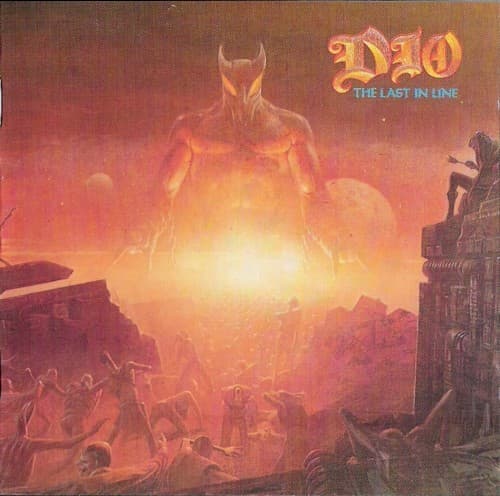
The scorecard
7.4/10 · Good
- Songwriting25%
- 7.5
- Sound25%
- 8.0
- Performance15%
- 8.5
- Cohesion15%
- 6.5
- Originality10%
- 6.0
- Replay value10%
- 7.0
The title track and Egypt build tension through patient riff development, but the back half sags into interchangeable mid-tempo rockers that trade ideas for repetition.
Recorded at Caribou Ranch and mixed on Westlake monitors with clarity that gives Vivian Campbell's guitar bite and space while keeping Dio's voice front and center without burying the rhythm section.
Campbell's neoclassical runs on Mystery and Egypt show technical command, while Dio sings with the conviction that made him credible in both Rainbow and Sabbath, pushing weak lyrics past their limitations.
Front-loads the strongest material then loses momentum through the middle stretch; at thirty-seven minutes it avoids filler but the sequencing makes it feel longer than it is.
Adds keyboards through Claude Schnell but otherwise refines the Holy Diver template without expanding it, landing closer to Sabbath's solo Ozzy albums than to where Rainbow left off.
The title track and We Rock earn repeated listens, but the sameness of Evil Eyes through Eat Your Heart Out makes the album less essential than its predecessor on the tenth spin.
Dio The Last in Line — When the Formula Calcifies Early
The Last in Line reached higher on both sides of the Atlantic than Holy Diver and went platinum faster, but it is the less important album. Where the debut established what Dio the band could do apart from Dio the hired voice, the follow-up mostly proves that the debut was not a fluke, which is a different and smaller achievement. The first four tracks show a band with room to grow: We Rock adds an anthemic stomp that Holy Diver lacked, the title track builds patiently through verses that trust the riff, and Breathless condenses the approach into four minutes without losing the drama. Then the album stops developing. The back half trades patient songwriting for the kind of mid-tempo interchangeability that would define Dio's next decade, and the shift is audible within the same thirty-seven-minute runtime.
The problem is not effort or performance. Vivian Campbell plays with more confidence than on the debut, the production recorded at Caribou Ranch and mixed on Westlake monitors by Ronnie James Dio himself is clearer and heavier, and Dio sings every line like it matters even when it does not. The problem is that the band arrived at a formula on Holy Diver and locked it in here before exploring what else it could do. Claude Schnell joins on keyboards, but his role is atmospheric padding rather than a second melodic voice, and the songs he appears on sound like the songs he does not. By the time Egypt closes the album with its most ambitious arrangement, the question is why the patience and dynamics it demonstrates could not be distributed across the five songs that precede it. The Last in Line is a good album that could have been a great one if it had been willing to risk more than refinement.
The Sound Hardens Without Deepening
Dio produced the album himself after co-producing Holy Diver, and the result is a guitar-forward mix that prioritizes clarity and punch over the murk that defined early-eighties metal. Campbell's tone is sharp and percussive, his neoclassical runs recorded with enough separation that every note registers, and Vinny Appice's drums hit with the snap of a well-tuned kit in a dry room. The production suits the band's strengths: Dio's voice can cut through the heaviest riff without requiring the mix to carve space for it, and Campbell's solos feel like events rather than texture. The addition of Schnell on keyboards does little to change the sound. His parts on the title track and Egypt add minor-key atmosphere, but they sit behind the guitars and rarely interact with them, functioning more like a subtle wash than a structural element. The clearest example is Mystery, where his synth line could be removed without altering the song's shape.
The songwriting improves on the debut's strengths and inherits its limitations. The title track demonstrates the best of what the band can do: a riff that cycles through variations instead of repeating verbatim, verses that build toward the chorus through dynamics rather than speed, and a solo that quotes the vocal melody before departing from it. Egypt attempts something similar at nearly seven minutes, opening with an acoustic figure and building through distinct sections that justify the length.
But between those two peaks, the album settles into a template. Evil Eyes, Mystery, and Eat Your Heart Out are all mid-tempo rockers with competent riffs, functional verses, and choruses that do not develop the ideas the verses introduce. The problem is not that they are bad songs; it is that they are the same song with different lyrics, and the sameness exposes how narrow the band's palette is when it defaults to cruise control. One Night in the City tries to break the mold with a faster tempo, but the riff is generic and the chorus is a missed opportunity, landing where Holy Diver's weaker moments landed. The album's second half feels like a band consolidating rather than exploring, and consolidation at this stage means arriving at competence and stopping there.
Front-Loaded Ambition, Back-Half Drift
The sequencing makes the formula problem worse. The opener arrives with an arena-ready stomp that works as a statement of intent, and the title track follows with the album's most patient and best-constructed song, giving the first stretch a sense of purpose and variety. The next two tracks keep the momentum, the second offering a tighter structure and the third providing a rare moment of simplicity, a three-minute rocker that knows what it is and does not overstay. By the halfway mark, the album has spent its strongest material.
The middle section blurs together. The fifth track picks up the tempo but not the ideas, and the stretch from there through track eight is competent heavy metal that does nothing to distinguish one song from the next. The riffs are solid, the performances are tight, and the songs are forgettable in sequence because the band leans on the same mid-tempo dynamics and verse-chorus structures without variation. The closer rescues the back half by reintroducing the patience and dynamics that made the title track work, but its placement only highlights how much stronger the album would be if its ambition were distributed across the runtime instead of saved for the bookends. The sequencing makes The Last in Line feel like a playlist with a great first half and a back half you tolerate to get to the final track, and at thirty-seven minutes, that imbalance is hard to ignore.
The Plateau Before the Decline
The Last in Line is Dio's second-best album, which says more about what came after than about what it achieves. It is better played and better produced than Holy Diver, but it is a less interesting record because it takes fewer risks and solves fewer problems. The debut had to prove that Dio could front a band that sounded like neither Rainbow nor Sabbath; the follow-up only had to prove he could do it twice, and that lower bar shows in the writing. The album's commercial success—it went platinum and remains one of only two Dio albums to do so—reflects how effectively it delivered what fans of the debut wanted, but it also set the template the band would repeat with diminishing returns through the rest of the decade.
For listeners who want straightforward heavy metal played with conviction and recorded with clarity, The Last in Line delivers across its strongest four tracks. Start with the title track, which is the best thing here, then We Rock and Egypt. If those three justify the purchase, the rest of the album is solid enough to avoid skipping, but do not expect the middle stretch to reveal hidden depths on repeat listens. Fans who found Holy Diver essential should hear this for the title track and to understand where the formula took hold; everyone else can stop at the debut. The closest comparison in the catalog is Sacred Heart, which repeats this album's virtues and vices at slightly lower quality. The Last in Line captures a band at its commercial and technical peak, which makes it the moment to hear before the slow decline, but it is not the album that justifies the peak.
Track by track
Track Listing
We Rock
StandoutAn arena anthem that opens the album with confidence and a riff designed for fists in the air rather than headbanging. The chorus is immediate and built to scale, and the song does what it sets out to do without pretending to be more than a statement of presence. Campbell's solo quotes the vocal melody before breaking into a neoclassical run that shows off his technical chops without grandstanding, and Appice's drumming locks in with Jimmy Bain's bass to give the song a foundation solid enough to support the size Dio is reaching for with his voice. The lyrics are generic motivation sloganeering, but Dio sells them through sheer conviction, which is his primary skill. As an opener, it establishes the band's ambition and reach, and it works better in that role than as a standalone track.
The Last in Line
StandoutThe best song Dio would write. It opens with a two-note riff that repeats with variations, trusting patience over flash, and the verses build through dynamics instead of piling on layers. The pre-chorus shifts the rhythm without breaking the flow, and the chorus itself feels earned because the song took the time to get there. Campbell's solo is melodic and structured, quoting the vocal line before developing it, and Schnell's keyboards add minor-key texture that deepens the atmosphere without taking focus from the guitar. The lyrics aim for mythos and hit vague prophecy, but the melody is strong enough that the words function as sound rather than meaning. At five minutes and forty seconds, it justifies the length through distinct sections and patient pacing, and it holds up on repeated listens because the structure rewards attention. This is the track that defines what the band could do when it chose development over repetition, and the fact that the album does not match it again makes the rest feel like a step down.
Breathless
StandoutA condensed version of the title track's approach, stripping the patient build down to four minutes and delivering the payoff faster. The riff is sharp and percussive, and the verse melody is strong enough to carry the song without needing a complicated arrangement. The chorus lands on the first try, and Campbell's solo is concise and melodic, avoiding the neoclassical excess that would become a crutch in later albums. The song works because it knows its limits and does not try to be more than a well-constructed heavy metal rocker with a memorable hook. It is the last track on the album that feels fully realized, and the fact that it comes third in the sequence means the album peaks early and spends the rest of the runtime managing the descent.
I Speed at Night
SolidA three-minute rocker that strips the formula down to its bare elements: a simple riff, a faster tempo, and a chorus that repeats the title. The song is functional and unpretentious, and it works as a palate cleanser between the more ambitious tracks that surround it. Campbell's playing is less ornate here, sticking to power chords and a brief solo that does not overstay, and Dio sings with the same conviction he brings to the longer tracks, which makes the simplicity feel intentional rather than lazy. The lyrics are car-metaphor nonsense, but the song moves fast enough that they do not drag it down.
One Night in the City
SolidA faster-tempo track that aims for urgency but lands on generic. The riff is competent but unremarkable, and the chorus repeats the title without developing a memorable melody around it. The verses do not build toward anything, and the bridge adds a tempo shift that feels like a structural obligation rather than a musical idea. Campbell's solo is technically proficient but forgettable, and the song as a whole feels like the band executing the formula without the spark that made the earlier tracks work. At five minutes, it is longer than it needs to be, and the runtime exposes how thin the ideas are. It is not bad, but it is the first clear sign that the album is running out of inspiration.
Evil Eyes
SolidMid-tempo heavy metal with a riff that does its job and a chorus that does not stick. The song is professionally executed, and Campbell's solo has the neoclassical flair that defines his playing, but the songwriting does not give him much to work with. The verses and chorus feel interchangeable with the tracks that follow, and the song does not develop its central idea past the first minute. It is solid, competent, and instantly forgettable, which is the worst thing a song on a thirty-seven-minute album can be.
Mystery
SolidAnother mid-tempo rocker that blurs into the song before it and the song after it. The riff is functional, the chorus is adequate, and Schnell's keyboards add a wash of atmosphere that could be removed without changing the song's impact. Campbell's solo is the highlight, showcasing his technical command and melodic sense, but the solo alone does not justify the track. The lyrics reach for intrigue and land on vague imagery, and Dio's performance is committed enough to sell them, but the song itself is filler dressed up as substance.
Eat Your Heart Out
WeakThe weakest song on the album. The riff is generic, the chorus is a placeholder, and the verses do not build toward anything. The song exists to fill space between Mystery and Egypt, and it does that job without contributing anything memorable. Campbell's solo is competent, Appice's drumming is tight, and Dio sings like he believes the words, but the songwriting gives them nothing to elevate. At three minutes and forty-nine seconds, it is mercifully short, but it is still a waste of runtime on an album this concise.
Egypt (The Chains Are On)
StandoutThe most ambitious track on the album and the only one in the back half that earns its length. It opens with an acoustic guitar figure that establishes a patient, atmospheric tone, then builds through distinct sections that shift dynamics and tempo without losing coherence. The riff that arrives at the two-minute mark is heavier and more deliberate than anything else on the album, and the song uses space and silence as structural elements rather than filling every moment with sound. Schnell's keyboards are more prominent here, adding texture that enhances the arrangement instead of padding it, and Campbell's solo is melodic and integrated into the song's flow rather than bolted on as an obligation. The lyrics aim for epic mythology and hit closer to the mark than most of Dio's writing, and the nearly seven-minute runtime feels justified because the song develops its ideas instead of repeating them. It is the second-best track on the album after the title track, and its placement as the closer highlights how much stronger the album would be if the patience and ambition it demonstrates had been spread across the middle stretch instead of saved for the end.