The scorecard
8.3/10 · Great
- Songwriting25%
- 8.5
- Sound25%
- 8.0
- Performance15%
- 9.0
- Cohesion15%
- 7.5
- Originality10%
- 7.5
- Replay value10%
- 9.5
The riffs are primitive but purposeful, hooks land instantly, and the lyrics trade poetry for punch without wasting a line.
Vic Maile's mix finally separates the instruments without neutering the live attack; the band sounds huge and legible for the first time.
Clarke's leads cut clean, Taylor's drumming locks into brutal swing, and Lemmy sings instead of just barking orders at the mic.
Thirty-six minutes of focused aggression with no ballads or experiments, though the back half sags slightly after the title track's peak.
Not inventing speed metal but refining it into a template that thrash would study: tighter songs, cleaner execution, louder attitude.
Four decades later it still sounds urgent and essential, with riffs that metal bands are still trying to match for economy and impact.
Motörhead Ace of Spades — The Blueprint for Speed Without the Fat
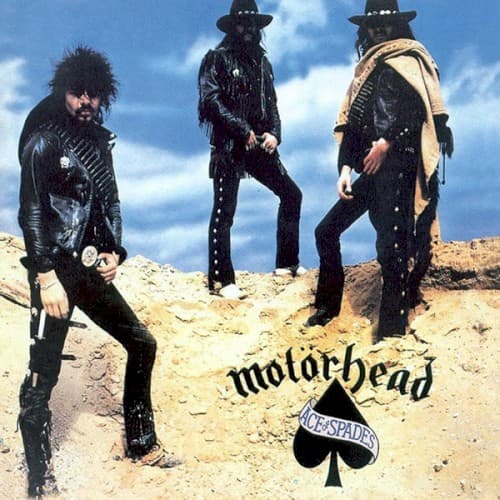
Ace of Spades solved a problem most bands never admit they have: how to make the studio version as violent as the live one without sounding like a bootleg. Motörhead spent 1979 building a reputation on Overkill and Bomber, two records that captured the spirit but not the detail, where the power came at the cost of clarity. By August 1980, with punk and metal fans both claiming the band and the NWOBHM machine labeling them whether they liked it or not, Lemmy, Fast Eddie Clarke and Philthy Animal Taylor went into Jackson's Studios with producer Vic Maile and recorded twelve tracks in a month. The result peaked at number four in the UK, went gold by March 1981, and gave thrash metal a instruction manual it would xerox for a decade.
The thesis is simple: Ace of Spades is the first time Motörhead sounded on record the way it needed to sound, with the clarity to hear every component of the assault and the rawness to make that assault worth hearing. Maile, who had engineered for Hendrix and Zeppelin and knew how to handle a power trio, refused to let the band's in-fighting and studio impatience result in another mud-caked mix. He took sole control of the mixing, separated the instruments without castrating the tone, and forced Lemmy to sing instead of shout and Taylor to play solid instead of loose.
The lineup responded with their tightest performances and their catchiest riffs, and the title track became the one song the band could never escape. What makes the album essential is not the anthem everyone knows but the eleven tracks around it, all of them built on the same principle: short, fast, mean, no solos longer than necessary, no riffs that outstay their welcome.
Riffs That Work and Production That Finally Lets You Hear Them
The songwriting on Ace of Spades operates on economy: one or two riffs per song, verses that set up choruses without filler, bridges only when the song earns them. Clarke's guitar tone is thicker and more defined than on the previous records, his leads cut through the mix instead of blending into the rumble, and his rhythm playing drives every track with palm-muted gallops and power chord stabs that became the texture of speed metal. Lemmy's bass is tuned low and overdriven to the point where it functions as a second rhythm guitar, filling the space a second guitarist would occupy and giving the trio the density of a four-piece. His vocal delivery is more controlled here, still bark and rasp but with melody audible underneath, especially on the chorus of the title track and the verses of The Chase Is Better Than the Catch.
Taylor's drumming is the hidden improvement: tighter, more deliberate, with the swing that separates rock from punk and the speed that separates Motörhead from the blues-rock bands they came up alongside. His kick drum work on Ace of Spades and Fast and Loose is what future thrash drummers would study.
Vic Maile's production is the reason the record works. Earlier Motörhead albums sounded like three instruments fighting for the same frequency; here the bass sits low and wide, the guitar occupies the midrange with definition, and the drums hit with clarity and punch. Maile worked the band harder than they were used to, insisting on tighter takes and refusing to let them settle for the first pass. Clarke later admitted the result was that you could finally hear everything going on.
The mix is dry and direct, no reverb washes or studio tricks, just the band loud and close. The weakness is that the production, for all its clarity, still sounds thin in the low end by modern standards. The guitar lacks the chunk that later metal would demand, and the drum sound, while punchy, does not have the weight that would come with better mics and more time. Maile got the best out of the band in the room, but the room itself was small and the budget was tight.
The songs themselves rarely misstep. The title track is the obvious peak, two minutes and forty-eight seconds of the defining Motörhead riff and the lyric that every bar band knows. The Road Crew pays tribute to the roadies with a mid-tempo chug that became a live staple. The Chase Is Better Than the Catch builds around a descending riff and a lyric about pursuit that lands harder than the sex songs around it.
But the record is not flawless. Dance is a throwaway with a riff that goes nowhere, Jailbait leans on a joke that wears thin, and the back half of the album struggles to match the momentum of the first six tracks. Fire, Fire and Bite the Bullet are competent but forgettable, riff-based tracks that do their job without leaving a mark.
Front-Loaded and Unrepentant, With a Sag at the Finish
The record sequences its strongest material up front, opening at full throttle and setting the tone for everything that follows. The first stretch keeps the pace high, delivering Clarke riffs that hit immediately and maintaining the energy before arriving at the emotional center, the one song that trades speed for groove and menace. By the time side one ends, the record has already delivered its best material.
Side two holds up through its closing stretch on the original vinyl sequencing, but the middle section reveals the limitations of writing an album in a month and recording it in another. These are not bad songs, but they are not essential ones, and the record would be tighter at ten tracks.
The pacing issue is partly a product of the era: thirty-six minutes was standard for a hard rock album in 1980, and Motörhead was writing for vinyl, where side breaks matter. The flow works better on the original UK pressing, which front-loads each side with a peak. The CD and streaming sequencing creates a different arc, one that peaks in the first three minutes and coasts from there.
The Definitive Motörhead Record and the Template Thrash Would Follow
Ace of Spades is the best Motörhead album for one reason: it is the first one where the production matches the performance. Earlier records had the energy, later records had the experience, but this one captured the band at the moment when the songs were tight, the playing was disciplined, and the studio was good enough to document it. It ranks as the essential Motörhead release not because of the title track alone but because the rest of the album earns its place around it.
The record aged well because it was never trying to be progressive or experimental; it set out to be fast, loud and direct, and it succeeded without overthinking. Thrash metal learned more from this album than from any single NWOBHM release, and speed metal as a concept does not exist without Clarke's riffs and Taylor's kick patterns. This is the record for anyone who wants to understand what Motörhead was and why it mattered. It is not for listeners who need variety or dynamics or songs longer than four minutes.
Start with Ace of Spades, The Road Crew and The Chase Is Better Than the Catch. Skip Dance and Jailbait unless you need the full experience. For the next step, the live energy translates best on the 1981 No Sleep 'til Hammersmith, which captured the band in front of an audience that understood the mission. If the stripped-down power trio template appeals, the self-titled Motörhead debut from 1977 shows where this sound came from, rawer and slower but built on the same principles.
Ace of Spades remains the high-water mark because it was the moment when Motörhead stopped fighting the studio and started using it.
Track by track
Track Listing
Ace of Spades
StandoutThe opening riff is the simplest thing Clarke ever wrote and the one that defined the band forever. Two minutes forty-eight seconds of palm-muted gallop, a chorus that is just the title shouted over power chords, and a Lemmy lyric about gambling metaphors that he admitted he got sick of playing. The song works because it does not try to be more than it is: fast, catchy, mean, over before it can wear out its welcome. The solo is eight bars of blues-scale pentatonics, the bridge is the riff again with a drum fill, and the ending is an abrupt stop. It is the Motörhead song that everyone knows, the one that made them famous, and the reason is that it sounds exactly like what it is trying to sound like. It became the template for thrash not because it invented speed but because it proved you could write a fast song with an actual hook. The production gives the riff clarity without sanding off the distortion, and Taylor's kick drum pattern became the blueprint for double-bass work that was still five years away from becoming standard.
Shoot You in the Back
StandoutA wild west motif and a riff that swings harder than it sprints. The vocal melody in the verse is more developed than most Motörhead songs bother with, and the chorus is a gang shout that works in a live setting. Clarke's solo is tasteful, built on bends and phrasing instead of speed, and the song ends cleanly instead of fading or repeating. Solid but not essential.
Live to Win
SolidMid-tempo chug with a riff that sounds like it came from a Thin Lizzy outtake. The verse melody is stronger than the chorus, and the bridge does not add much. The playing is tight, the tone is good, but the song does not have a moment that justifies coming back to it when the title track and The Road Crew are on the same record.
Fast and Loose
StandoutThe title delivers: a three-minute sprint with a riff that moves and a vocal that barely keeps up. The lyric is about sex with the bluntness the band was known for, and the solo is a twelve-bar burst that hits the target. The song works because it does not stop moving, and the production lets the rhythm section lock in without blurring together. A strong example of what the album does best.
(We Are) The Road Crew
StandoutThe mid-album peak and the one song on the record that trades speed for menace. The riff is slower, heavier, built on palm-muted chugs and a descending pattern that sounds like a truck downshifting. Lemmy wrote it in ten minutes as a tribute to the roadies, and the lyric names the job without romanticizing it: loading gear, fixing amps, driving through the night. The vocal delivery is more sung than shouted, with a melody that sticks, and the chorus is a gang chant that became a live staple. Clarke's solo is one of his best on the record, a blues-based lead that fits the groove instead of fighting it. The track proves the band could write something other than sprints, and it holds up better than most of the faster songs because it has space to breathe. Essential.
Fire, Fire
SolidA riff-based rocker that does its job without leaving a mark. The verse and chorus are competent, the solo is fine, and the song ends without saying much. Filler by Ace of Spades standards, though it would be a highlight on a weaker record.
Love Me Like a Reptile
StandoutA sex song with a riff that bites and a vocal hook that works. The reptile metaphor is exactly as subtle as you expect, and the playing is tight enough to sell it. Clarke's lead is short and effective, Taylor's drumming keeps the energy high, and the song ends before it runs out of ideas. One of the stronger tracks on side two.
Jailbait
WeakA joke that was already wearing thin in 1980 and has not aged at all. The riff is serviceable, the chorus is a one-note gag, and the track feels longer than its three and a half minutes. The band could play, but they were not trying to say anything here.
Dance
WeakA throwaway. The riff does not develop, the vocal melody is forgettable, and the song exists because the album needed twelve tracks. Skip it.
Bite the Bullet
SolidA minute and thirty-eight seconds of instrumental that functions as a palate cleanser before the closing stretch. The riff is fine, the playing is tight, and it does not overstay its welcome. Not filler, but not a reason to return to the record either.
The Chase Is Better Than the Catch
StandoutThe longest track on the record and the second-best song after the title cut. Built on a descending riff that moves through multiple sections, with a verse melody that develops and a chorus that lands harder than it should. The lyric is about pursuit, written with more thought than the other sex songs, and the playing is the tightest on the album. Clarke's solo is tasteful, built on phrasing and bends, and the song earns its four-minute runtime by actually going somewhere. On the original UK vinyl sequencing this closed side one, giving the first half of the album a proper climax. Essential listening.
The Hammer
StandoutA closing track that hits hard and ends the record on a high note. The riff is a straightforward rocker, the vocal is more melody than bark, and the solo is brief and effective. The song does not try to be more than it is, and it works because the band plays it with conviction. A solid finish to a front-loaded record.