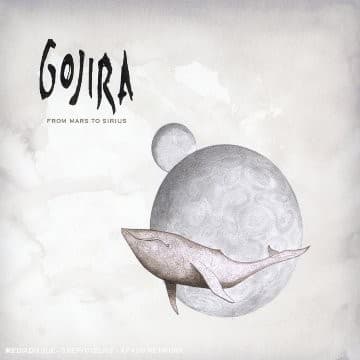
The scorecard
8.1/10 · Great
- Songwriting25%
- 8.5
- Sound25%
- 8.0
- Performance15%
- 8.0
- Cohesion15%
- 7.5
- Originality10%
- 8.0
- Replay value10%
- 8.5
The transitions between crushing riffs and clean interludes on tracks like "Where Dragons Dwell" and "Flying Whales" show songwriting that thinks in arcs rather than formulas, though the hour-plus runtime includes stretches that could have been tightened.
Self-produced in their own studio, the guitar tone balances djent-like precision with organic heft, the drums breathe despite the density, and the bass sits warm in the mix instead of buried—a technical achievement for an extreme metal record made outside major facilities.
Mario Duplantier's drum work alternates between machine-like syncopation and groove-based swing with complete control, while Joe Duplantier's vocals commit fully to both the death growls and the clean passages without reaching for melodrama.
The environmental concept holds the sequencing together through seventy-two minutes, but the album sags in the final third after "In the Wilderness," and the instrumental interludes work better as structural breathing room than as standalone pieces.
Released in 2005, it pulled Meshuggah's polyrhythmic discipline and Neurosis's dynamics into death metal songwriting before that fusion became common, establishing the template for progressive extremity that would dominate the next decade.
The central run from "Backbone" through "Flying Whales" holds up on repeat listens across nearly two decades, though the back half loses momentum and the album works better as a highlights playlist than as a complete journey.
Gojira From Mars to Sirius — Death Metal Learns to Breathe
The claim that progressive death metal became a viable subgenre rather than a contradiction in terms rests heavily on what Gojira did in their home-built studio in 2005. From Mars to Sirius arrived when technical death metal meant either Necrophagist's neo-classical shred or Cryptopsy's chaos, and when progressive meant Dream Theater's showboating or Opeth's acoustic detours. This album split the difference: polyrhythmic djent riffs played with death metal conviction, clean passages that function as structural counterweight rather than ballad relief, and an environmental concept that runs deeper than liner note window dressing. The thesis is audible in the first four minutes of "Ocean Planet," where a picked clean intro gives way to a syncopated chug that locks into a groove before collapsing back into space—dynamics as songwriting architecture, not as a producer's trick. The album's influence is now so thoroughly absorbed into progressive metal that it is difficult to hear how strange this balance was in 2005, when extreme metal was getting faster and more complex but rarely more patient.
The stakes were the band's own trajectory. Their first two albums established them as a capable French death metal act in a scene that produced little of international note. From Mars to Sirius was the bid for the top tier, recorded in a studio they built themselves after a ten-day sprint in Brussels for their debut. The result was an album that critics compared favorably to Meshuggah and Mastodon within months of release and that Rolling Stone would later rank among the hundred greatest metal albums ever made. That acclaim was earned not through reinventing death metal's tools but through reconfiguring how those tools could be arranged: the album proved that extreme metal could sustain an hour-plus runtime and a narrative arc without resorting to interludes as filler or clean vocals as apology. The environmental concept—a journey from war (Mars) to peace (Sirius), addressing climate change and marine extinction along the way—gave the sequencing a spine, even if the execution sags under its own ambition in the final third.
Precision Without Sterility, Groove Without Surrender
The sound is built on a contradiction that should not work: mechanical precision in the rhythm section played with enough human swing to avoid the grid-locked feel that makes tech-death exhausting. Mario Duplantier's drumming is the fulcrum. On "Backbone" and "The Heaviest Matter of the Universe," his patterns lock into the guitars with the tightness Meshuggah pioneered, but he plays behind the beat just enough to give the riffs weight rather than snap. The double bass is a texture, not a constant blur, and the fills are placed for impact rather than to demonstrate chops.
When the tempo drops on "Flying Whales," he shifts into a half-time groove that feels monolithic without turning sludge—there is air in the pocket. The production, self-managed by the band with mixing help from Joe Duplantier and Jean-Michel Labadie and mastered by Jean-Pierre Chalbos, supports this balance. The guitar tone is thick but defined, the low end present without muddying the polyrhythms, and the vocals sit in the mix rather than on top of it, which keeps the growls from dominating the instrumental interplay.
The songwriting's core move is the use of clean guitar sections not as breathers but as structural pivots. "Where Dragons Dwell" opens with a clean picked melody that Christian Andreu contributed, and when the distortion kicks in, the riff is a development of that melody rather than a separate idea pasted on. The verse riff in "Flying Whales" is a Meshuggah-style chug, but the song's architecture is post-rock: a slow build through dynamics rather than a verse-chorus template, with the clean whale-call section in the middle functioning as the keystone. The environmental lyrics, largely written by Joe Duplantier, avoid the pitfall of preachy abstraction by staying concrete—whales as intelligent beings facing extinction, oceans as ecosystems rather than backdrops—but they also avoid graphic eco-horror in favor of something closer to lament, which matches the music's patient pacing.
The weakness is editing. At seventy-two minutes, the album includes at least three tracks that either repeat ideas already explored or fail to justify their length. "In the Wilderness" runs nearly eight minutes on a central riff that does not develop enough to earn the runtime.
"Global Warming" revisits the slow-build dynamics of "Flying Whales" with less memorable material, and its placement after two instrumental connective tracks ("From Mars," "To Sirius") means the album's final stretch feels like an appendix rather than a conclusion. The Japanese bonus track "Escape," a Metallica cover, is competent but adds nothing. The album would be stronger at fifty-five minutes, cutting the back half's redundancies and ending on "World to Come," which lands the environmental theme with more focus. That lack of concision is the trade-off for ambition: the band was reaching for an epic scope and got most of the way there, but the album's length works against repeat listens of the whole sequence.
An Arc That Peaks Early and Coasts Long
The sequencing front-loads the strongest material. The first stretch—roughly the opening seven tracks—contains nearly all of the ideas that justify the critical acclaim and almost none of the filler. The early run establishes the rhythmic discipline, adds extended clean sections, and shows the band can build songs that move through multiple moods without losing thread. The middle section delivers the compositional peak, a seven-minute track that has become the band's signature because it achieves what the rest of the album attempts: a balance of extremity and patience where neither side feels like compromise.
After that, the album loses focus. The next stretch is solid but overlong, followed by material that has a strong melodic center but arrives after momentum has already stalled, and the instrumental pair function more as conceptual bridges than as compelling listens.
The pacing issue is structural: the album's concept is a journey from war to peace, which implies a rising action toward resolution, but the musical arc inverts that. The most aggressive and engaging tracks cluster in the first half, and the back half leans into the atmospheric and meditative, which makes thematic sense but creates a sag in energy. The problem is not the presence of slower material—the middle section proves the band can make patient music work—but that the slower material in the final third does not develop the ideas enough to justify the additional twenty minutes. An album this long needs either escalation or variation to hold attention, and the closing run provides neither after the ninth track. The result is an album that plays better as a curated selection than as a straight-through experience, which undermines the concept-album ambitions even as it highlights the band's strengths.
The Album That Defined a Decade of Progressive Death Metal
From Mars to Sirius is the most important progressive death metal album of the 2000s, not because it invented the fusion but because it made the fusion work on death metal's terms rather than progressive rock's. It proved that extreme metal could incorporate dynamics, melody and conceptual ambition without softening the core sound or requiring clean singing as a crutch. The influence is everywhere: the djent movement owes as much to this album's polyrhythmic groove as to Meshuggah's sterile precision, and the wave of atmospheric death metal bands in the 2010s borrowed its patient pacing and environmental themes wholesale. For a band with no prior albums rated on this site, this is the essential entry point—it contains their most celebrated song ("Flying Whales"), their tightest songwriting, and the clearest statement of what makes them distinct from the Swedish and American death metal traditions. It is also their longest and least edited album, which means it is not the easiest listen despite being the most acclaimed.
Who should start here: listeners who found Meshuggah too mechanical or Opeth too soft, fans of Mastodon's Leviathan looking for something with more death metal heft, and anyone interested in how progressive metal evolved beyond Dream Theater's template. Who should skip it: those allergic to death growls, those who need hooks over architecture, and those who consider anything over fifty minutes a slog. Start with "Flying Whales" to hear the album's thesis in one track, then "Backbone" and "Where Dragons Dwell" to understand the rhythmic and melodic toolkit. If those three tracks land, the full album is worth the seventy-two minutes despite the sag in the final third. If they do not, nothing else here will convert you.
After this, hear Gojira's later albums to see how they refined the template—The Way of All Flesh tightens the editing, and Magma experiments with simpler structures. Outside the catalog, Mastodon's Leviathan is the closest peer from the same era: another environmental concept album that uses progressive structures without abandoning extreme metal's core. Neurosis's Through Silver in Blood is the older record that pioneered the dynamics Gojira uses, and Meshuggah's Catch Thirtythree is the rhythmic influence stripped of the melodic counterweight. From Mars to Sirius sits at the intersection of those approaches, and nearly two decades later it remains the clearest argument that death metal could think in album-length statements without losing the plot.
Track by track
Track Listing
Ocean Planet
StandoutThe album's thesis statement, opening with a clean picked intro that establishes the environmental theme before the distorted riff enters with a syncopated chug that defines the album's rhythmic approach. The verse riff locks into a Meshuggah-style groove, but the song's structure moves through distinct sections rather than looping, with a melodic bridge that previews the cleaner textures used throughout. The production's warmth is evident immediately—the bass is audible and the guitars have heft without muddiness. The transition back to the clean section at the song's close shows the band thinking in arcs rather than verse-chorus templates, and the environmental lyrics about ocean ecosystems set the conceptual stage without abstraction. It is a strong opener that does the work of both establishing the sound and previewing the structural ambition, and it holds up as one of the album's more focused tracks.
Backbone
StandoutThe album's most rhythmically disciplined track, built on a start-stop riff that demonstrates Mario Duplantier's ability to lock into polyrhythms without losing groove. The verse pattern is a syncopated chug that shifts accents across the bar, and the drumming plays it straight without overplaying. The vocal delivery is pure death growl, but the riff underneath has enough space to avoid monotony. The bridge introduces a brief clean guitar line before slamming back into the main riff, and the song's sub-four-minute runtime is a model of economy the rest of the album does not always follow. It was one of the two tracks performed live before the album's release, and it is easy to hear why: it is immediate, heavy, and tight, with no wasted motion. A highlight.
From the Sky
StandoutThe first extended clean section, arriving in the song's midsection after two minutes of heavy riffing. The clean passage is picked arpeggios over a quiet drum pattern, and it lasts long enough to function as a structural shift rather than a breather. When the distortion returns, the riff is a development of the clean melody, which shows the integration of dynamics into the songwriting rather than using them as contrast for its own sake. The vocals alternate between growls and a cleaner, chanted delivery, and the song's nearly six-minute runtime is earned by the variation in texture and tempo. The environmental theme continues with imagery of skies and flight, connecting to the album's larger concept. It is one of the album's stronger tracks, demonstrating the balance of extremity and patience that defines the record's ambition.
Unicorn
SolidA two-minute instrumental interlude, clean guitars playing a gentle melody with minimal percussion. It functions as a breather after three heavy tracks and a setup for the heavier material to follow. The melody is pleasant but not memorable enough to stand alone, and the track works better as a structural pause than as a composition. It does not overstay its welcome, which is the main thing required of an interlude, and it serves the album's pacing by providing space before the next assault.
Where Dragons Dwell
StandoutOne of the album's most successful integrations of clean and heavy sections, opening with a melodic guitar line contributed by Christian Andreu that establishes the song's central theme before the distortion enters. The heavy riff is a development of the opening melody, and the song moves through multiple sections with clear transitions rather than abrupt cuts. The drumming is precise but swings enough to avoid sounding programmed, and the bass adds warmth to the low end. The bridge features another extended clean passage, and the outro—also written by Andreu—brings the melody full circle, ending on a clean resolution rather than a heavy fadeout. At nearly seven minutes, the song earns its length by developing its ideas and using dynamics as architecture rather than decoration. It is one of the album's compositional peaks and a clear demonstration of what the band was reaching for across the full runtime.
The Heaviest Matter of the Universe
StandoutThe shortest full track on the album, under four minutes, and one of the most aggressive. The title is literal: the riff is a low-tuned chug with a polyrhythmic pattern that shifts accents, and the drumming is relentless without turning into blur. The vocals are pure death growl, and the lyrics address cosmic scale and existential weight, fitting the environmental and conceptual themes without diluting the extremity. There is no clean section, no dynamic shift, just four minutes of disciplined brutality. It was the other track performed live before release, and it works as a showcase for the band's rhythmic precision and heaviness without the progressive elements. A standout for its focus and intensity.
Flying Whales
StandoutThe album's centerpiece and the band's signature song, a seven-minute track that balances Meshuggah-style polyrhythmic chugging with post-rock dynamics and a memorable melodic center. The opening riff is a syncopated groove that builds slowly, adding layers of guitar and percussion before the full band enters. The verse sections are heavy and precise, but the song's architecture is patient, moving through a clean midsection with whale-call guitar melodies that function as the song's emotional core. The breakdown that follows is one of the most celebrated riffs in 2000s metal, a half-time groove that feels monolithic without turning sludge, and the song's resolution brings back the clean textures before fading out. The environmental theme is explicit—the song is a tribute to whales and their intelligence—and the music matches the subject's scale and grace. It is the track that justifies the album's critical acclaim and the clearest demonstration of the band's ability to make extreme metal patient and melodic without compromise. Nearly two decades later, it remains iconic.
In the Wilderness
SolidThe album's longest track at nearly eight minutes, and the point where the sequencing begins to sag. The song has a strong central riff and a memorable clean section in the midsection, but it does not develop its ideas enough to justify the length. The heavy sections repeat the polyrhythmic approach established earlier on the album without adding new wrinkles, and the clean passage, while well-executed, feels like a retread of the dynamics used more effectively on "Flying Whales" and "Where Dragons Dwell." The drumming remains solid, and the production keeps the low end present, but the song does not build toward a payoff. It is competent but overlong, and its placement after the album's peak makes the pacing issue more obvious. A solid track that would have been stronger at five minutes.
World to Come
StandoutA nearly seven-minute track built around a melodic guitar line contributed by Christian Andreu, one of the album's stronger melodic moments. The song alternates between heavy riffing and clean passages, and the central melody is memorable enough to anchor the structure. The drumming is varied, moving between blast beats and slower, groovier patterns, and the vocals are committed. The environmental theme continues with imagery of rebirth and renewal, fitting the album's conceptual arc from war to peace. The song is solid and contains some of the album's better melodic writing, but it arrives after momentum has already stalled following "In the Wilderness," and it does not quite have the impact it might have had earlier in the sequence. Still, it is one of the back half's highlights and shows the band's melodic strengths.
From Mars
SolidA two-and-a-half-minute instrumental transitional piece, mostly clean guitars and atmospheric textures. It functions as a conceptual bridge, representing the midpoint of the journey from Mars to Sirius, but it does not stand on its own as a composition. The melodies are gentle and the production is spacious, but the track feels like connective tissue rather than a developed idea. It works in the context of the full album's narrative but adds to the sense that the back half is padded.
To Sirius
SolidThe destination of the album's conceptual journey, a nearly six-minute track that alternates between heavy riffing and atmospheric clean sections. The song has a strong melodic theme and the production emphasizes space and clarity, fitting the titular arrival at peace. The drumming is restrained compared to earlier tracks, and the vocals include more clean passages alongside the growls. A video was directed for this track by Alain Duplantier, indicating it was considered a single-worthy piece. The song is solid and thematically appropriate, but it does not have the compositional strength of the album's peaks, and its placement after two instrumental connective tracks means it arrives with diminished momentum. It would have worked better as the album's closer, ending on the conceptual resolution rather than continuing for two more tracks.
Global Warming
WeakThe longest track on the standard edition at nearly eight minutes, and the most obvious example of the album's editing problems. The song addresses climate change explicitly, fitting the environmental concept, and it uses the slow-build dynamics of "Flying Whales," but the central riff is less memorable and the song does not develop enough to justify the runtime. The clean passages are well-executed, and the drumming remains solid, but the track feels like a retread of ideas executed more effectively earlier on the album. It is competent but redundant, and its placement as the penultimate track means the album ends on a sag rather than a peak. Cutting this track would have tightened the album significantly without losing anything essential.
Escape
SolidA Japanese bonus track covering Metallica's "Escape" from Ride the Lightning, a competent rendition that adds nothing to the original or to this album. The performance is tight and the production matches the rest of the record, but it is a covers-album curiosity rather than essential listening. It does not appear on most editions and is not part of the album's conceptual arc, making it easy to skip.