The Voice That Defined Heavy Metal's Mythic Dimension
When Ronnie James Dio formed his eponymous band in 1982, he wasn't starting over—he was claiming independence after already reshaping heavy metal twice. First with Rainbow, where he helped Ritchie Blackmore forge neoclassical metal from hard rock's raw materials. Then with Black Sabbath, where he redirected the band from Ozzy Osbourne's street-level darkness toward medieval grandeur. Dio the band represented the complete realization of his artistic vision: a vehicle designed specifically for his operatic voice, fantasy-driven lyrics, and conviction that metal could be both heavy and sophisticated without compromise.
The formation came at heavy metal's commercial crossroads. The New Wave of British Heavy Metal had revitalized the genre's energy, while American acts were pushing toward either pop-metal accessibility or thrash extremity. Dio carved a third path—maintaining traditional heavy metal's melodic foundation while amplifying its theatrical and compositional ambitions. The band's lineup coalesced around Vivian Campbell's virtuosic guitar work, Jimmy Bain's driving bass, and Vinny Appice's powerful drumming, creating a sound that honored metal's blues-rock origins while reaching toward progressive complexity.
Dio's cultural significance extends beyond record sales or chart positions. The band became heavy metal's most unapologetic defender of fantasy, mysticism, and escapist storytelling during an era when many acts either chased radio formats or gravitated toward social realism. This commitment to imaginative world-building influenced generations of power metal, progressive metal, and symphonic metal bands who saw Dio as proof that heavy music could explore literary and mythological themes without sacrificing sonic power.
Operatic Power Meets Neoclassical Precision
Ronnie James Dio's vocal approach defined the band's sonic identity—a technique blending operatic projection with rock grit, capable of shifting from tender melodicism to battle-cry intensity within single verses. Unlike the shrieking high registers favored by many 1980s metal vocalists, Dio worked primarily in a powerful mid-range, using vibrato and dynamic control rather than pure altitude to create drama. His phrasing drew from classical singing traditions, treating lyrics as narrative performance rather than rhythmic delivery, which gave even straightforward heavy metal arrangements an epic scale.
The instrumental framework built around this voice prioritized melodic clarity and neoclassical sophistication. Vivian Campbell's guitar work on the early albums combined Tony Iommi's riff-centric heaviness with Ritchie Blackmore's baroque sensibilities—arpeggiated passages, harmonic minor scales, and extended solos that told musical stories rather than simply showcasing technique. The rhythm section, anchored by Vinny Appice's precise yet powerful drumming, provided both foundation and counterpoint, allowing songs to shift between galloping energy and atmospheric passages without losing momentum.
Production choices consistently emphasized warmth and dimension over the increasingly compressed, effects-heavy sound dominating 1980s metal. The band worked with producers who understood how to capture Dio's voice without burying the instrumental interplay, creating records that sounded powerful on arena sound systems while retaining detail for closer listening. This approach kept Dio's albums sounding timeless rather than dated by period production trends, though it sometimes cost them radio-friendly punch compared to more commercially calculated contemporaries.
From Holy Diver's Lightning Strike to Three Decades of Consistent Vision
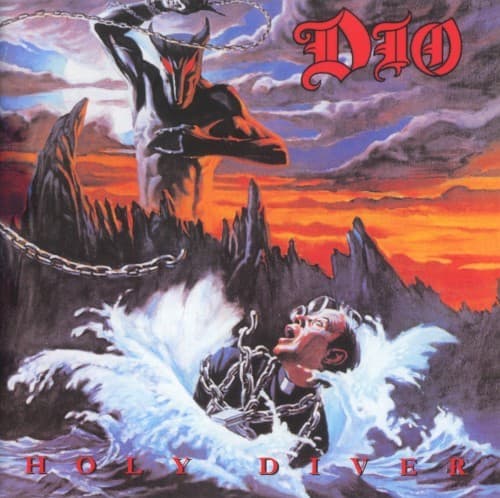
Holy Diver arrived in May 1983 as one of heavy metal's most assured debut statements. The album announced its intentions immediately with the title track's iconic opening riff and Dio's cryptic narrative about a mysterious figure cast into dark waters. Songs like "Rainbow in the Dark" demonstrated the band's ability to craft radio-accessible singles without compromising their sound, while "Stand Up and Shout" became an anthem for metal's outsider community. The album's fantasy-oriented artwork, featuring a demon drowning a priest, established visual themes the band would explore throughout their career—mythology, good versus evil, personal empowerment through dark imagery.
The success of Holy Diver—eventually certified platinum—gave the band commercial leverage and creative confidence. The Last in Line (1984) expanded their sonic palette, incorporating more textured arrangements and varied tempos while maintaining the debut's intensity. Sacred Heart (1985) pushed further into conceptual territory, with interconnected songs exploring religious imagery and moral ambiguity. These mid-1980s albums established Dio as arena headliners capable of competing with metal's biggest acts, though lineup instability began affecting creative continuity when Vivian Campbell departed amid personal and financial tensions.
The late 1980s and 1990s brought both challenges and adaptation. Dream Evil (1987), featuring Craig Goldy on guitar, maintained commercial viability but faced shifting musical landscapes as thrash metal and alternative rock redrew heavy metal's boundaries. Lock Up the Wolves (1990) and Strange Highways (1993) found the band navigating grunge's impact on metal's commercial prospects, continuing to release solid work for a dedicated fanbase even as mainstream attention drifted. These albums revealed Dio's commitment to his artistic vision regardless of trends—a stance that cost immediate relevance but built long-term credibility.
The 2000s brought renewed appreciation and creative resurgence. Killing the Dragon (2002) and Master of the Moon (2004) showed the band still capable of vital, muscular heavy metal in an era dominated by nu-metal and metalcore. A brief Black Sabbath reunion as Heaven & Hell (2006-2009) reminded broader audiences of Dio's historical importance and vocal power. The band's final shows in 2009, before Ronnie James Dio's death from stomach cancer in May 2010, demonstrated undiminished performance intensity—the voice remained a force of nature until the end. His passing at 67 marked not just a band's conclusion but the close of heavy metal's foundational era.
The Template for Metal's Unapologetic Grandeur
Dio's influence operates on multiple levels within metal culture. Most obviously, Ronnie James Dio's vocal style became a template for power metal, progressive metal, and traditional heavy metal singers who prioritized melodic strength and dynamic range over aggression alone. Bands from Helloween to Blind Guardian to Symphony X built entire sounds around vocalists attempting to capture some fraction of Dio's combination of power, precision, and narrative delivery. His technical approach—classical breath support, strategic vibrato, careful phrasing—raised expectations for what metal vocalists could achieve.
Beyond technique, Dio legitimized fantasy and mythology as serious lyrical territory within heavy metal. While earlier bands incorporated occasional mystical themes, Dio committed fully to imaginative world-building, creating a permission structure for entire metal subgenres. Power metal's dragon-and-castle aesthetics, symphonic metal's literary ambitions, and progressive metal's conceptual storytelling all trace lineage to Dio's conviction that metal could explore imaginative realms with artistic seriousness. This influence extends to visual presentation—elaborate stage sets, thematic album artwork, theatrical performance—establishing standards for metal as multi-sensory experience.
The band's business model and career arc also provided a template for artistic independence. By maintaining creative control, refusing to chase trends, and prioritizing fan connection over radio formats, Dio demonstrated sustainable career paths outside mainstream commercial systems. This approach influenced how subsequent generations of metal bands structured their careers, particularly as the internet enabled direct artist-fan relationships. Dio's consistent quality across decades, even through commercial valleys, proved that artistic integrity and long-term viability weren't mutually exclusive in heavy metal.