The scorecard
7.9/10 · Great
- Songwriting25%
- 8.5
- Sound25%
- 7.5
- Performance15%
- 8.0
- Cohesion15%
- 7.0
- Originality10%
- 7.5
- Replay value10%
- 8.5
The riff architecture on "Crazy Train" and the chord voicings on "Mr. Crowley" are built for permanence, with ideas that develop across sections instead of looping.
Max Norman's uncredited mix captures Rhoads' tone and Airey's keys clearly, though the rhythm section sits oddly distant on "Revelation" and "Steal Away."
Rhoads' soloing on "Mr. Crowley" and "I Don't Know" is both precise and expressive; Osbourne's vocal on "Goodbye to Romance" carries real vulnerability after the Sabbath bravado.
The first five tracks are sequenced tightly from aggression to introspection, but "No Bone Movies" disrupts the momentum and the album sags noticeably in its final third.
Rhoads imported classical guitar phrasing and harmonic minor runs into a genre still playing pentatonic blues, setting a template Eddie Van Halen had only hinted at.
Four decades later "Crazy Train," "Mr. Crowley" and "Suicide Solution" remain in rotation on rock radio, and the album holds up on full listens despite its uneven back half.
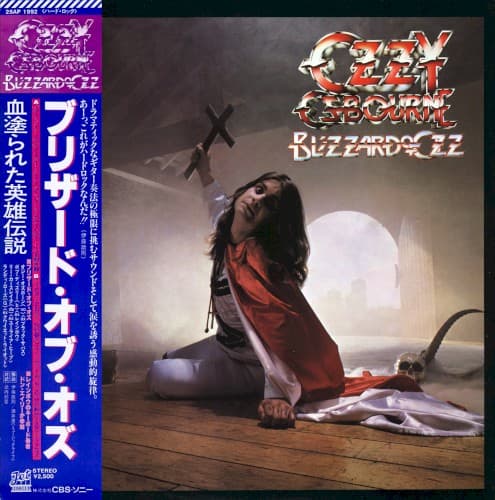
Ozzy Osbourne Blizzard of Ozz — The Divorce Settlement That Rewrote the Metal Guitar Rulebook
Blizzard of Ozz is less an Ozzy Osbourne album than a Randy Rhoads album with Ozzy's voice on it, and that imbalance is both its greatest strength and the source of the legal bitterness that followed. The debut dropped in September 1980 as proof that Osbourne could exist outside Black Sabbath, but the real story is what guitarist Randy Rhoads brought to heavy metal: classical training applied to riff construction, harmonic minor scales imported into a genre still coasting on blues boxes, and a sense that a guitar solo could be compositional rather than improvisational.
Osbourne himself has admitted he felt he was competing with his former band during the sessions at Ridge Farm Studio, and the album's best moments—"Crazy Train," "Mr. Crowley," "I Don't Know"—succeed because Rhoads composed parts that didn't need Tony Iommi for comparison. The material was written primarily by Rhoads, bassist Bob Daisley and Osbourne during rehearsals at Monnow Valley Studio and Clearwell Castle, with drummer Lee Kerslake joining too late to shape most of the songs.
That collaborative tension, and the question of who deserved credit, would poison the well for decades. But the album itself argues clearly: Rhoads was the architect, Daisley provided the lyrical weight, and Osbourne was the vehicle. What matters now is that the formula worked long enough to produce four or five tracks that forced every metal guitarist who heard them to reconsider what the instrument could do.
How Rhoads Imported the Conservatory Into Metal Without Sounding Like a Show-Off
The songwriting on Blizzard of Ozz is built around Rhoads' ability to make classical technique sound like heavy metal rather than like fusion or prog. The main riff on "Crazy Train" is a major-key gallop that shifts between straight chords and a chromatic ascending line, giving the song momentum without the blues-scale sludge that Sabbath relied on. The solo is structured in phrases, not just fast runs: it opens with a melodic statement, answers itself, builds in intensity, then lands on a held note that the rhythm section catches. That approach—treating the solo as another verse—came from Rhoads' formal training and his admiration for classical guitar, but it never sounds academic because the tone is still rooted in Marshall distortion and the phrasing swings.
"Mr. Crowley" takes the same principle to a slower tempo: the verses are built on Don Airey's keyboard intro (which Airey claims he wrote in the studio, though he gave up the credit), and Rhoads' solo moves through harmonic minor passages that sound like they were written at a piano before being transferred to the fretboard. The solo doesn't showboat; it serves the song's Gothic atmosphere. "I Don't Know" is the album's most economical track, with a main riff that's just a two-note motif bent into different shapes across the verse and chorus, and a solo that uses space and phrasing rather than speed to make its point.
The rhythm section, bassist Bob Daisley and drummer Lee Kerslake, plays this material with more swing than Sabbath's rhythm sections ever allowed, which makes the songs feel less monolithic and more dynamic. Max Norman's engineering captures Rhoads' tone clearly—bright, articulate, slightly scooped in the mids—and Airey's keyboards add texture without crowding the guitars. Osbourne's voice is lower in confidence than it was on Paranoid or Master of Reality, but that works in the album's favor: the vulnerability on "Goodbye to Romance" and the exhaustion on "Suicide Solution" sound like a man who thought his career was finished.
Daisley wrote most of the lyrics, including "Suicide Solution," which he has said was aimed at Osbourne's own substance abuse (the song later became the center of a lawsuit after a teenager's suicide in 1984, though the case was dismissed on First Amendment grounds). The subject matter is heavier than Sabbath's occult imagery, more direct and more personal. The production is clean by 1980 standards but not overproduced; the album sounds like a band playing together in a room, which it mostly was.
The weak spots are structural.
"No Bone Movies" was written quickly to give Kerslake a songwriting credit after he joined too late to contribute to the other material, and it sounds like filler: the riff is basic, the lyrics (about Daisley's dislike of porn) are disposable, and the track disrupts the album's momentum at the point where it should be building toward a climax. "Revelation (Mother Earth)" has an interesting premise—climate change framed in biblical terms—but the song is too long and too repetitive to earn its six minutes. "Steal Away (The Night)" was sequenced as the closer to mirror the uptempo ending of a live set, but it's a minor track that leaves the album on a shrug rather than a statement.
Why the Album Runs Out of Fuel Before the Finish Line
The first stretch runs like a single argument: opening aggression and speed, a shift to introspection without breaking the flow, a brief acoustic interlude that resets the energy, and then the A-side's darkest and most personal moment to close. That sequence feels deliberate and earned.
The second half falls apart. The strongest track on side two is one of the album's peaks, but it's surrounded by material that doesn't justify its place. The pacing problem is that Rhoads and Daisley had already written the album's best material before Kerslake joined, and the late additions feel like late additions.
The closing stretch would be stronger if the middle section's peak were the closer and the last two tracks were cut, but Osbourne wanted to end on an uptempo note the way Sabbath shows ended with "Paranoid." That instinct doesn't serve the album. The length isn't excessive—under forty minutes—but the quality drop in the final third makes it feel longer than it is.
The Blueprint for Eighties Metal Guitar, Delivered by a Band That Imploded Over the Credit
Blizzard of Ozz ranks as Osbourne's most important solo album because it set the standard for what metal guitar would sound like in the eighties: technically advanced, compositionally rigorous, and still heavy. Rhoads didn't invent the approach—Eddie Van Halen's 1978 debut had already shown that virtuosity could coexist with riffs—but Rhoads applied it more systematically and with a clearer sense of song structure. Every metal guitarist who came after, from the shred wave to the neoclassical revivalists, was answering Rhoads' work on this album.
For listeners, it's essential if you care about where metal guitar went after Sabbath and Zeppelin, and it's still worth hearing for "Crazy Train," "Mr. Crowley," "I Don't Know" and "Suicide Solution," which remain in rotation for good reason. The rest is solid but not crucial. The album has aged better than most of Osbourne's later solo work because the production is relatively restrained and because Rhoads' playing still sounds distinctive rather than dated. Start with "Crazy Train" and "Mr. Crowley" if you only know the singles; move to "I Don't Know" and "Suicide Solution" if those land.
Skip "No Bone Movies" and "Revelation" unless you're a completist. If this works, the logical next step is Diary of a Madman, the second and final album with Rhoads before his death in 1982, which is more ambitious but less consistent. For context on where Rhoads came from, Black Sabbath's Paranoid and Van Halen's self-titled debut are the bookends.
Blizzard of Ozz is the bridge between Iommi's riff-doom and Van Halen's virtuosity, and it succeeded because Rhoads understood both and synthesized them into something that sounded new in 1980. The legal battles over songwriting credits—Daisley and Kerslake sued for royalties in 1986 and eventually won recognition, but Sharon Osbourne controversially had their original bass and drum tracks replaced on a 2002 reissue before public outcry forced a restoration in 2011—are a reminder that the album was never really the solo vehicle the cover suggested. Rhoads almost left the band in late 1981 because he didn't want to be a sideman in what was being marketed as Osbourne's comeback. The music proves he was right to resist.
Track by track
Track Listing
I Don’t Know
StandoutThe opening track does the work of announcing that this is not Black Sabbath redux. The main riff is a two-note motif—root and minor third—bent and shifted across different positions, economical and aggressive without sounding primitive. Rhoads' solo is phrased like speech: short melodic statements that build in intensity rather than unloading technique from the first bar. Osbourne's vocal is lower in register and less confident than his Sabbath work, which makes the uncertainty in the lyric feel real rather than theatrical. Daisley's bass line mirrors the guitar in the verse but moves independently in the bridge, giving the song more dynamic range than a simple riff-loop would allow. The track works because it establishes the album's approach in under five and a half minutes: Rhoads writes the architecture, Osbourne delivers the character, and the rhythm section provides the swing. It's still one of Osbourne's most-performed songs, and it holds up because the solo and the riff are specific to this track rather than interchangeable with anything else in the catalog.
Crazy Train
StandoutThe most famous track on the album and the one that defined Osbourne's solo career. The main riff is a major-key gallop that moves between straight power chords and a chromatic ascending line, giving the song forward momentum that never lets up. The solo is structured in phrases rather than built from patterns: it opens with a melodic idea, develops it, answers itself, and lands on a sustained bend that the band catches together. That compositional rigor came from Rhoads' classical training, but the tone and the phrasing keep it rooted in metal rather than drifting into fusion. Osbourne's vocal melody in the chorus is one of the few moments on the album where his contribution is as memorable as Rhoads', and the lyric about a world going off the rails has aged into a perennial. The production captures the brightness of Rhoads' tone without thinning out the low end, and Kerslake's drums push the tempo without rushing. The track became a staple of rock radio and was certified double platinum in 2009, and it's still the entry point for listeners who only know Osbourne from the singles. It deserves the reputation.
Goodbye to Romance
StandoutThe album's most vulnerable moment and the only ballad that earns its length. Osbourne has said the song was his way of saying goodbye to Black Sabbath after he thought his career was over, and the lyric carries that weight without melodrama. Rhoads' acoustic intro is fingerpicked and classical in tone, and when the electric guitars enter they double the melody instead of shifting to a riff, which keeps the song's focus on the vocal. The solo is restrained by Rhoads' standards—mostly sustained bends and melodic phrases rather than fast runs—and it works because the track doesn't need fireworks. Daisley's bass line is simple and supportive, and Kerslake's drums stay out of the way. The song runs five and a half minutes, but the arrangement justifies the length because it builds gradually from acoustic to full band and then back down. This is the clearest example of Daisley's lyrical contribution, and it's one of the few tracks where Osbourne's vocal performance is the centerpiece. The band was dissatisfied with the original mix and returned to Ridge Farm Studio to remix it after a Birmingham show, which suggests they knew the song mattered. It still sounds like the album's emotional center.
Dee
SolidA fifty-second classical guitar instrumental that Rhoads wrote as a tribute to his mother, Delores. It's fingerpicked, clean-toned, and serves as a palate cleanser between the ballad and the darkness of "Suicide Solution." The piece doesn't develop or build—it's just a short statement—but it resets the album's energy at the right moment and reminds the listener that Rhoads' training was formal. Short enough to work, no filler.
Suicide Solution
StandoutThe album's most controversial and one of its darkest tracks. Daisley wrote the lyric about Osbourne's own substance abuse, though Osbourne claimed in court that the phrase "wine is fine but whiskey's quicker" came to him as a reflection on the death of AC/DC's Bon Scott. The song became the center of a lawsuit in 1984 after a teenager's suicide, with the parents alleging the track encouraged self-destructive behavior; the case was dismissed on First Amendment grounds. Musically, the track is built around a grinding main riff in a mid-tempo groove, with Rhoads layering open-string drones under the distorted chords to create a queasy, dissonant atmosphere. The solo is one of the album's most aggressive, with fast alternate-picked runs that sound frantic rather than controlled. Osbourne's vocal is exhausted and raw, and the production keeps the mix claustrophobic rather than spacious. The song is grim without being theatrical, and it closes the A-side on a note of genuine unease. It's heavier than anything else on the album and one of the tracks that makes the case for Blizzard of Ozz as something more than a singles collection.
Mr. Crowley
StandoutThe second single and the album's other undeniable peak. The intro is built around Don Airey's keyboard line, which Airey claims he wrote in the studio (though he gave up the credit as a favor to Osbourne, who was broke at the time). Rhoads' main riff uses a harmonic minor scale that gives the song a Gothic, almost baroque atmosphere, and the solo is structured in movements: it opens with a melodic statement in the lower register, shifts to faster runs in the middle, and climaxes with a high sustained note that the band catches. The solo sounds written, not improvised, and that's the point—it's compositional, not just flashy. Osbourne's vocal in the verses is restrained, almost spoken, which makes the chorus feel like a release. The lyric refers to occultist Aleister Crowley, and the tone is more curious than condemnatory, which fits the song's eerie atmosphere. The production gives Airey's keys and Rhoads' guitar equal space in the mix, and the result is one of the few tracks from 1980 that still sounds distinctive rather than just well-executed. This is the high point of side two and one of the reasons the album is considered essential.
No Bone Movies
WeakFiller that only exists because the band needed to give drummer Lee Kerslake a songwriting credit after he joined too late to contribute to the rest of the material. Daisley wrote the lyric to express his dislike of porn films, and the subject matter is as disposable as it sounds. The riff is basic, the solo is short and unremarkable, and the track disrupts the album's momentum at the worst possible moment. It's under four minutes, but it still feels like padding. The weakest track on the album.
Revelation (Mother Earth)
SolidAn environmentally-themed track that uses biblical imagery to criticize humanity's damage to the planet. The premise is more interesting than the execution: the song is over six minutes long, and the riff and structure are too repetitive to justify the length. Rhoads' solo is solid but not memorable, and the arrangement doesn't build or develop the way "Mr. Crowley" does. Airey's keyboards are more prominent here than on the rest of the album, which gives the track a slightly proggy feel that doesn't fit the record's overall tone. The lyric is earnest but heavy-handed, and Osbourne's vocal doesn't have the dynamic range to carry the song's shifts in intensity. It's not bad, but it's too long and it comes at the point in the sequence where the album needs to be tightening, not sprawling.
Steal Away (The Night)
SolidThe closing track, sequenced here because Osbourne wanted to end the album on an uptempo note the way Sabbath sets ended with "Paranoid." The song is mid-tempo rather than fast, and the riff is straightforward without being memorable. The solo is short and functional, and the track feels like a minor idea that wasn't developed enough to stand with the album's stronger material. It's not weak enough to ruin the album, but it's not strong enough to justify the closer slot. The album would be better served if "Mr. Crowley" were the final track.