Style & Context
Influences
Western movie posters, honky-tonk documentary photography, outlaw country album aesthetics
Location
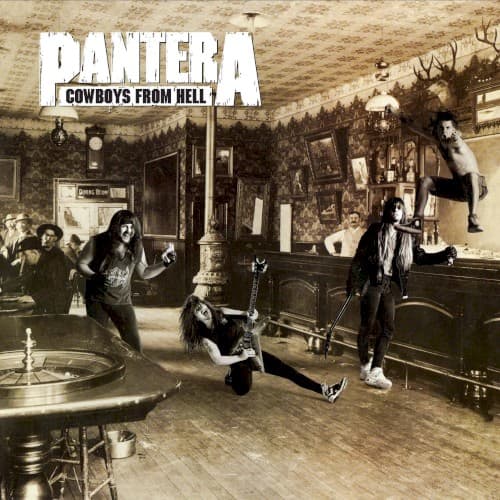
The saloon setting claims Texas identity as central to metal credibility during an era when geography mattered less than image.
Visual Language
The documentary-style composition rejects glam metal's artifice for something rawer and more territorially Texan in character.
Symbols
Western saloon setting
The American frontier mythology merges with metal's outsider ethos, positioning Pantera as gunslinging outlaws of a musical revolution.
Scattered instruments and casual poses
The band inhabits the space rather than performing for it, suggesting ownership and authenticity over staged theatrics.
Vintage photography aesthetic
The sepia treatment connects groove metal's birth to historical lineage, claiming legitimacy through visual association with Americana.
Where Sound Meets Image
The saloon's raw wood and worn surfaces mirror the album's unpolished guitar tone—thick, warm, and deliberately rough around the edges. Dimebag Darrell's guitar dominates the frame just as his riffs dominate the album's sound, while the casual poses reflect groove metal's swagger over thrash's frantic energy. The Western setting perfectly frames songs like the title track's outlaw stomp and 'Cemetery Gates' melancholy, creating visual shorthand for metal that's heavy but distinctly American rather than European.
This cover established the template for regional metal identity in album art—geography as credibility, local flavor as authenticity marker. Countless groove and Southern metal bands afterward adopted similar rustic, documentary-style photography to claim their own territorial legitimacy. The sepia-Western aesthetic became so associated with Pantera that it influenced metal photography beyond album covers, teaching the genre that stripped-down realism could communicate heaviness as effectively as fantasy illustrations.