The scorecard
9.0/10 · Essential
- Songwriting25%
- 9.5
- Sound25%
- 9.0
- Performance15%
- 9.0
- Cohesion15%
- 8.5
- Originality10%
- 8.5
- Replay value10%
- 9.5
Holy Wars and Hangar 18 develop multiple distinct riffs into complete compositions, while even short tracks like Poison Was the Cure sustain ideas without repetition.
Mike Clink and Max Norman delivered guitar tone that cuts without shrillness and a mix where twin leads remain distinct through Hangar 18's solo section.
Marty Friedman's melodic sense on Tornado of Souls and Nick Menza's shifts between precision and swing elevate musicianship above genre standard.
Dawn Patrol disrupts momentum before the closer, but the sequencing otherwise builds tension from Holy Wars through Tornado of Souls without sag.
The twin-lead arrangements and progressive structures distinguished thrash in 1990, though the speed and aggression stay within the genre's established vocabulary.
Three decades later the riffs still reveal details and the solos hold up where most thrash leads blur into exercises.
Megadeth Rust in Peace — When Thrash Learned to Write Progressions
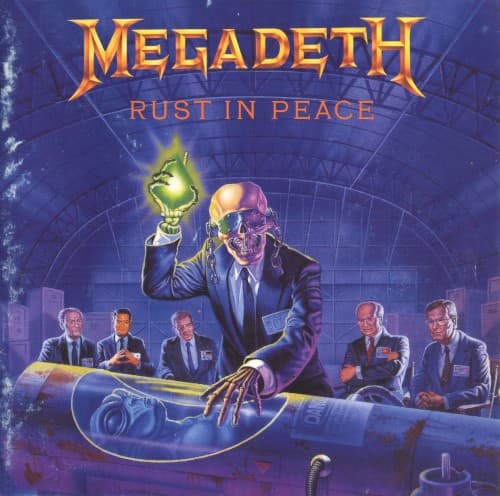
Rust in Peace proves that thrash metal could build songs instead of just accelerating them. Where most of the genre in 1990 mistook speed for intensity and riffs for composition, Megadeth's fourth album structures its ideas: Holy Wars develops three distinct sections with separate tempos and feels, Hangar 18 sequences five guitar solos that comment on each other rather than repeat the same scale run, and even the two-minute Poison Was the Cure works through a complete thought instead of looping a verse. The result is an album that rewards attention rather than punishing it, where the playing justifies the length and the arrangements earn the complexity. This is thrash that expects you to remember what happened four minutes ago.
The stakes were survival. Dave Mustaine had fired half the band after the 1988 Monsters of Rock tour, spent the first half of recording in rehab, and hired a guitarist whose previous work leaned melodic. The lineup that made this record—Mustaine, bassist David Ellefson, new drummer Nick Menza, and new lead guitarist Marty Friedman—had no tour history and no second chances. That pressure shows up as focus: nine tracks with no filler masquerading as interludes, no half-written songs padded to album length, and no solos that exist because the form requires one. When a thrash album from 1990 still gets studied note-for-note thirty years later, it is because the songs were built to last.
How Thrash Writes When It Stops Shouting
The songwriting operates on tension between Mustaine's rhythmic riffing and Friedman's harmonic sense. Mustaine writes in jagged patterns that break the beat into unusual subdivisions—the main riff of Holy Wars shifts accents mid-phrase so the downbeat keeps moving—while Friedman layers melodic figures that resolve where the rhythm riffs leave space. Hangar 18 demonstrates the method: Mustaine's opening figure establishes the key and the pace, then Friedman's harmony line in the second half of the riff pulls the tonality sideways before snapping back. The solo section that follows presents five distinct leads, each with its own melodic shape, building to the climactic shred run that closes the sequence. That level of intentional structure was rare in 1990 thrash, where most solos served as technique highlight between verses.
The rhythm section gives the compositions room to develop. Nick Menza plays behind the riff on verses and in front of it on transitions, shifting the pocket to mark sections rather than just doubling the guitars. His work on Five Magics moves from straight time on the verse to syncopated kick patterns on the bridge, making the tempo shifts feel like decisions instead of accidents. Ellefson's bass mirrors Mustaine's rhythm guitar more often than it walks independent lines, but the clarity of the mix means you hear both instruments articulating the riff, giving the low end mass without mud. When Take No Prisoners accelerates into its bridge, the bass and kick drum lock so tightly that the speed feels controlled rather than desperate.
Producer Mike Clink's work—complicated by his divided attention between this record and Guns N' Roses—nonetheless yielded a guitar tone that balances attack and sustain. The rhythm sound bites without the icepick treble that plagued late-eighties thrash, and the leads sustain long enough for Friedman's phrasing to breathe. Max Norman's mix keeps the twin guitars distinct in the stereo field during harmony sections, so Hangar 18's dual leads never collapse into mush. The production serves the songs: when Tornado of Souls builds to its solo, the rhythm guitars step back in volume, and Friedman's lead sits forward without burying the drums. That spatial awareness was not standard in thrash production.
Weaknesses appear in the album's concessions to radio ambition. Dawn Patrol, a bass-led experiment with vocoders and minimal drums, breaks the album's momentum with no payoff and no connection to the tracks surrounding it. The decision to place it second-to-last suggests someone thought a breather was necessary; the song itself argues otherwise. Mustaine's vocals, while committed and precise in their phrasing, lack tonal range: the snarl that works on Holy Wars wears thin across nine tracks, and moments that might benefit from a sung melody instead get the same bark.
An Album That Earns Its Forty Minutes
The sequencing front-loads the most intricate writing. Holy Wars and Hangar 18 open the record with thirteen minutes of progressive thrash that set expectations the rest of the album must meet, and mostly does: Five Magics follows with shifting time signatures, Lucretia balances speed with melodic hooks, and Tornado of Souls delivers the album's most celebrated guitar solo over a mid-tempo stomp. The pacing works because the shorter tracks between the epics—Take No Prisoners, Poison Was the Cure—hit hard and exit before they repeat themselves. At three minutes or less, they function as palate cleansers that maintain intensity without demanding the focus required by the longer compositions.
The exception is Dawn Patrol, which stalls the sequence just as the album should be building toward its conclusion. Removing it would tighten the flow: Tornado of Souls into Rust in Peace Polaris makes a stronger close, and the album would lose nothing but ninety seconds of failed experimentation. As it stands, the final two tracks recover the momentum, but the stumble is noticeable. Rust in Peace Polaris brings back the tempo and the dual-guitar interplay, ending the album on the same terms it opened, which makes the whole forty minutes feel like a deliberate statement rather than a collection of songs. The album's length is just short enough that the sequencing choices matter; one more weak track would have tipped it into bloat.
The Thrash Record That Separated Writers From Riff Machines
Rust in Peace sits near the top of Megadeth's catalog and the thrash genre because it prioritizes composition over convention. The progressive structures and melodic leads separated it from the Bay Area template in 1990, and the songs have aged better than most of the era's output because they were built on ideas that develop rather than riffs that loop. The production remains clear three decades later, the performances are disciplined without losing intensity, and the writing justifies repeat listens where most thrash rewards volume more than attention. The weaknesses are minor: one failed experiment in Dawn Patrol, a vocal performance that lacks dynamic range, and a length that could lose ninety seconds without harm.
This is for listeners who want thrash that challenges as much as it crushes, and who will notice the architecture beneath the speed. It is not for those who need raw aggression without melodic content, or who prefer their metal stripped to tempo and distortion.
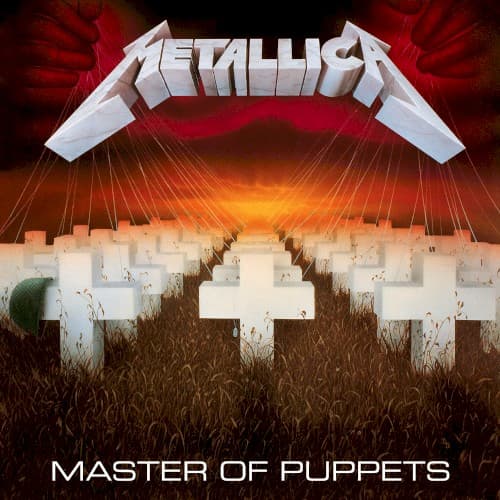
The album has aged into a benchmark: later thrash borrowed its ambition, progressive metal borrowed its structure, and the guitar-playing influenced two generations of lead players who studied the solos note-for-note. Start with the opening two tracks to hear the thesis, then the third-to-last entry for the execution. Skip the penultimate experiment. From here, try Megadeth's Peace Sells for the blueprint this album refined, or Metallica's Master of Puppets for the other branch of thrash that learned to write songs. Rust in Peace remains the clearest answer thrash ever gave to the question of whether speed and complexity could coexist without one swallowing the other.
Track by track
Track Listing
Holy Wars… The Punishment Due
StandoutThe album's thesis statement in six and a half minutes. The opening riff works in odd subdivisions that displace the downbeat, setting up the controlled chaos Mustaine specializes in, then transitions into a mid-tempo bridge with a different key center and feel. The second half, inspired by Marvel's Punisher, shifts again into a galloping thrash section that bears no melodic connection to the first half yet functions as a logical continuation. The structure is three songs welded into one, held together by the intensity of the performances rather than by thematic development. Friedman's solo navigates the tempo changes without resorting to pure speed, using melodic phrasing that comments on the riffs beneath it. Lyrically, Mustaine connects the Northern Ireland conflict to vigilante justice, a pairing that only works because the music makes the jump feel inevitable. This is progressive thrash before the term meant anything specific: a song that develops ideas in real time and trusts the listener to follow.
Hangar 18
StandoutBuilt around UFO conspiracy theories and Area 51, this track is famous for its twin-lead arrangements and the sequence of five distinct guitar solos that occupy the song's second half. The opening riff pairs Mustaine's rhythmic chug with Friedman's harmony line, establishing the interplay that defines the album's sound. After two verses, the song abandons vocals entirely and becomes a showcase for the lead guitars: each solo has its own melodic shape and technical approach, from the pentatonic runs that open the sequence to the neoclassical shred that closes it. The solos are long enough that they risk self-indulgence, but they build tension across the section instead of repeating the same ideas at different tempos. The rhythm section stays active beneath the leads, with Menza's fills marking transitions between solos and Ellefson's bass providing harmonic foundation. The song's five-minute runtime feels shorter because the structure keeps moving; this is not a riff with solos tacked on, but a composition where the solos are the second movement.
Take No Prisoners
SolidA three-and-a-half-minute thrash sprint with no wasted motion. The verse riff is a single-note chug that builds tension through rhythm rather than melody, and the chorus releases that tension without offering resolution. Mustaine's vocal phrasing is clipped and percussive, treating the words as additional rhythm guitar. The bridge accelerates into pure speed before snapping back to the verse tempo, and the solo is short enough to feel like punctuation rather than digression. This is filler in the best sense: a track that serves a structural purpose, maintains intensity, and exits before it overstays. It lacks the ambition of the tracks surrounding it, but it does not pretend otherwise.
Five Magics
SolidThe most overtly progressive composition on the album, built on tempo shifts and odd-meter riffs that never settle into a groove. The verse alternates between straight time and syncopated patterns, forcing the listener to track multiple rhythms simultaneously, and the bridge drops into a slower, heavier section that feels like a different song until the transition pulls it back. Friedman's solo is more restrained than his work on Hangar 18, favoring phrasing over speed, which suits the song's shifting structure. Lyrically, Mustaine references occult themes without committing to narrative, using imagery as texture rather than story. The song's complexity is its strength and its weakness: it rewards close listening but lacks the immediate hooks that make Holy Wars or Tornado of Souls more memorable. Solid writing that earns its five-minute length without quite justifying it.
Poison Was the Cure
StandoutA two-minute thrash burst with a single riff, a single tempo, and a solo that lasts twelve bars. The song was worked on during the Peace Sells era and sounds like it: simpler structure, faster tempo, less melodic ambition. It functions as a reset after Five Magics, clearing the palette before Lucretia. The riff is strong enough to carry the short runtime, and the solo delivers the requisite shred without wasting time on development. Efficient and brutal, nothing more.
Lucretia
StandoutA mid-tempo track with stronger melodic content than most of the album's faster material. The verse riff uses a descending chromatic figure that gives the song a darker tone, and the chorus opens up into a more anthemic shape without losing the edge. Friedman's lead work here is more lyrical than technical, favoring sustained notes and bent pitches over rapid runs, which makes the solo memorable in a way that pure speed rarely achieves. The song's four-minute length feels deliberate: long enough to develop the melody, short enough to avoid repetition. Lyrically, Mustaine keeps the focus tight, and the song benefits from the restraint. This is one of the album's quieter successes, overshadowed by the flashier tracks but built just as well.
Tornado of Souls
StandoutThe showcase for Friedman's lead playing and the track most often cited when discussing the album's legacy. The main riff is a mid-tempo chug in a minor key, simple enough to let the vocal melody carry the verse, and the pre-chorus builds tension through rhythmic displacement before releasing into a straightforward chorus. The solo is the point: a two-minute statement that moves through multiple sections, each with its own melodic and harmonic identity, building to a climactic run that has been studied and imitated for three decades. Friedman's phrasing is vocal—he bends notes, sustains phrases, and uses space as deliberately as he uses speed—which is why the solo remains compelling on repeated listens. The song's five-minute length is justified entirely by that solo; the rest of the track is solid but unremarkable thrash. Mustaine's lyrics are among his more direct, and the song works because it does not try to do more than it needs to.
Dawn Patrol
WeakA failed experiment. Ellefson's bass carries the track over minimal programmed drums and Mustaine's vocoder-processed voice, attempting atmosphere the album does not need and achieving tedium it does not deserve. The track has no riffs, no momentum, and no clear purpose in the sequence. Removing it would improve the album.
Rust in Peace… Polaris
StandoutThe closer returns to the album's opening intensity, built on a main riff that uses palm-muted chugs and open-string drones to create tension. The song references Cold War nuclear threats, with Polaris naming the UGM-27 ballistic missile, and the music matches the lyrical urgency: fast tempo, tight performances, and a structure that moves through distinct sections without losing coherence. Friedman and Mustaine trade leads in the solo section, and the interplay justifies the five-minute length. The song was written before Mustaine joined Metallica, originally titled Child Saint, and the early composition shows in the simpler structure compared to Holy Wars or Hangar 18. It functions as a strong closer because it delivers the album's core sound—speed, precision, melodic leads—without attempting the progressive ambition of the longer tracks. A fitting end that reinforces the album's strengths.