The scorecard
8.3/10 · Great
- Songwriting25%
- 8.5
- Sound25%
- 8.0
- Performance15%
- 9.0
- Cohesion15%
- 7.5
- Originality10%
- 8.0
- Replay value10%
- 9.0
Five genuinely distinct epics on one record, from the prisoner's lament in "Hallowed Be Thy Name" to the colonial massacre narrative in "Run to the Hills", each built on riffs that develop instead of loop.
Martin Birch's mix gives the twin guitars separation and bite while keeping Dickinson's voice front, and the drum sound has weight without burying the bass—compare the clarity of "Children of the Damned" to the muddy NWOBHM norm.
Dickinson's range and phrasing turn Harris's literary conceits into theater—the desperation in "Hallowed Be Thy Name", the sneer in "The Number of the Beast"—while Murray and Smith trade leads that sound composed, not jammed.
"Invaders" and "Gangland" are filler Harris has since disavowed, and the tracklist puts the two weakest songs at opposite ends instead of burying them, which drags the flow.
Not the first NWOBHM album to pair galloping bass with dual leads, but the first to write six-minute narrative epics with actual dramatic structure instead of extended jams—"The Prisoner" and "Hallowed" made progressive metal possible.
Four decades on, "Hallowed Be Thy Name" and "Run to the Hills" remain setlist fixtures because the songs are built on melodies and transitions that reward repetition, not just energy.
Iron Maiden The Number of the Beast — The Album That Made Prog Metal Possible
The Number of the Beast answered a question no one knew NWOBHM had: what happens when a band treats six-minute metal songs like theatrical narratives instead of extended jams? Iron Maiden's third album was the first to feature Bruce Dickinson, whose operatic range and sense of phrasing gave bassist Steve Harris the vocalist he needed to attempt something more ambitious than the punk-adjacent energy of the Di'Anno era. The result is an album with five genuine epics—songs built on distinct sections, melodic development and lyrical concepts drawn from film, literature and nightmare—and two pieces of filler Harris has since admitted were not good enough.
The divide matters because it separates what The Number of the Beast achieved from what it merely compiled. This is not the album that invented twin-guitar harmonies or galloping bass, both of which Thin Lizzy and Judas Priest had explored years earlier. It is the album that proved metal could sustain narrative ambition across album-length structures without collapsing into aimless soloing or verse-chorus repetition.
"Hallowed Be Thy Name" and "The Prisoner" are prog metal blueprints: multi-part suites with distinct movements, thematic lyrics and riffs that develop like motifs instead of looping. That five of the eight tracks meet that standard is notable; that the other three do not keeps this from all-time status.
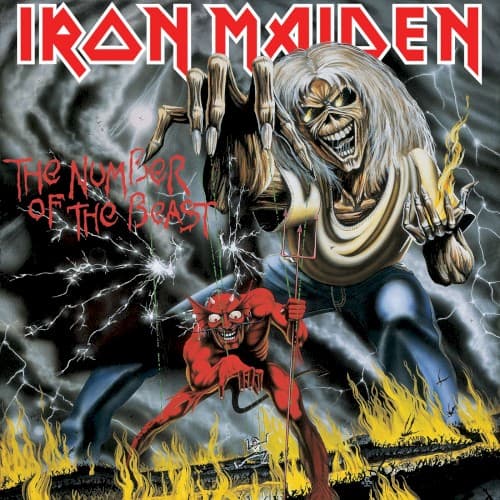
The controversy over the title and cover art—religious groups in the United States organized record burnings and venue protests—was theater based on willful misreading. Harris wrote the title track after watching a horror film and the lyrics describe fear, not worship. The real argument is whether Maiden earned their commercial breakthrough or simply timed it well, and the songs provide the answer.
How Dickinson and Birch Opened the Sound
The upgrade from Paul Di'Anno to Bruce Dickinson was not a matter of technical skill but of range and dramatics. Di'Anno was a capable punk-inflected shouter; Dickinson could sustain a melody over six minutes and shift tone mid-song to match lyrical shifts, which is what "Children of the Damned" and "Hallowed Be Thy Name" require. Producer Martin Birch remarked that Di'Anno was not capable of handling the directions Harris wanted to explore, and the evidence is audible: the quiet-loud dynamics of "Children of the Damned", the desperate narrative arc of "Hallowed", the sneering taunt in "The Number of the Beast" all depend on a vocalist who can act with his voice. Dickinson delivered that, though contractual issues with his previous band Samson prevented him from receiving writing credits despite what Harris and Dickinson have described as significant contributions to "Children of the Damned", "The Prisoner" and "Run to the Hills".
The twin-guitar interplay between Dave Murray and Adrian Smith is the album's instrumental anchor. Murray had been with Maiden since the beginning; Smith was the new hire, and his arrival brought a second songwriter and a more melodic sensibility. The harmonized leads in "Hallowed Be Thy Name" and "The Prisoner" sound composed rather than improvised, with distinct phrases that answer each other instead of trading bars in the expected call-and-response.
The riffs themselves are built for movement: the chugging triplets in "Run to the Hills", the descending figure in "22 Acacia Avenue", the staccato attack in "The Number of the Beast" all drive the songs forward instead of sitting in one groove. Birch's production gives the guitars separation and bite without losing the weight of the rhythm section, and the mix keeps Dickinson's voice front without burying the instruments.
The drum sound has body—compare the tom rolls in "Hallowed" to the thin clatter that plagued much of NWOBHM—and Harris's bass is audible throughout, which matters because the galloping sixteenth-note runs are as much a part of the band's signature as the dual leads. Clive Burr, in his final album with the band, plays with precision and variety; the fills in "Children of the Damned" and the shifts in "Hallowed" show a drummer thinking in song terms, not just keeping time.
The recording was completed in five weeks, a rush that Harris has blamed for the inclusion of weaker material. "Invaders", the opener, was not good enough and Harris knew it at the time but had nothing to replace it with. "Gangland" made the album only because the band chose it over "Total Eclipse" as the non-album side of the "Run to the Hills" single, a decision Harris has since called a mistake. Both tracks are competent but formulaic, lacking the melodic ideas and structural ambition that distinguish the rest of the record.
The rushed schedule is less obvious elsewhere, though "22 Acacia Avenue" feels like it could have used another pass to tighten the transitions between sections.
Where the Album Peaks and Where It Sags
The sequencing is a problem. The opening track is the weakest, a mid-tempo rocker with a forgettable riff and a chorus that does nothing. The energy picks up immediately with the second song, which uses quiet verses and a soaring chorus to build tension, but the first impression is wasted. The first stretch otherwise flows well through an up-tempo narrative with dialogue samples and a multi-part epic that closes the side.
The back half front-loads the two singles—both shorter and more immediate than the album tracks—and then stumbles with a by-numbers thrasher with no hook and no reason to exist. The decision to put filler in the seven-slot instead of burying it earlier in the sequence is baffling, and it kills the momentum heading into the closer, which then has to re-earn the listener's attention. That it succeeds is a proof of the song's quality, but the album would have been stronger if a different track or even a well-placed instrumental had taken that place.
The album is thirty-nine minutes long, which is exactly right for the amount of strong material Maiden had written. The filler is not padding for length but the result of poor choices. When the album works—the second and third tracks, the two singles back to back—the flow is natural and the pacing holds. When it does not, the flaws are obvious and avoidable.
The Album That Defined Maiden and the Blueprint They Built On
The Number of the Beast is the third-best album in Iron Maiden's catalog, behind Powerslave and Seventh Son of a Stranger, and the most important because it established the template the band would refine for the next decade: narrative epics built on dual-guitar melodies, theatrical vocals and prog-length structures without prog's self-indulgence. It is not a flawless record—"Invaders" and "Gangland" are dead weight Harris has admitted do not belong—but the five great songs are among the best the band ever wrote, and "Hallowed Be Thy Name" is the single track that best represents what Maiden does. The album aged well because the songs were built on melody and structure rather than energy and novelty, and because Dickinson's voice and the guitar interplay were strong enough to survive decades of imitators. This is the album for listeners who want to understand why Maiden matters, though Powerslave is the one to hear once this makes the case. Start with "Hallowed Be Thy Name" and "Children of the Damned", skip "Invaders" and "Gangland" unless completionism compels you, and then move to Powerslave to hear the same ambition with better quality control. The Number of the Beast is essential not because every track is great but because half the album defined what heavy metal could be, and the other half proves that even a landmark record is still a product of deadlines and compromises.
Track by track
Track Listing
Invaders
WeakA mid-tempo rocker with a forgettable riff and a chorus that goes nowhere. Harris has since admitted it was not good enough and that he knew it at the time but had nothing to replace it with. The verse riff is competent but the song never develops, and the solo section feels like an obligation rather than a payoff. Opening the album with the weakest track is a sequencing mistake that costs the record momentum it has to spend two songs recovering.
Children of the Damned
StandoutThe first great song on the album and the one that showcases what Dickinson brought to the band: the ability to sing quiet verses with control and then soar over the heavy chorus without shouting. The dynamics are deliberate, the riff in the heavy section is one of Murray and Smith's best harmonized figures, and the lyrics—based on the film of the same name—treat the story seriously instead of as an excuse for atmosphere. The song is built in distinct sections that develop instead of repeating, and the transition from the quiet intro to the full-band attack is earned. Harris, Murray and Dickinson are credited as writers, though Dickinson could not be listed due to contractual issues with Samson. This is the blueprint for what Maiden would do better on later albums, but it works completely here.
The Prisoner
StandoutAn up-tempo narrative with dialogue samples from the Patrick McGoohan TV series, and one of the album's most energetic tracks. The main riff is a galloping figure that drives the verses, and the chorus is immediate and singable. The song does not attempt the multi-part structure of "Hallowed" or "Children of the Damned", but it does not need to—this is Maiden writing a five-minute rocker that stays focused and never loses momentum. The solo section is one of the album's best, with Murray and Smith trading phrases that feel composed rather than jammed. Smith and Harris are credited as writers.
22 Acacia Avenue
StandoutA six-minute multi-part epic about a prostitute named Charlotte, continuing a character Harris introduced on the debut album. The song shifts between a heavy mid-tempo verse, a faster pre-chorus and a melodic chorus, and the transitions are mostly smooth though one or two feel rushed, likely a result of the five-week recording schedule. Smith wrote the song years earlier for his previous band Urchin, and Harris modified it for this album. The lyrics are more narrative than most Maiden songs, with specific details about the character and her circumstances, and Dickinson sells the story with phrasing that shifts tone to match the sections. The solo section is extended and features some of the album's most melodic lead work. A strong track that could have been great with another pass at the arrangement.
The Number of the Beast
StandoutThe title track and second single, written by Harris after a nightmare triggered by watching Damien: Omen II. The song opens with a spoken passage from the Book of Revelation, read by actor Barry Clayton after the band decided Vincent Price's fee was too high. The main riff is a descending figure that sounds ominous without being heavy, and the chorus is one of the album's most immediate hooks. Dickinson's vocal on the verses is a sneer, and the way he delivers the title line in the chorus sold the theatrical menace the religious protestors mistook for genuine Satanism. The song is four and a half minutes, shorter than the epics but more focused, and the solo section is concise. This is Maiden writing a single that works on the radio and on the album without compromising either.
Run to the Hills
StandoutThe first single and the band's first top-ten UK hit, written by Harris with significant input from Dickinson. The lyrics describe a colonial massacre from both the Native American and settler perspectives, and the verse riff is one of the album's most distinctive: a chugging triplet figure that gallops without feeling repetitive. The chorus is huge and singable, and the song is three minutes fifty seconds, which is as concise as Maiden gets. The solo section is short and melodic, and the song never wastes a bar. This is the track that made Maiden a commercial band without softening the sound, and it remains a setlist staple four decades later because the riff and chorus are built to last.
Gangland
WeakFiller. Harris has since stated that this song should not have been on the album and that "Total Eclipse" should have taken its place. The riff is generic, the chorus is forgettable, and the song does nothing that a dozen other NWOBHM bands were not already doing. The solo section is competent but the song gives the guitarists nothing to work with. Putting this in the seven-slot instead of burying it earlier in the sequence is a sequencing mistake that kills momentum heading into the closer.
Hallowed Be Thy Name
StandoutThe album's longest track and its best, a seven-minute epic about a prisoner facing execution. The song is built in distinct sections: a quiet intro with Harris's bass leading, a mid-tempo verse with Dickinson narrating the prisoner's thoughts, a faster pre-chorus, a soaring chorus, and an extended instrumental section with some of the album's most melodic guitar work. The lyrics are Harris at his most literary, with philosophical reflections on death and fate, and Dickinson delivers them with the phrasing of an actor, shifting tone to match the prisoner's emotional arc. The song has remained in nearly every Maiden setlist since 1982 because it is the single track that best represents what the band does: narrative ambition, melodic guitar work, dramatic vocals and prog-length structure without prog's self-indulgence. This is the track that made progressive metal possible, and it is the reason the album matters.