The scorecard
9.0/10 · Essential
- Songwriting25%
- 9.5
- Sound25%
- 9.0
- Performance15%
- 9.0
- Cohesion15%
- 8.5
- Originality10%
- 8.0
- Replay value10%
- 9.5
Eight songs built on riffs that loop, develop and resolve instead of just hammering the downbeat: Battery's minor-dyad gallop, Master of Puppets' shifting time-signature maze, Sanitarium's clean-to-distorted arc.
Flemming Rasmussen and Michael Wagener captured the Mesa/Boogie crunch and the Ludwig snare crack without smoothing out the edges; thick but never muddy, with Burton's bass audible throughout.
Hetfield's vocals deepened from hoarse shouting to controlled aggression, Hammett's solos balance precision and feel, and Burton's harmonic understanding lifts Orion and the Master of Puppets interlude above the riff pile.
Fifty-five minutes with no filler: the acoustic Battery intro sets up the attack, Orion provides the mid-album exhale, Damage Inc. closes with the only fade-out, and the sequencing never sags.
Extended the thrash template with odd meters, classical-guitar intros, instrumental storytelling and a bass showcase, raising the bar for complexity without abandoning speed or heaviness.
Thirty-nine years later the riffs still sound fresh, the solos still surprise, and the long songs still earn their lengths; certified eight-times platinum for sustained listening across decades.
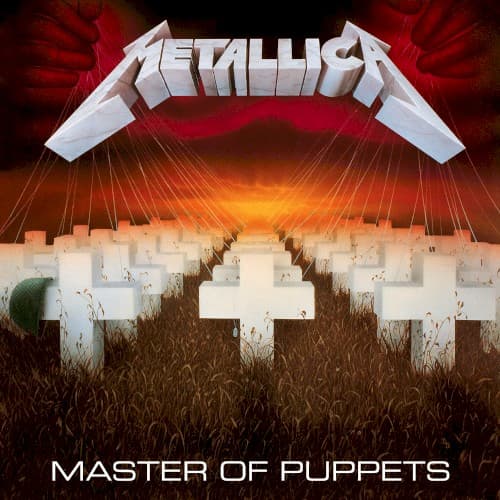
Metallica Master of Puppets — Thrash Metal Learns Architecture
Master of Puppets is thrash metal's argument that complexity and aggression are not opposites. Metallica's third album takes the velocity of Kill 'Em All and the ambition of Ride the Lightning and builds eight songs that sustain ideas across fifty-five minutes without repeating a riff or wasting a bar. The claim here is structural: thrash does not need to choose between speed and development, between heaviness and musicianship, between intensity and patience. Master of Puppets proves the genre can do all of it in one record, and the proof is audible in every transition, every tempo shift, every moment where a song changes direction instead of cycling back to the verse.
Recorded at Sweet Silence Studios in Copenhagen with producer Flemming Rasmussen from September to December 1985, the album was finished by Michael Wagener's mix in January 1986 and released in March with no single, no video, and no radio support. It peaked at number twenty-nine on the Billboard 200, sold five hundred thousand copies in its first year, and has since been certified eight-times platinum. The Library of Congress added it to the National Recording Registry in 2015.
Bassist Cliff Burton died in a tour-bus accident in Sweden six months after release, making this his final album. His harmonic sense and classical training shaped the arrangements throughout, most audibly on the instrumental Orion and the arpeggiated middle section of the title track. The question is whether the architecture holds: whether songs this long and this layered earn their complexity or collapse under it. The answer is in the riffs, the sequencing, and the fact that thirty-nine years later the album still sounds like a band at full strength.
How Eight Songs Avoid the Riff Pile
The songwriting on Master of Puppets follows a pattern: take a thrash riff, develop it through meter changes and harmonic shifts, and resolve it instead of looping it until the listener tunes out. Battery opens with a bass-heavy classical guitar fade-in that builds through multitracked layers, then breaks into downpicked minor dyads at breakneck tempo. The structure is simple but the execution is not: the riff uses off-beat accents where power chords would sit comfortably, creating tension that never fully releases.
Master of Puppets runs eight and a half minutes on odd-meter riffing and a clean arpeggiated interlude that quotes David Bowie's Andy Warhol at 6:19, a homage from Burton and Hammett. The song cuts bars short in the verses—each fourth bar drops more than a beat—so the rhythm never settles. Disposable Heroes and Damage Inc. push past eight minutes and five minutes respectively, both sustaining 220-beat-per-minute sections without turning into endurance tests.
The Thing That Should Not Be slows to Black Sabbath tempos with down-tuned guitars that drag like the Lovecraft beast the lyrics describe. Welcome Home (Sanitarium) alternates clean arpeggios in 4/4 and 6/4 with distorted choruses, following the power-ballad structure Metallica established with Fade to Black but with tighter verse-chorus contrast.
The arrangements benefit from Burton's classical training and his understanding of harmony. Orion is an eight-minute instrumental built on fade-in bass, mid-tempo riffing, a half-tempo bass solo, and multipart guitar harmonies in the middle section that Burton arranged. The bass line is heavily processed to resemble an orchestra, and the transitions between sections are smooth enough that the shifts in tempo feel inevitable rather than jarring. Leper Messiah moves from 136-beat-per-minute syncopated verses to a galloping 184-beat-per-minute middle section, with a descending chromatic chorus riff and a distorted scream of "Lie!" that lands harder because the song earns the buildup. The riffs are technical but never decorative: every meter change and tempo shift serves the song's momentum.
Rasmussen's production captures the Mesa/Boogie crunch and the Ludwig snare without smoothing out the aggression. Hetfield's Jackson King V ran through a modified Mesa/Boogie Mark IIC+ as a pre-amp, and the guitar tone is thick enough to carry the palm-muted riffing without losing definition. Burton's Aria Pro II SB1000 bass is audible in the mix throughout, not just on Orion but in the verses of Master of Puppets and the opening of Damage Inc., which starts with reversed bass chords based on Bach's Come, Sweet Death. Ulrich borrowed Rick Allen's rare Ludwig Black Beauty snare for the sessions, and the drum sound is sharp and present without overwhelming the guitars. Wagener's mix balances the layers: the multitracked acoustic guitars on Battery, the harmonized solos on Orion, the dual-guitar attack on Disposable Heroes. The production is heavy but not slick, aggressive but not thin.
Hetfield's vocals matured from the hoarse shouting of the first two albums to a deeper, controlled aggression. The delivery on Leper Messiah and Disposable Heroes is forceful without straining, and the phrasing follows the riff patterns closely enough that the voice functions as another rhythm instrument. Hammett's solos balance precision and feel: the melodic solo on Master of Puppets, the war-film imitation at the end of each Disposable Heroes verse, the virtuosic run before the final verse of the title track. Burton's bass playing is the album's secret weapon, audible in the arrangements and in the harmonic choices that separate these songs from straightforward thrash.
The weakness is that the album's ambition occasionally leads to overextension. The interlude in Master of Puppets is strong, but the song could trim thirty seconds from the outro fade and lose nothing. Damage Inc.'s intro, while clever, takes longer to arrive at the main riff than the payoff justifies. The sequencing compensates for these minor sags, but a tighter edit would have made the album flawless instead of merely essential.
Fifty-Five Minutes Without a Sag
The sequencing on Master of Puppets is deliberate: the album peaks early, exhales in the middle, and closes with the heaviest track. The first stretch sets the tone with an acoustic intro and immediate shift to speed, establishing that the album will not follow thrash conventions. The centerpiece follows as the longest and most ambitious song placed second instead of buried mid-album.
The third track slows the tempo before the fourth offers the first clean-verse structure, and the two together provide the album's only extended break from relentless riffing. The fifth track is the album's most intense song, placed to reset the aggression before the middle section brings the pace down again. The instrumental functions as the album's intermission: a piece that gives the listener room to breathe before the closing track ends with the only fade-out on the record.
The pacing works because the long songs earn their length and the short songs stay focused. The first stretch clocks in at five minutes, the sixth track under six, and both feel complete. Two tracks run over eight minutes, and both justify the runtime with riff development and structural variation. The album's total length is fifty-five minutes, under an hour, and the absence of filler makes the runtime feel earned. The sequencing never drags: even the slower tracks serve the album's flow by providing contrast before the next wave of speed.
The weakness in the sequencing is minor: placing the centerpiece second risks front-loading the album, and some listeners may find the middle stretch less immediate than the opening and closing pairs. The solution is the instrumental, which resets the energy before the final sprint. The album's arc is clear: establish dominance, prove ambition, exhale, close heavy. It works.
Where It Ranks and Who It Is For
Master of Puppets is the best thrash metal album of the 1980s and the genre's clearest argument that complexity and aggression can coexist. It ranks above Ride the Lightning for tighter songwriting and above later Metallica albums for focus and intensity. The album works because every long song justifies its length, every riff serves the structure, and the production captures the heaviness without burying the detail. Rasmussen and Wagener's work on the guitar tone and the drum sound remains a benchmark for metal production, and Burton's bass playing and harmonic contributions make the arrangements richer than most thrash records attempt.
The album is for listeners who want thrash metal that builds ideas instead of repeating them, and for fans of technical playing that never loses the momentum. It is not for listeners who prefer shorter, simpler songs or who find Hetfield's vocal delivery too aggressive. The album's length and complexity require attention: this is not background music, and the rewards come from following the riff progressions and tempo shifts across full songs. Start with Battery for the acoustic-to-electric shift, Master of Puppets for the odd-meter riffing and the Bowie homage, and Orion for Burton's bass display. Skip The Thing That Should Not Be if slower tempos feel like a detour, though the Sabbath influence and the Lovecraft theme make it worth hearing once.
The album has aged well because the songwriting holds up and the production choices—no synthesizers, no slick sheen—sound timeless rather than dated. The influence is audible in every thrash album that followed: the extended song structures, the instrumental ambition, the balance of speed and melody. Metallica would make longer albums (Justice) and more commercially successful albums (Black Album), but none more focused or more complete than this. After Master of Puppets, hear Ride the Lightning for the blueprint and Slayer's Reign in Blood for the opposite approach—shorter songs, faster tempos, less development. For similar ambition within thrash, try Megadeth's Rust in Peace. Master of Puppets remains the standard: fifty-five minutes of riffs that develop, solos that serve the songs, and not a wasted bar.
Track by track
Track Listing
Battery
StandoutThe classical guitar intro builds tension through multitracked layers before the distorted riff hits, and the shift from acoustic to electric establishes the album's pattern of structural ambition. The main riff uses off-beat minor dyads instead of power chords, creating rhythmic tension that drives the song forward. Hetfield improvised the riff while relaxing in London, and the execution is tight enough that the speed never feels rushed. The song is five minutes of relentless forward motion with no wasted sections, and the absence of a solo keeps the focus on the riff. Battery sets the tone for the album: aggressive, technical, and never predictable.
Master of Puppets
StandoutEight and a half minutes of odd-meter riffing, time-signature shifts, and a clean arpeggiated interlude that quotes David Bowie's Andy Warhol at 6:19. The verse riff cuts the fourth bar short by more than a beat, creating a stumble that keeps the rhythm from settling into a groove. The interlude features Hetfield's melodic solo over clean arpeggios, then shifts to Hammett's virtuosic run before returning to the main verse. The structure mirrors The Four Horsemen from Kill 'Em All: two verse-chorus sets surrounding a lengthy middle section. The song's length is earned by the riff development and the harmonic shifts, and Burton's influence is audible in the interlude's multipart guitar harmonies. The fade-out of sinister laughter closes the track. The lyrical theme is cocaine addiction, and the title summarizes the album's concept of control and manipulation. The song was issued as a single in France and later featured in the Stranger Things fourth-season finale, which drove it back onto streaming charts in 2022. The composition remains the album's centerpiece and thrash metal's most ambitious song structure.
The Thing That Should Not Be
SolidThe slowest and heaviest track on the album, inspired by H.P. Lovecraft's Cthulhu Mythos with direct references to The Shadow over Innsmouth. The down-tuned guitars and Black Sabbath-influenced riffing create a moody, dragging ambience that emulates a beast pulling itself into the sea. The tempo shift provides necessary contrast after the opening pair of speed-driven tracks, and the Lovecraft theme fits the oppressive guitar tone. The song works as a palette cleanser but is the album's weakest track: the riff is strong but the structure is straightforward, and the slower tempo exposes the lack of melodic development. Essential for the album's pacing, skippable on its own.
Welcome Home (Sanitarium)
StandoutBased on Ken Kesey's One Flew Over the Cuckoo's Nest, the song alternates clean arpeggiated verses in 4/4 and 6/4 with distorted heavy choruses, following the power-ballad structure Metallica established with Fade to Black. The clean single-string intro and harmonics set the tone, and the verse-chorus contrast is tighter than on the earlier ballad. The song builds to an aggressive finale, and the structure works because the clean sections never feel like filler. The pacing is deliberate, and the shift from somber to heavy is gradual enough that the final section lands with full force. The track is one of the album's most accessible songs and one of its strongest, with the clean-to-distorted arc providing a template Metallica would follow on One and The Day That Never Comes.
Disposable Heroes
StandoutAn anti-war song about a young soldier controlled by his superiors, and the album's most intense track. Sections run at 220 beats per minute, and the guitar passage at the end of each verse imitates war-film music, according to Hammett. The song is eight minutes of relentless aggression with no clean interludes or tempo breaks, and the length is earned by the riff variations and the vocal phrasing that follows the rhythm closely. The structure is simpler than Master of Puppets or Sanitarium, but the intensity is higher and the execution is tight. Bassist Robert Trujillo later cited this as his favorite Metallica song for the riffs and the segues. The track is essential listening for fans of speed and precision, and it ranks among the album's three or four strongest songs.
Leper Messiah
SolidA takedown of 1980s televangelism, with syncopated mid-tempo riffing at 136 beats per minute in the verses and a galloping 184 beats per minute in the middle section. The descending chromatic chorus riff and the distorted scream of "Lie!" are the song's highlights. The title derives from David Bowie's Ziggy Stardust, continuing the album's Bowie references. The song is solid but not essential: the riff is strong and the tempo shifts work, but the structure is predictable and the middle section feels tacked on rather than integrated. Dave Mustaine claimed he co-wrote the song based on an old track called The Hills Ran Red; the band denied this but acknowledged that one section incorporated Mustaine's ideas. The track works in the album's sequence but is one of the weaker standalone songs.
Orion
StandoutAn eight-minute instrumental showcasing Cliff Burton's bass playing and classical training. The song opens with a fade-in bass section heavily processed to resemble an orchestra, then moves through mid-tempo riffing and a bass solo at half-tempo before accelerating in the final section. Burton arranged the moody middle section with its bass line and multipart guitar harmonies, and his harmonic understanding is audible throughout. Hetfield contributes the second guitar solo. The track functions as the album's intermission, providing a break from vocal-driven aggression while maintaining the album's intensity. The transitions between sections are smooth, and the tempo shifts feel natural rather than forced. Orion is the album's most ambitious arrangement and one of its strongest tracks, and it ranks among the best metal instrumentals of the 1980s. The fade-out ending mirrors the fade-in intro.
Damage, Inc.
SolidA rant about senseless violence, opening with reversed bass chords based on Bach's Come, Sweet Death before jumping into a rapid E-pedal-point riff influenced by Deep Purple, according to Hammett. The song is five and a half minutes of aggression with the album's only fade-out, and the structure is straightforward: intro, verse, chorus, solo, outro. The Bach intro is clever but takes longer to arrive at the main riff than the payoff justifies, and the song is the album's weakest closer compared to the ambition of the tracks before it. The riff is strong and the execution is tight, but the song feels like an afterthought compared to Orion and the three opening tracks. Still solid, but not essential.