The scorecard
6.5/10 · Good
- Songwriting25%
- 7.0
- Sound25%
- 5.5
- Performance15%
- 7.5
- Cohesion15%
- 4.5
- Originality10%
- 9.0
- Replay value10%
- 6.5
Riffs are blunt and functional rather than memorable, but the anarcho-punk lyrical focus and willingness to write thirty-second songs show real conviction.
The overnight Rich Bitch sessions yield a mix where drum sound varies wildly between sides and everything bleeds red, though Mike Ivory somehow keeps instruments audible through the chaos.
Mick Harris drums faster than anyone had in 1987 and the two-vocalist approach gives the record contrasting textures, from Bullen's bark to Dorrian's deeper growl.
Two lineups a year apart with no shared aesthetic vision produce an A-side rooted in anarcho-punk and a B-side leaning metal, held together only by Harris and the commitment to speed.
Nothing in metal or hardcore had combined blast beats, one-second songs, death growls and political rage at this velocity in 1987; the template for grindcore arrives fully formed.
The sheer aggression holds attention and the brevity invites flipping it again, but the murky production and sameness within each side limit long-term discovery.
Napalm Death Scum — The One-Second Song That Broke the Speed Limit
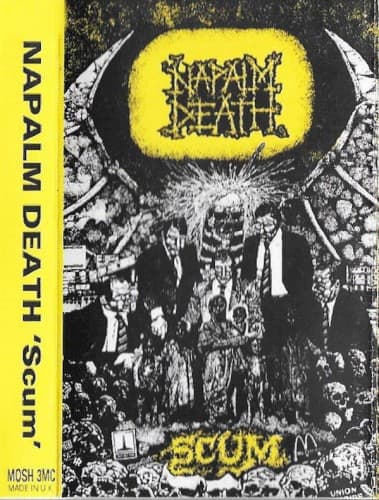
Grindcore did not evolve toward Scum. It detonated into existence with it. The claim that extreme music could go faster, heavier and briefer than hardcore punk had allowed was settled in July 1987 when Earache Records released this twenty-eight-track, thirty-three-minute document of two different Napalm Death lineups recorded a year apart in the same Birmingham studio. The album that defined a genre is also a structural mess: an A-side of anarcho-punk played at impossible tempos and a B-side where down-tuned guitars and death growls anticipate the metal half of the grindcore equation, unified only by drummer Mick Harris and a shared refusal to let a song breathe. The thesis is in the running time. When a band writes a one-second track and titles it "You Suffer," the point is not the riff or the lyric but the fact that a song can be a thought, a burst, a shout, and then gone.
Scum is not Napalm Death's best album—decades of refinement and lineup changes would see to that—but it is their most important, and the distance between those two facts defines its value. This is the record that taught extreme metal how to be extreme, that showed Earache Records a genre could be built from overnight studio sessions and a two-thousand-copy pressing, and that reached number four on the UK Indie chart by doing everything louder, faster and more confrontational than the hardcore bands whose stages Napalm Death had shared at The Mermaid in Birmingham. It is also an album that sounds exactly like what it is: two bands with one drummer, recorded on a budget that required booking studio time after midnight to afford the hourly rate, mixed in a final session that ran from four to eight in the morning because the band hated the drum sound. The seams show. The question is whether the invention that pours through them is worth the lack of polish.
Two Bands, One Drum Kit, Zero Patience
The split between the A-side and B-side is audible from the first seconds of each. Side A, tracked in August 1986 by the Bullen-Broadrick-Harris lineup, is anarcho-punk logic taken to a brutal conclusion: downtuned guitars that recall Celtic Frost but played with the velocity Mick Harris had absorbed from American hardcore bands Siege and Deep Wound, and Nicholas Bullen's shouted vocals that treat every syllable as an accusation. The songs from this session were written across different phases of the band's development—some dating to 1983 Broadrick ideas, others pulled from the Hatred Surge demo—and the recording itself had twenty friends in the studio, a borrowed effects pedal from Sacrilege's Damian Thompson, and a band that had been playing Birmingham's punk circuit as a house band for foreign hardcore acts. The result is raw and single-minded: riffs are power-chord bursts, song structures are verse-shout-verse or sometimes just shout, and the production captures the room more than the notes.
The longest track on the A-side stretches to nearly four minutes and is the only moment where a song has time to develop; the rest are salvos.
Side B, recorded in May 1987 by the Dorrian-Steer-Whiteley-Harris lineup, is where the metal half of grindcore announces itself. Bill Steer's guitar tone is lower and thicker, Lee Dorrian's vocals are growled rather than shouted, and the sixteen songs Harris had written with Steer in Liverpool—composed on a detuned guitar despite Harris not being able to play the instrument—lean into riff repetition and rhythmic churn rather than punk's forward-motion attack. The band had one three-hour rehearsal before entering Rich Bitch Studio, and Dorrian was in a recording studio for the first time; Harris had to signal him when to start singing. Mike Ivory's engineering keeps the instruments separated despite the chaos, but the production is deliberately in the red and the drum sound—which the band disliked enough to require a final overnight mixing session—is thin and clattering compared to the low-end thud modern extreme metal would later demand.
The riffs are simpler and more repetitive than the A-side, and the songs feel less like ideas than like exercises in seeing how much punishment can fit into forty seconds. That is not a weakness when the goal is to redefine what fast means, but it does mean that individual tracks blur together. By the time the album closes, the B-side has made its point six times over.
The through-line is Harris, whose drumming rewrote the genre's possibilities. Blast beats existed before Scum, but Harris played them faster, more relentlessly and with more confidence that speed itself was a statement. The fact that he could do this on both a punk-rooted A-side and a metal-leaning B-side, and that both sessions sound like the same drummer pushing two different bands past their limits, is the album's unifying achievement. Broadrick, Bullen, Steer and Dorrian would all go on to other significant projects, but Harris is the reason this record could exist in 1987 rather than 1990.
The weakness is that the songwriting serves the speed rather than the other way around. Riffs are functional, song structures are minimal, and dynamics are abandoned in favor of constant attack. That choice is what makes the album historically crucial, but it is also why later Napalm Death records are better albums.
Thirty-Three Minutes, Twenty-Eight Statements, One Gimmick That Worked
Scum does not have an arc because it has two separate arcs happening on two separate sides, and neither side is interested in pacing. The A-side front-loads its longest and most developed songs, then accelerates into shorter and shorter bursts until reaching its one-second punchline and closing moment. The sequencing works because the side is only sixteen minutes long and the escalation from two-minute songs to sub-minute blasts feels like a controlled detonation. The B-side reverses the approach: it opens with five tracks in under three minutes, establishes that this lineup lives in the sub-minute range, and then scatters a few longer pieces to break the monotony.
The result is a side that feels more uniform in its aggression but also more samey, with less sense of progression and more reliance on the listener's tolerance for unvarying blast.
The album's length is earned only because grindcore had not been codified yet; Scum is inventing the form as it goes, and the sheer number of ideas—even when those ideas are just variations on "play it faster"—justifies the track count. A tighter album would have cut five or six of the B-side's interchangeable sub-minute tracks, but that would also have undermined the point, which is that a record can be this brutal for this long and still demand to be heard. The real sequencing failure is the split itself: releasing this as two EPs from two lineups would have been more honest, but Earache needed a full-length to justify the pressing cost and distribution deal with Revolver Records. The compromise works because Harris is the bridge, but it asks the listener to accept two different records as one.
The Blueprint, Not the Masterpiece
Scum is the most important album Napalm Death ever made and somewhere between their fifth and eighth best, depending on how much credit you give to From Enslavement to Obliteration and Harmony Corruption. It defined grindcore the way Black Sabbath defined doom: by getting there first with enough conviction and volume that everyone who followed had to reckon with it. The split-lineup structure is a liability that becomes an asset in retrospect—hearing two bands solve the same problem with different tools makes the argument for grindcore's flexibility—but in the moment it just sounds like an album that cannot decide what it wants to be. The production is rough enough that modern listeners raised on Cephalic Carnage or Nile will find it tame, and the riffs are too blunt to reward the kind of close listening that later extreme metal would demand. What holds up is the sheer hunger. Every song on Scum sounds like a band that believes this is the only chance they will get to be heard, and that urgency translates across the murky mix and the lack of sonic consistency.
This is essential for anyone interested in grindcore or extreme metal history, and it is a good album for listeners who want their punk faster and their metal meaner, but it is not the place to start with Napalm Death unless you are willing to hear them as a work in progress. Begin with "Multinational Corporations," "Instinct of Survival" and "You Suffer" from the A-side to understand what anarcho-punk became when it stopped caring about melody, then jump to "Life?" and "M.A.D." from the B-side to hear the death-metal influence take hold. If those five tracks land, the rest of the album will justify the time. If they do not, try From Enslavement to Obliteration or Harmony Corruption instead; both are more cohesive and better-produced examples of what Napalm Death could do once they figured out who they were. Fans of early Carcass, Repulsion and Terrorizer will find this indispensable. Everyone else should approach it as a history lesson that happens to rip.
Track by track
Track Listing
Multinational Corporations
StandoutOpens the album with the thesis in miniature: a mid-tempo riff that sounds like Celtic Frost played by a hardcore band, Bullen's shouted condemnation of corporate exploitation, and Harris accelerating into the blast that will define the record. At just over a minute it is economical rather than rushed, and the lyrical target—corporations profiting from third-world suffering—sets the political tone for the A-side. A strong opener that establishes the template without overcommitting to it.
Instinct of Survival
StandoutThe longest and most developed song on the A-side, with actual riff variation and a mid-section that lets the band shift gears before returning to the blast. Broadrick's guitar tone is thin but cutting, and Bullen's vocal delivery has enough clarity that the anarcho-punk roots are audible beneath the speed. This is as close as the A-side gets to traditional song structure, and it works because the band uses the time to build tension rather than just repeat the opening riff. A key track for understanding what the Bullen-Broadrick lineup could do when they gave a song room to develop.
The Kill
SolidTwenty-three seconds of pure acceleration, recorded faster than the Hatred Surge demo version according to the fact sheet. No riff to speak of, just a burst of noise and shouting that exists to prove the band can condense a song into the time it takes to read this sentence. It works as a palate cleanser between longer tracks but offers nothing on its own.
Scum
StandoutThe title track and the A-side's second-longest song, with a grinding mid-tempo riff that recalls the band's metal influences more than their punk ones. Bullen's vocals are more decipherable here, the lyrics targeting societal decay, and the song structure allows for a verse-chorus-verse approach that gives the track more replay value than most of the side. The production is murky enough that the riff's details are lost, but the intent is clear. A solid example of the A-side's heavier moments, though it drags slightly in the final thirty seconds.
Caught… in a Dream
SolidReturns to the blast-driven template with a riff that is more rhythmic chug than melodic idea, and Bullen's vocals are buried enough in the mix that the lyrics are largely unintelligible. At under two minutes it does not overstay its welcome, but it also does not offer much beyond the formula established by the first three tracks. Functional filler that keeps the momentum going without adding new ideas.
Polluted Minds
SolidNotable for Broadrick taking over vocals, his voice slightly higher and more frantic than Bullen's. The riff is a two-chord stomp and the song is over before it develops, but the vocal switch provides enough variety to keep the A-side from calcifying into sameness. A minor moment that earns its place by showing the lineup's flexibility.
Sacrificed
WeakAnother sub-minute blast with a riff that is indistinguishable from the previous three tracks and vocals that are shouted syllables rather than sung lines. The production is at its muddiest here, with the guitar and bass blending into a single low-end roar and only Harris's snare cuts providing definition. Filler, though the brevity keeps it from being a drag.
Siege of Power
SolidThe A-side's longest track at nearly four minutes, and the only moment where the Bullen-Broadrick lineup attempts to sustain an idea across multiple movements. The song opens with a slow, doomy riff that could be a Celtic Frost homage, builds into a mid-tempo chug, and then explodes into the expected blast section before collapsing back into the opening riff. The structure is ambitious for a band whose other songs average ninety seconds, and the execution is rough—the transitions are abrupt and the riff repetition grows tedious by the third minute—but the intent to write an actual composition rather than a blast-beat exercise is audible and worth credit. The weakest of the A-side's longer tracks because it overreaches, but also the most interesting because it tries.
Control
SolidA minute-long rager that returns to the A-side's core formula with a vengeance, Bullen shouting about authority and oppression over a riff that is more texture than melody. The lyrics are the point here—anarcho-punk sloganeering delivered with enough conviction to sell it—but the music is just a vehicle. Solid within its limitations.
Born on Your Knees
StandoutMid-tempo stomp with a riff that has more space than most of the A-side, allowing Bullen's vocals to land with more weight. The song is still under two minutes and still built on repetition, but the slower tempo makes the riff audible and gives the track a sense of deliberate menace rather than just speed-for-speed's-sake. One of the A-side's better examples of the band using dynamics, even in a limited range.
Human Garbage
StandoutCloses the A-side with a minute and a half of grinding riffage and Bullen's most venomous vocal performance on the record, spitting out the title phrase with genuine contempt. The riff is a single chord progression repeated until the song ends, and the production is dense enough that the bass is inaudible, but the raw hostility makes it work. A strong closer for the A-side, summarizing its strengths and weaknesses in ninety seconds.
You Suffer
StandoutOne second. A blast, a scream, silence. The gimmick that made Napalm Death famous, and the proof that grindcore could strip a song down to pure concept. It is not a great song because it is not really a song, but it is a perfect statement of intent and a landmark moment in extreme music history. Essential for what it represents, irrelevant as a listening experience.
Life?
SolidOpens the B-side with the new lineup's approach fully formed: Dorrian's deeper growl, Steer's lower guitar tuning, and a forty-three-second burst that sounds more like death metal than punk. The riff is a single chugging pattern, the vocals are unintelligible, and the song exists only to establish the B-side's template. It works as an opener because it announces the shift immediately, but it offers nothing on repeat listens.
Prison Without Walls
WeakThirty-eight seconds of the same blasted riff and growled vocals, with no variation or development. The title suggests a lyrical theme about societal control, but Dorrian's delivery makes the words impossible to parse. Pure filler, saved only by the fact that it is over before it can become annoying.
Point of No Return
SolidAnother sub-minute track with a slightly more defined riff that hints at a groove before the blast takes over. The production is marginally clearer here, and Steer's guitar work has enough low-end presence to give the track some heft. Still interchangeable with most of the B-side's short tracks, but functional within the template.
Negative Approach
WeakThirty-two seconds of the same riff-and-blast formula, with Dorrian's vocals more buried in the mix than on the previous tracks. The song's only notable feature is its title, which may be a nod to the American hardcore band or just a lyrical concept about pessimism. Either way, the music does not support close analysis. Filler.
Success?
StandoutBreaks the B-side's sub-minute streak with a song that stretches past a minute and uses the time to develop a riff that actually shifts between sections. Dorrian's vocals are more varied here, moving between a mid-range shout and a lower growl, and Harris's drumming includes a brief slower passage before returning to the blast. The question mark in the title suggests a critique of ambition or achievement, and the song's structure—such as it is—supports that ambiguity by refusing to resolve. One of the B-side's better tracks because it attempts something beyond pure speed.
Deceiver
WeakTwenty-nine seconds of blasted riffing with no distinguishing features. The title is the only memorable element. Filler.
C.S.
StandoutThe longest B-side track outside of the final three, with a riff that alternates between a grinding chug and a faster tremolo section. Dorrian's vocals are more decipherable here, though still largely unintelligible, and the song's structure includes an actual breakdown in the middle that provides a moment of dynamics before the blast resumes. The title likely stands for a lyrical or political acronym, but without access to the lyric sheet the meaning is lost. A solid track that uses its runtime better than most of the B-side's sub-minute efforts.
Parasites
WeakTwenty-three seconds. A riff, a blast, Dorrian shouting the title. Nothing else. The B-side's answer to "The Kill," but without even the historical significance of being a speed milestone. Pointless.
Pseudo Youth
WeakForty-two seconds of the same template, distinguished only by a slightly more memorable riff that hints at a melody before dissolving into the blast. The production is at its thinnest here, with the guitar sounding like it is being recorded through a telephone. Filler that blurs into the surrounding tracks.
Divine Death
StandoutBreaks the minute mark and uses the time to build a riff that has actual momentum, starting with a slow chug and accelerating into a blast that feels earned rather than automatic. Dorrian's vocals are more forceful here, and the song's pacing suggests the band is learning how to use dynamics even in a grindcore context. One of the B-side's stronger tracks, showing what the Dorrian-Steer lineup could do when they gave a song room to develop.
As the Machine Rolls On
WeakForty-two seconds of political commentary delivered as a blast-beat assault. The title is more memorable than the music, which is indistinguishable from the B-side's other short tracks. The riff is a single-chord chug, the vocals are buried, and the song exists only to fill space. Filler.
Common Enemy
WeakSixteen seconds. The B-side's shortest track and one of the album's most pointless. A riff fragment, a shout, silence. No reason to exist beyond proving the band could write songs this short.
Moral Crusade
StandoutThe B-side's second-longest track, with a riff that shifts between a grinding chug and a faster section and Dorrian's vocals moving between a shout and a growl. The lyrics likely target religious or political hypocrisy, and the song's structure supports that theme by building tension across its ninety-second runtime. Harris's drumming is more varied here, with actual fills and transitions rather than just constant blasting. A strong track that shows the Dorrian-Steer lineup at their most cohesive, and one of the few B-side moments that rewards repeat listens.
Stigmatised
SolidJust over a minute of grinding riffage with a riff that has more definition than most of the B-side's short tracks. Dorrian's vocals are more intelligible here, and the production allows the bass to cut through the mix for the first time in several songs. The song does not develop beyond its opening riff, but the riff itself is strong enough to carry the track. Solid filler that works within the template.
M.A.D.
StandoutThe B-side's longest track at a minute and thirty-four seconds, and the closest thing to a statement piece in the second half of the album. The title likely refers to mutually assured destruction, and the song's structure—a slow, grinding intro that builds into a mid-tempo chug and then explodes into a blast—supports that apocalyptic theme. Dorrian's vocals are at their most forceful, Harris's drumming includes actual dynamics, and Steer's riff has enough variation to justify the length. The final mixing session's attempt to fix the drum sound is most audible here, with the snare cutting through the murk more clearly than elsewhere on the B-side. A key track for understanding what the Dorrian-Steer lineup was capable of when they committed to a song.
Dragnet
SolidCloses the album with a minute of grinding riffage that feels more like a fade-out than a conclusion. The riff is a single-chord chug, the vocals are shouted slogans, and the song ends abruptly without resolution. It works as a closer only because the album has no interest in traditional endings; Scum just stops when it runs out of ideas. Functional but forgettable, and a reminder that the B-side's songwriting was more about quantity than quality.