The scorecard
7.4/10 · Good
- Songwriting25%
- 7.5
- Sound25%
- 8.0
- Performance15%
- 7.0
- Cohesion15%
- 6.5
- Originality10%
- 7.0
- Replay value10%
- 8.0
Riffs repeat as hooks instead of endless churn; 'Hammer Smashed Face' proves death metal can be catchy without softening.
Scott Burns' Morrisound mix lets Webster's bass push through the wall of sound; overdubbing created depth the first two albums lacked.
Barnes belches incomprehensibly but with conviction; Owen's rhythm work is tight enough to make the hooks land.
Nine tracks in thirty-five minutes with minimal filler, though the sequencing offers little arc beyond sustained brutality.
Borrowed technical ambitions from Atheist and Cynic but applied them to shock-value death metal no one else was willing to touch.
The hooks in 'Hammer Smashed Face' and 'I Cum Blood' still work three decades later; the bass tone alone keeps fans returning.
Cannibal Corpse Tomb of the Mutilated — Death Metal Learns the Hook
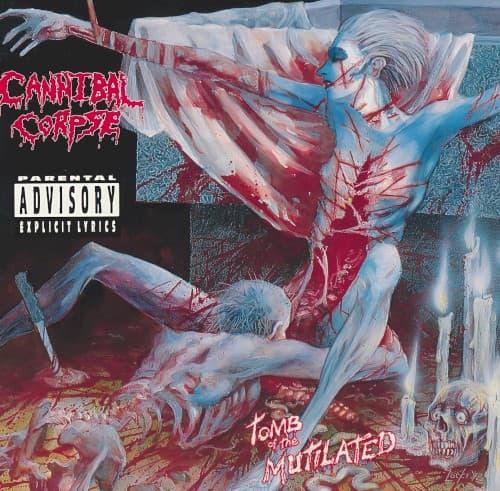
The argument that extreme metal cannot be catchy collapsed in September 1992. Tomb of the Mutilated took the formula Cannibal Corpse had been refining across two albums and made one crucial adjustment: the riffs repeat. Not endlessly, not as verse-chorus pop, but enough that the listener can latch onto something while the drums blast and Chris Barnes belches unintelligible horrors. The opening bassline of Hammer Smashed Face became death metal's first true earworm, a phrase simple enough to remember and heavy enough to satisfy the genre's demands for brutality. That the album arrived with cover art depicting zombie cunnilingus and song titles that made record store clerks visibly uncomfortable only confirmed what the music itself proved: Cannibal Corpse had figured out how to be both extreme and accessible without compromising either quality.
The stakes were modest in 1992. Death metal was still underground, still defining itself against thrash's commercial success. Cannibal Corpse were not trying to break the mainstream or refine the genre into progressive complexity. They wanted to be the most extreme band in a scene built on extremity, and they understood that extremity without songs is just noise.
Tomb of the Mutilated succeeded because it paired the most offensive lyrical content the band would ever write with their most structured songwriting to date. Where Butchered at Birth piled riff after riff with no regard for repetition, Tomb built tracks around motifs that returned and developed. The result was an album that death metal fans could actually remember after it ended, and one that casual listeners stumbled into via a Jim Carrey cameo could not forget. It remains the band's signature work because it mastered the balance between brutality and memorability that most death metal refuses to attempt.
How to Make Death Metal Stick
The shift toward hooks began in the writing process. Alex Webster spent the months after the Butchered at Birth tour practicing bass obsessively, trying to match players he considered better than himself. The discipline showed. Hammer Smashed Face emerged from those practice sessions, and its main riff is both technically demanding and immediately recognizable, a rare combination in early nineties death metal.
The rest of the band followed Webster's lead, composing individually rather than collaboratively and bringing finished ideas to rehearsal. Jack Owen wrote most of I Cum Blood, Addicted to Vaginal Skin, Split Wide Open and Necropedophile. Bob Rusay contributed Post Mortal Ejaculation and Beyond the Cemetery before hitting a creative wall that would cost him his job. The individual writing approach produced tighter songs with clearer identities, even when the identity was sustained blast beat aggression.
Scott Burns recorded the album at Morrisound over two weeks in February 1992, and his production choices elevated the material. The mix emphasizes Webster's bass in a way death metal rarely allowed, letting it punch through the guitar churn with an audible melodic presence. Owen tracked all rhythm guitars at Burns' request, eliminating the inconsistencies that come from two players with different approaches. Rusay handled the solos, though Burns had Owen re-record many of them when the takes did not meet his standard.
The decision to use overdubbing for the first time gave the album a layered depth that the raw live-to-tape sound of the earlier records lacked. The guitars were tracked through a Marshall Valvestate running into a Carbon head, a setup that produced a thick, chugging tone suited to the mid-paced riffs that anchor most of the album. The production is a wall of sound, but one with space for the bass to operate and for individual riffs to stand out rather than blur together.
Barnes' vocal performance is a series of guttural belches, words sliced and incomprehensible. He sounds less like a singer than like a malfunctioning garbage disposal, which serves the music better than clarity would have. The rhythm section drives everything. Paul Mazurkiewicz's drumming locks into the riffs without attempting the technical showmanship that was becoming fashionable in death metal by 1992, and his restraint makes the tempo changes hit harder.
The technical ambitions are present but controlled. Webster cited Atheist and Cynic as influences after touring with them, and the album reflects an interest in complexity without abandoning the straightforward brutality that defined the band. The riffs chug and repeat, the tempo shifts yank the listener between speeds, and the whole structure aims for impact over innovation.
The weakness is the sameness. Nine tracks of blast beats and chugging riffs at comparable tempos begin to blur by the back half. Beyond the Cemetery offers a longer runtime and some variety in pacing, but the album does not develop or shift moods across its thirty-five minutes. It is a single sustained assault, effective in the moment and exhausting over repeated listens in one sitting.
Brutality Without Variation
Tomb of the Mutilated does not sequence for dynamics. It opens with the album's strongest and most famous track, and maintains roughly the same level of intensity for the next eight songs. The decision to lead with the best material works for casual listeners who will hear the opener and move on, but it means the album peaks immediately and coasts. The first stretch follows with similarly structured mid-paced grooves, effective individually but indistinguishable in sequence.
The middle section offers a brief respite with a slower, doomier intro before returning to the same chugging template. The back half benefits from notoriety more than from musical merit, competent but unremarkable material elevated by titles. The closing run features the album's longest runtime and some interesting tempo shifts, but by that point the ear has adjusted to the formula.
The pacing problem is that the album has no pacing. It is nine songs of comparable aggression with minimal variation in texture or mood. The sequencing does not build or release tension because there is no interest in doing so. Cannibal Corpse wanted to be unrelenting, and they succeeded, but unrelenting becomes monotonous.
The album is best consumed in pieces rather than as a complete listen. Pull the three or four strongest tracks for a playlist and the material shines. Play it front to back and the strengths start to feel redundant. At thirty-five minutes the length is reasonable, but the lack of contrast makes it feel longer.
A doom interlude or an acoustic intro or even a purely instrumental bridge would have given the ear something to reset against. Instead it is blast, chug, blast, chug, solo, repeat. Effective in doses, numbing in full.
The Album That Made Death Metal Catchy
Tomb of the Mutilated is the essential Cannibal Corpse album because it does what the band does best without the weak production of the debut or the formless riffing of Butchered at Birth. It refined death metal songwriting by proving that hooks and brutality are not opposites, and it demonstrated Alex Webster's bass playing in a way that influenced a generation of extreme metal bassists. The Scott Burns production remains a reference point for death metal mixing thirty years later, and the album's influence is audible in every brutal death metal band that emerged in its wake. It is also the record where the band's shock tactics reached their peak, with cover art and song titles designed to provoke and lyrics that explore horror and violence in graphic detail. Those elements will repel some listeners and attract others, but they are inseparable from the album's identity.
This is not the album for listeners who want progressive complexity or emotional depth. It is single-minded brutality executed with enough musicianship to be memorable. Fans of later technical death metal will find the songwriting simple, and fans of atmospheric death metal will find it monotonous. It is for listeners who want death metal that sounds like death metal, played with precision and recorded well enough to appreciate the details.
Start with the opening track and the second song. If those tracks do not work, the rest of the album will not change your mind. If they do, the entire record delivers the same satisfying crunch.
The album has aged well in the sense that it still sounds exactly like what it is: early nineties death metal at the peak of the genre's first wave. The production holds up, the bass tone is still a clinic, and the hooks still work. It has aged poorly in the sense that the template it established has been copied and refined by hundreds of bands since, and Cannibal Corpse themselves have made more technically accomplished albums with better sequencing. For listeners new to the band, this remains the best entry point because it captures the core sound without the weaknesses of the earlier albums or the later shift toward technicality. For listeners exploring death metal history, it is required. Hear it next to Morbid Angel's Covenant and Death's Human for the full picture of where the genre stood in 1992.
Track by track
Track Listing
Hammer Smashed Face
StandoutThe signature track and the best argument for death metal as a form of songwriting rather than sustained noise. Webster's bassline opens alone, a descending phrase simple enough to hum and heavy enough to anchor the entire track. When the guitars enter they double the bass rather than obscure it, and the main riff is built around that motif. The verse sections chug at mid-tempo, letting the groove land before the drums blast into the chorus. Barnes' vocals are incomprehensible, but the phrasing matches the riff structure closely enough that the listener can follow the song even without understanding a word. The solo section features a melodic lead that contrasts with the grinding rhythm, and the return to the main riff feels earned rather than obligatory. The track works because it respects repetition as a tool rather than a crutch. The same ideas recur throughout, but they develop and shift context. It is the death metal equivalent of a pop song in its structural clarity, and the fact that it became the band's signature track proves that extreme music can be catchy when the songwriting is deliberate. Still holds up as one of the genre's essential songs.
I Cum Blood
StandoutThe second-best track on the album and the clearest example of Owen's riff-writing at this stage. The opening riff is a chugging palm-muted phrase that repeats with slight variations, creating a hypnotic forward momentum. Mazurkiewicz contributed the intro riff according to the fact sheet, and Owen morphed it into the main theme. The mid-paced tempo allows the groove to breathe, and the bass sits high enough in the mix to add melodic counterpoint. The tempo shifts are abrupt but effective, yanking between blast sections and slower chugs without losing coherence. Barnes' vocal phrasing is rhythmic enough to function as percussion. The track is less structurally ambitious than Hammer Smashed Face, but the core riff is strong enough to carry the song. The title became infamous enough to generate social media reactions decades later, which says more about the shock value than the music, but the music justifies the attention. A solid example of Cannibal Corpse writing songs rather than riff collections.
Addicted to Vaginal Skin
SolidOpens with a sample from serial killer Arthur Shawcross, a taped confession that Barnes included without the band's knowledge because it disturbed him. The sample sets a tone the music does not quite match. The main riff is competent but less memorable than the openers, a mid-paced chug that repeats without much variation. The tempo shifts are predictable, moving from blast to mid-tempo and back without surprise. Webster's bass is audible but does not add much melodically. The solo section is brief and forgettable. The track works as filler in the middle of the album but does not stand alone. It is competent death metal that would be forgotten if the album were sequenced differently.
Split Wide Open
WeakThe shortest track on the album at just over three minutes, and it feels like an idea that was not developed. The main riff is a fast tremolo phrase that repeats without much evolution, and the mid-section slows into a groove that arrives too late to balance the structure. The lyrics describe a couple murdering their children for experiments, placing genitalia in jars, which is extreme even by this album's standards. The music does not match the conceptual ambition. It is a functional death metal track that fills time without offering a reason to return to it. Forgettable.
Necropedophile
SolidA longer track at just over four minutes, and the extended runtime allows for more variation in tempo and texture. The opening riff is a slower, doom-inflected chug that contrasts with the faster tracks that precede it. The verse sections blast at full speed, and the contrast between the slow intro and the fast verses creates a sense of dynamic range the album otherwise lacks. Webster's bass adds a melodic line during the slower sections that gives the track some identity. The solo is one of the album's better leads, with a melodic sensibility that contrasts with the grinding rhythm. The track is not essential but it is stronger than the mid-album filler, and the tempo contrasts make it more engaging than Split Wide Open or Addicted to Vaginal Skin.
The Cryptic Stench
StandoutThe best track outside the opening pair. The intro is a slow, doom-heavy riff that builds tension before the blast sections arrive, and the contrast gives the song a sense of structure that most of the album lacks. The main riff is a chugging mid-tempo phrase that repeats with slight variations, and the tempo shifts feel deliberate rather than arbitrary. Webster's bass is prominent in the mix, adding melodic counterpoint during the slower sections. The solo section features a melodic lead that complements the rhythm rather than fighting it. The track benefits from the tempo contrasts and from the patience to let the slower sections develop before returning to speed. It is the closest the album comes to dynamic sequencing within a single song, and it proves the band could write with nuance when they chose to.
Entrails Ripped From a Virgin’s Cunt
WeakThe most infamous title on the album, based on a story Barnes heard from a prison employee about two inmates who kidnapped, raped and disemboweled a girl with a coat hanger. The music is unremarkable. Owen himself admitted the track is mediocre and that listeners were distracted by the title. The main riff is a standard mid-tempo chug, and the tempo shifts are predictable. The solo is brief and forgettable. The track has no hooks and no structural ideas that distinguish it from the filler tracks earlier in the sequence. It is remembered for shock value, not for musical merit.
Post Mortal Ejaculation
StandoutRusay composed much of this track according to the fact sheet, and it is one of the album's more structurally adventurous songs. Webster described it as far from mainstream arrangement, and the track shifts between tempos and riffs without settling into a clear verse-chorus pattern. The riffs are technically demanding, with fast tremolo runs and abrupt stops that create a disorienting effect. The bass adds melodic lines during the slower sections, and the solo section features one of the album's more expressive leads. The track is less immediately catchy than Hammer Smashed Face or I Cum Blood, but it rewards repeated listens with details that the more straightforward songs do not offer. It is one of the album's more interesting deep cuts.
Beyond the Cemetery
StandoutThe longest track at just under five minutes, and it closes the album with the most variation in pacing and texture. Rusay contributed much of the composition, and the track shifts between slow doom sections and fast blast sections with more patience than most of the album allows. The intro is a slow, atmospheric build that gives the ear a chance to reset after eight tracks of sustained aggression. The main riff is a chugging mid-tempo phrase that develops across the song rather than repeating unchanged. Webster's bass is prominent, adding melodic lines that complement the guitar riffs. The solo section is one of the album's longer and more melodic leads, and the return to the main riff after the solo feels like a resolution rather than a repetition. The track is the best example of the band writing with dynamics and structure, and it is the album's strongest closer. It proves they could write longer, more developed songs when they chose to, which makes the lack of variation across the rest of the album feel like a missed opportunity.