The scorecard
6.6/10 · Good
- Songwriting25%
- 6.0
- Sound25%
- 7.5
- Performance15%
- 7.0
- Cohesion15%
- 5.5
- Originality10%
- 6.0
- Replay value10%
- 7.0
The riffs on "Stupify" and "Down with the Sickness" have stayed in rotation for twenty-five years, but half the album recycles the same chromatic stomp without development.
Johnny K's mix gives the guitars a focused mid-range bite and the drums a percussive punch that separated this from the scooped tones dominating turn-of-the-century metal.
Draiman's rhythmic vocal phrasing and operatic range made the aggression articulate, though the performance settles into a single gear by the album's second half.
The album front-loads its ideas in the first five tracks, then repeats the formula with diminishing returns until the Tears for Fears cover breaks the pattern.
Disturbed stripped the rap-metal hybrid down to monolithic riffs and staccato vocals, carving out space between Korn's funk and Pantera's groove, but the blueprint was set by track three.
The singles have proven durable enough to survive twenty-five years of licensing and meme culture, while the deep cuts fade from memory between listens.
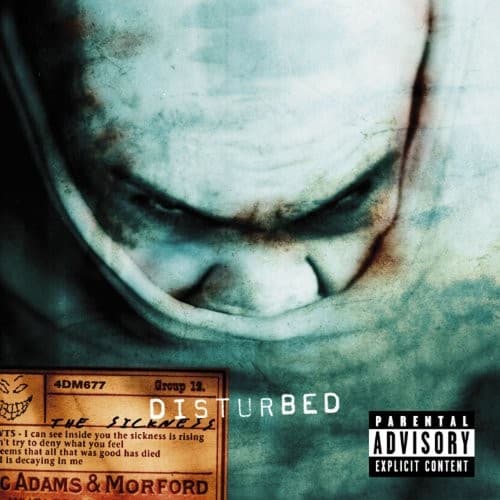
Disturbed The Sickness — The Album That Made Nu-Metal Monolithic
The Sickness answered a question nu-metal had been circling for three years: what happens when you strip out the funk bass, the turntable scratches and the rapped verses, and build the entire sound around one downtuned guitar playing the same chromatic riff for four minutes straight. Disturbed's debut took the genre's heaviness and made it blunt force, replacing Korn's sprawl and Limp Bizkit's crossover with a focused, almost industrial repetition. The result was five platinum certifications and a dozen years of imitators, but also an album that exhausts its ideas before the halfway mark.
When The Sickness landed in March 2000, it arrived as nu-metal's second wave was cresting. The genre had proven commercially viable, and labels were signing anything with a seven-string guitar and a baseball cap. Disturbed had spent the late nineties grinding through a Chicago scene that wanted nothing to do with heavy bands, self-promoting until Giant Records offered a deal. Producer Johnny K, a high school connection of guitarist Dan Donegan's brother, recorded the album in late 1999 with a clear strategy: make the demos bigger without softening them.
The mix emphasizes midrange bite over the scooped tones that dominated the era, giving the guitars a percussive attack that cuts through without relying on bass-heavy rumble. That production choice, combined with David Draiman's staccato phrasing and operatic delivery, made the band immediately identifiable on rock radio. The first single took months of label pushing to chart, but once the second hit rotation, the album spent over two years on the Billboard 200. The Sickness never reaches for greatness, but it executed a specific formula with enough clarity to define it.
The Sound — Chromatic Riffs as Blunt Instruments
Disturbed built The Sickness on a single songwriting decision: Dan Donegan's elimination of guitar solos in favor of monolithic, repeating riff structures. In interviews, Donegan described cutting solos entirely after early attempts cluttered the songs, and that choice became the album's signature. Tracks like "Stupify" and "Down with the Sickness" rely on chromatic riffs that chug through verse and chorus with minimal variation, creating a hypnotic, almost industrial heaviness. The approach works when the riffs themselves have shape—"Stupify" builds tension through its syncopated bounce, and "The Game" uses a descending pattern that actually resolves—but it becomes a liability when the same technique gets applied to weaker material. "Violence Fetish", "Numb" and "Want" all follow the template without finding hooks worth repeating, and by the time "Conflict" arrives, the formula feels mechanized.
Johnny K's production keeps the repetition from collapsing into mush. The guitar tone is focused and percussive, sitting in the midrange rather than burying itself in the low end, and the drum sound punches through with a clicky, aggressive clarity that was uncommon in 2000. Mike Wengren's drumming favors double-bass endurance and precise snare hits over fills, locking the rhythm section into a metronomic pulse that amplifies the riffs' weight. Steve Kmak's bass largely doubles the guitars, adding thickness without exploring independent lines, which makes the sound monolithic but also one-dimensional. The mix rewards the listener who wants to feel the riff as much as hear it, but it offers little dynamic range—every song sits at the same volume and intensity, which works for highlights and exposes filler in equal measure.
Draiman's vocal performance is the album's most divisive element. His operatic range and rhythmic phrasing turned nu-metal's usual growl-rap dichotomy into something more theatrical, and on tracks like "Voices" and "Fear", the melodrama serves the songs. He sings in staccato bursts that mirror the guitar's percussive attack, creating a unified sonic assault. The lyrics address personal trauma and anger with blunt directness—"Stupify" confronts racism, "Fear" examines control, "Down with the Sickness" includes a spoken-word abuse narrative that has aged into unintentional camp—but the writing rarely develops its themes beyond the initial statement. By the back half, Draiman's delivery settles into a single mode, and the variety that made the early tracks compelling becomes a predictable cycle of quiet-verse-loud-chorus dynamics. The cover of Tears for Fears' "Shout 2000" breaks the monotony by forcing a different melody onto the formula, but it also highlights how locked-in the rest of the album is.
The Album Arc — Front-Loaded and Repetitive
The Sickness peaks in its first five tracks and never recovers that momentum. The sequencing places the strongest material up front, establishing the sound and then repeating it with diminishing returns. By the time the middle section arrives, the chromatic riff formula has been heard in multiple configurations, and the album still has six songs to go. The seventh track offers a brief respite with a more melodic verse, and the cover provides an actual break from the band's own material, but everything between feels like the same song rewritten with slightly different riffs.
The back half sags under the weight of its own redundancy. The three tracks following the cover are competent but forgettable, lacking the hooks that made the singles endure. The instrumental adds texture without a compelling reason to exist, and the closing run does nothing the earlier material hasn't already done. The album's fifty-minute runtime feels padded, as if the band and label believed a debut needed twelve tracks regardless of whether the songwriting could support that length. A ten-track version ending with the cover would have been a tighter, more defensible record. As released, The Sickness spends its second half reminding you why the singles worked without offering new reasons to keep listening.
Legacy — The Blueprint That Calcified
The Sickness is Disturbed's defining album because it arrived first and sold five million copies, not because it is their best work. It occupies a specific position in nu-metal history: the moment the genre stopped experimenting with hip-hop fusion and crossover appeal, and instead weaponized the downtuned riff as the sole point. That clarity made it massively influential—dozens of bands in the early 2000s adopted the monolithic riff approach—but it also locked Disturbed into a formula they would spend the next two decades refining rather than escaping. The album has aged unevenly. The singles remain effective in short bursts, built on riffs durable enough to survive endless licensing and parody, but the deep cuts feel like relics of an era that mistook heaviness for depth.
This is an album for listeners who want nu-metal distilled to its most direct form: no rapping, no scratching, no funk, just riffs and shouting. It is not for anyone seeking variety, dynamic songwriting or emotional nuance. Start with the three opening singles—the tracks that defined the band and justified the album's success. If those land, the fourth and seventh tracks offer more of the same formula executed well.
Skip the back half unless you need to hear every version of the blueprint. For a clearer picture of where Disturbed went next, their second album Believe refined the approach with better pacing, but The Sickness remains the foundational document. It proved that nu-metal could be monolithic, and then spent eight tracks proving that monolithic could also mean monotonous.
Track by track
Track Listing
Voices
StandoutThe album's opener establishes the template with ruthless efficiency: a quiet intro that erupts into a chromatic stomp, Draiman's staccato vocals bouncing against the riff's syncopation, and a melodic chorus that pivots from aggression to melody without softening. The riff itself is simple—three notes descending in lockstep—but the rhythm section's precision makes it land with percussive force. Draiman's vocal performance alternates between snarled verses and a sung chorus that uses his full range, a dynamic that becomes the album's blueprint. The track peaks in its final minute, when the chorus repeats over double-bass thunder, and the simplicity of the structure works because the hook is strong enough to carry it. This is Disturbed at their most focused: one idea, executed with clarity and conviction.
The Game
StandoutA descending riff that resolves instead of endlessly churning gives this track a sense of progression the rest of the album rarely achieves. The verses lock into a mid-tempo groove, and the chorus opens into a melodic release that feels earned rather than pasted on. Draiman's phrasing mirrors the riff's rhythm, creating a unified vocal-guitar attack, and the bridge offers a brief dynamic shift before the final chorus. The lyrics address manipulation and control with more specificity than most of the album's anger, though they never develop the theme beyond surface-level accusation. "The Game" works because the riff has shape and the song has a clear arc, making it one of the few deep cuts that justifies repeated listens.
Stupify
StandoutThe track that took months of label effort to chart remains the album's most durable single, built on a riff that combines groove and aggression in equal measure. The main riff is a syncopated bounce that lands just off the beat, creating rhythmic tension that the chorus resolves with a straight-ahead stomp. Draiman's vocals shift from a low growl in the verses to a melodic hook in the chorus, and the performance feels inhabited rather than performed—his phrasing locks into the riff's pocket, making the vocal as percussive as the guitar. The lyrics, addressing racism and discrimination based on Draiman's own experiences, give the track thematic weight without spelling out the narrative. The song's durability is a testament to its construction: the riff is simple enough to remember and complex enough to not wear out in three listens. Johnny K's production keeps the mix tight, with the guitars cutting through without burying the vocal. This is the clearest example of Disturbed's approach working at full strength.
Down With the Sickness
SolidThe album's most ubiquitous track became a cultural artifact for reasons both musical and extratextual. The opening percussion-and-vocal intro is instantly recognizable, and the main riff—a chromatic chug that rides a single rhythm for the entire song—became the template every imitator copied. The verse-chorus structure is minimal, with Draiman's vocals carrying the melody over a riff that never changes, and the bridge includes a spoken-word abuse narrative that has aged from confrontational to camp. The track's endurance is undeniable—it has been licensed into films, video games, television and memes for twenty-five years—but its power is almost entirely in the first ninety seconds. Once the main riff is established, the song simply repeats it, relying on Draiman's vocal dynamics to create the illusion of progression. The mix keeps the percussive attack sharp, and Wengren's double-bass work drives the track's intensity, but the structure is the album's formula at its most reductive. It works because the riff is iconic, not because the songwriting earns the four-and-a-half-minute runtime.
Violence Fetish
SolidThe album's first sign of diminishing returns applies the chromatic riff formula to weaker material. The main riff is serviceable but generic, lacking the rhythmic hooks that made the opening tracks memorable, and the chorus repeats a single phrase without building melodic or lyrical interest. Draiman's delivery is committed, but the song gives him little to work with—the verses chug along without variation, and the bridge offers no dynamic shift. The lyrics address desensitization to violence with surface-level observation, and the track fades from memory the moment it ends.
Fear
StandoutA brief detour into melody, with verses that actually breathe and a chorus that builds to a climax rather than simply repeating at high volume. The riff is less percussive than the surrounding tracks, allowing space for Draiman's vocal to carry the melody, and the lyrics explore themes of control and paranoia with slightly more nuance than the album's usual blunt declarations. The bridge includes a rare moment of dynamic restraint, pulling back before the final chorus hits, and the song benefits from that sense of pacing. It is one of the few tracks on the second half that feels deliberately constructed rather than assembled from the same parts.
Numb
WeakThe album's midpoint begins the slide into redundancy. The riff is a minor variation on the chromatic stomp already heard in four previous songs, and the chorus repeats a single melodic phrase without development. Draiman's performance is professional but uninspired, and the track offers no new ideas or dynamics to justify its inclusion. It is competent filler, executed well enough to not actively detract but adding nothing to the album's argument.
Want
WeakAnother iteration of the same formula: quiet verse, loud chorus, chromatic riff, staccato vocals. The main riff has a slightly different rhythmic pattern than "Numb", but the overall effect is identical. The lyrics express frustration and desire in the broadest possible terms, and the track coasts on the momentum established earlier in the album. It is not poorly executed, but it is entirely unnecessary.
Conflict
WeakAt four and a half minutes, the album's longest original track feels even longer. The riff is a slower, doomier take on the chromatic chug, and the verses drag without building tension. The chorus attempts to add melody, but the hook is weak, and the song's extended runtime only highlights the lack of development. Draiman's performance is one-note, and the track suffers from the same pacing issues that plague the entire back half: it repeats its central idea without variation, and the listener has already heard this idea six times.
Shout 2000
SolidThe Tears for Fears cover is the album's most polarizing track and also its most necessary. By forcing a different melody onto Disturbed's monolithic sound, the song breaks the cycle of repetition that has dominated since track six. The original's new wave brightness is flattened into a mid-tempo stomp, and the melodic vocal line gives Draiman something to sing rather than shout. The arrangement is straightforward—riff, verse, chorus, repeat—but the track's value is in its contrast to the surrounding material. It is not a great cover, but it is a functional palate cleanser on an album that badly needs one.
Dropping Plates
SolidAn instrumental interlude that adds texture without purpose. The track builds around a clean guitar line and atmospheric effects, offering a brief respite from the chromatic assault, but it leads nowhere and serves no structural function. It is the sound of a band trying to vary the album's relentless sameness without committing to an actual dynamic shift.
Meaning of Life
WeakThe album's closer retreads the same ground as the previous eleven tracks, ending the record on a note of exhaustion rather than resolution. The riff is competent, the vocals are committed, and the production is sharp, but the song offers no new ideas or memorable hooks. It is the sound of a band that ran out of material but needed one more track to fill the runtime.
God of the Mind
WeakOriginally included on later reissues as a bonus track, this is more of the same chromatic stomp with no distinguishing features. It was left off the original tracklist for a reason.