The scorecard
7.5/10 · Great
- Songwriting25%
- 7.5
- Sound25%
- 8.5
- Performance15%
- 7.0
- Cohesion15%
- 7.0
- Originality10%
- 6.0
- Replay value10%
- 7.5
Strong hooks on Cirice and From the Pinnacle to the Pit earn the radio push, but the ballad He Is and the apocalyptic closer Deus in Absentia show depth beyond the riff-rock centerpieces.
Klas Åhlund's four-guitar, twelve-amplifier setup delivers heft without mud; the mellotron choirs and theremin on Spirit add texture instead of kitsch.
The vocals handle melody well but rarely push beyond a croon; the precision drumming and clean guitar tones do the heavy lifting.
The two short interludes Spöksonat and Devil Church break momentum rather than build it, and the sequencing sags between Mummy Dust and Absolution.
The retro-doom template is executed with polish but offers little the band's first two albums or Blue Öyster Cult in the seventies had not already mapped.
Cirice and From the Pinnacle to the Pit hold up on repeat; the ten-track runtime keeps filler minimal and the rest wears well enough.
Ghost Meliora — Pop Craft Meets Occult Theater Without Apology
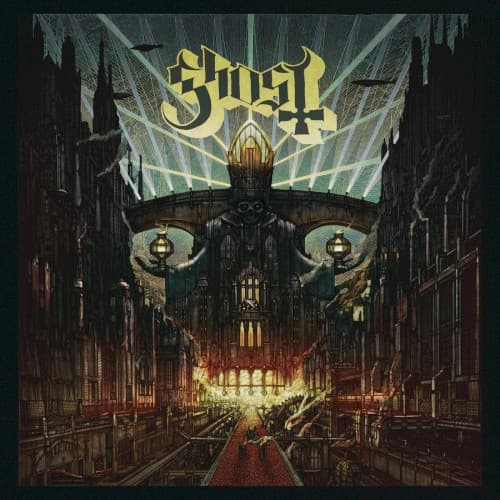
Meliora won a Grammy for Cirice and a platinum certification in Sweden, which means Ghost succeeded at the thing that makes purists nervous: writing doom-adjacent hard rock songs that work on mainstream rock radio without sanding off the Satanic imagery. The question is whether the album earns those hooks or whether it is a collection of well-produced singles padded with interludes and filler. The answer sits in between. Producer Klas Åhlund, whose resume before this was pop acts and no metal bands, pushed the band toward tighter song structures and bigger choruses, and the result is an album that sounds enormous and moves at a brisk pace but rarely surprises. The thesis here is that Meliora is Ghost at their most accessible and their most accomplished sonically, but also at their safest; the retro-doom aesthetic is executed with care, but the songwriting does not reach beyond what that aesthetic allows.
The album's concept, the absence of God in a dystopian future, gives the lyrics a target but does not change the way the songs are built. This is still verse-chorus hard rock with theatricality in the presentation and melody in the vocals, closer to Alice Cooper or Blue Öyster Cult than to any band that would be booked on a death metal or Black Sabbath tour. That is not a flaw if the songs justify the approach.
On Meliora, about half of them do. The singles are built to last, with riffs that develop and choruses that do not wear out. The ballad, written in 2007 and shelved until Åhlund insisted on recording it as-is, proves the band can write a song that does not lean on heaviness. The rest of the album is solid but workmanlike, with two instrumental interludes that add nothing and a couple of mid-album tracks that feel like they are filling time until the closer.
Four Guitars, Twelve Amps, and a Mellotron Choir
The production is the album's greatest strength. Åhlund's decision to record four different guitars through three amplifiers each, then layer the takes, gives the album a thickness that Infestissumam lacked. The band admitted that guitar took a backseat on the previous record; here it is front and center, with two Gibson SGs, a 1962 Les Paul, and a Telecaster all contributing to a tone that is both warm and cutting. The drums, recorded with a session player in Los Angeles, are precise and punchy, never buried in the mix. The mellotron choirs, used to replace the real choirs that caused problems on the previous album, add a synthetic gothic doom texture that fits the dystopian theme without sounding cheap. The theremin and glockenspiel on Spirit, the opening track, set the sci-fi tone that a member of the band said inspired the entire album.
The vocals are the weak point. The singing is clean and melodic, which works for the pop-rock framework, but it rarely commits to anything beyond a smooth croon. The Pitchfork review noted the lack of screams or manic energy, and the criticism holds. On a song like Mummy Dust, which is lyrically about greed and corruption, the vocal performance is too polite to sell the venom. The same goes for Majesty, which is described as a hymn to the dark lord but sounds more like a mid-tempo arena rock song. The contrast between the lyrical content and the vocal delivery is part of the band's charm, but it also means the album never hits the intensity that the heavier riffs suggest.
The songwriting is strongest when the band leans into hooks. From the Pinnacle to the Pit is a stomping riff-rocker with a chorus that lands immediately, and Cirice builds from a doomy verse into a soaring chorus that justifies the Grammy. Both songs were shaped by Åhlund's insistence on tighter structures; Cirice was originally a nine-minute instrumental that included the segment that became Devil Church, and splitting it into two pieces made both stronger. He Is, the ballad, works because it does not try to be heavy; it is a straightforward melody-first song that could have been on a seventies soft rock record, and the band recorded it with minimal changes from the 2007 demo. The weaker songs, like Absolution and Deus in Absentia, do not develop their ideas; they repeat a riff and a verse structure without adding much in the second half. The two interludes, Spöksonat and Devil Church, are atmospheric but too short to justify breaking up the sequencing.
Momentum Broken by Brevity
The opening stretch establishes the sound with futuristic guitar tones and mellotron choirs before the riffs arrive, then shifts into a Led Zeppelin-style stomp with a chorus that sticks. The Grammy-winning single peaks at six minutes of building tension, massive hooks, and enough dynamic range to avoid monotony. These first three tracks form the strongest sequence on the record.
After that, the pacing falters. A brief instrumental interrupts the flow instead of enhancing it, though the ballad is strong enough to justify the change in tone. The middle section sags, with one track overstaying its welcome by half a minute and another being pleasant but forgettable. A second brief instrumental splits the album in half without adding anything the first one did not already provide. The back half picks up energy before the five-and-a-half-minute prog-rock closer, which works as a finale but does not reach the heights of the opening stretch. At forty-one minutes for ten tracks, the album is not overlong, but the two interludes make it feel less focused than it could have been.
Accessible Without Compromise, but Few Risks Taken
Meliora is Ghost's most polished and accessible album, and for listeners who want retro-doom-rock with big hooks and pristine production, it delivers. The singles Cirice and From the Pinnacle to the Pit are among the best hard rock songs of the 2010s, and the production elevates every track even when the songwriting does not. The ballad He Is proves the band can write outside the riff-rock template, and the runtime is short enough that the weaker tracks do not drag the album down. For fans who came to Ghost through Opus Eponymous and want a return to guitar-driven songs after the choir-heavy Infestissumam, this is the album that delivers on that promise. The Grammy and platinum certification were not accidents; this is a well-crafted record that works on rock radio without diluting the occult theater.
The weaknesses are in the songwriting and the sequencing. The two interludes add nothing, and the mid-album stretch from Mummy Dust to Absolution is solid but not essential. The vocals, while melodic and clean, rarely push beyond a comfortable croon, and the lack of intensity means the heavier riffs do not hit as hard as they could. The album does not take risks; it executes a formula with precision, but that formula was already established by the band's first two albums and by the retro-doom bands Ghost draws from. For listeners who want something heavier or more adventurous, Meliora will feel too polished and too safe. For listeners who want hooks and melody with Satanic lyrics and pristine guitar tones, it is exactly what it promises.
Start with Cirice, then From the Pinnacle to the Pit, then He Is. If those three songs work for you, the rest of the album will hold up. Skip the interludes on repeat listens. For a next step, the Meliora Redux edition adds Zenith, the track left off the main album, and the Popestar EP, which includes the single Square Hammer. If you want more Ghost, go back to Opus Eponymous for a rawer, less polished take on the same sound. If you want something heavier in the same retro-doom vein, try Pallbearer or Khemmis.
Track by track
Track Listing
Spirit
StandoutThe opening track establishes the futuristic, dystopian tone with a spacey guitar riff processed through a theremin and layered with mellotron choirs and glockenspiel. The sci-fi effect, achieved during a rehearsal accident, became the conceptual anchor for the entire album. The track builds slowly, with organs adding gothic weight before the drums enter. At just over five minutes, it works as an introduction because it sets up the sound without overextending a single idea. The production here is immaculate: every layer is audible, and the mix never feels cluttered despite the instrumentation. The vocals enter late and stay restrained, which keeps the focus on the atmosphere. This is Ghost at their most cinematic, and it proves the band can build tension without relying on a riff.
From the Pinnacle to the Pit
StandoutA stomping, Led Zeppelin-style riff-rocker with a chorus built for arenas and car stereos. The production is dense but clear, with the layered guitar tones filling every available space without turning to mud. The drums lock into a groove that never wavers, and the bass sits high enough in the mix to add punch. The vocals handle the melody well, but the performance is too smooth to match the aggression the riff suggests. The song was designed to sound great on rock radio, and it succeeds; the hook is immediate, and the structure is tight enough that the four-minute runtime feels earned. This is Ghost at their most accessible, and the song holds up on repeat listens because the riff does not wear out. The best pure hard rock song on the album.
Cirice
StandoutThe Grammy-winning single and the album's centerpiece. Originally conceived as a nine-minute doom instrumental paired with what became Devil Church, the song was split and restructured at producer Klas Åhlund's urging. The result is six minutes of building tension, with a doomy verse that shifts into a soaring, melodic chorus. The dynamic range is the key: the verse is sparse and heavy, the pre-chorus adds layers, and the chorus explodes with harmonized vocals and a wall of guitar. The production allows every element to breathe; the mellotron choirs add gothic texture without overwhelming the riff. The vocal performance is the strongest on the album, with enough conviction in the delivery to sell the hook. The song works as both a radio single and a centerpiece for the album's concept. The best track on Meliora and one of the best hard rock songs of the 2010s.
Spöksonat
SolidA fifty-six-second instrumental interlude with organ and ambient noise. The title translates to "ghost sonata," and the track is atmospheric but too brief to develop any ideas. It breaks the momentum after Cirice rather than enhancing the transition to He Is. The production is fine, but the track does not justify its inclusion; cutting it would have made the album flow better.
He Is
StandoutA ballad written in 2007 and shelved until Åhlund insisted on recording it as-is. The band tried to make it sound like Ghost during the Infestissumam sessions, adding and subtracting elements, but eventually gave up. For Meliora, they recorded it with minimal changes from the original demo, and the simplicity works. This is a straightforward melody-first song with clean vocals, acoustic guitar, and organ, closer to seventies soft rock than to doom or hard rock. The lyrics, influenced by the suicide of Selim Lemouchi of The Devil's Blood, add weight to the performance. The vocal delivery is restrained but committed, and the production is warm without being syrupy. The song proves Ghost can write outside the riff-rock template, and it holds up as one of the album's strongest moments. A risk that pays off.
Mummy Dust
SolidA mid-tempo riff-rocker about greed and corruption, with a groove that locks in immediately but does not develop much over four minutes. The production is thick, with the layered guitars and punchy drums creating a wall of sound, but the vocal performance is too polite to match the lyrical content. The riff is solid but repetitive, and the song overstays its welcome by about thirty seconds. The chorus is functional but not memorable. This is a serviceable album track, but it does not reach the heights of the singles or the depth of He Is. Filler in a strong tracklist.
Majesty
SolidDescribed as a hymn to the dark lord, the song is lyrically about worship of an authority that despises its followers. Musically, it is a mid-tempo arena rock song with a steady groove and a melodic chorus. The production is clean, with the guitars and drums sitting in perfect balance, but the arrangement is too safe to justify the five-and-a-half-minute runtime. The vocals coast on a croon, and the performance never builds to a climax. The riff is pleasant but not distinctive, and the song does not develop its ideas in the second half. This is competent but forgettable, and it sags in the album's sequencing. Another track that feels like it is filling time.
Devil Church
SolidThe second instrumental interlude, just over a minute long. This was originally the opening section of Cirice before Åhlund split the two pieces. As a standalone track, it is atmospheric and doomy, with distorted guitar and organ building tension. The problem is that it arrives seven tracks into a ten-track album, breaking momentum rather than enhancing it. The production is strong, but the track does not justify its placement. Cutting this and Spöksonat would have tightened the album.
Absolution
SolidA faster-paced hard rock song with a driving rhythm and a solid riff. The production keeps the energy high, with the drums pushing the tempo and the guitars staying sharp in the mix. The vocals handle the melody competently, and the chorus is functional if not spectacular. The song works as a palate cleanser after the slower mid-album stretch, but it does not add much to the album's themes or sound. The four-and-a-half-minute runtime is justified, but the song does not reach the quality of the singles. A solid album track that does its job without standing out.
Deus in Absentia
SolidThe closer, a five-and-a-half-minute prog-rock song with layered guitars, organ, and a building structure. The title translates to "God in absence," which ties directly to the album's thematic focus on the void left when there is no divine authority. The song opens with a clean guitar line and mellotron, then adds layers as it builds toward a heavier second half. The production is lush, with every instrument clearly defined, and the vocals handle the melody well. The arrangement is ambitious, with tempo shifts and dynamic changes, but the song does not quite reach the emotional weight of Cirice or the immediacy of From the Pinnacle to the Pit. It works as a finale because it closes the album on a reflective note rather than a bombastic one, but it is not a strong enough track to elevate the back half of the album. A solid closer that does not fully deliver on its ambitions.