The scorecard
8.9/10 · Essential
- Songwriting25%
- 9.0
- Sound25%
- 9.5
- Performance15%
- 9.0
- Cohesion15%
- 7.5
- Originality10%
- 8.5
- Replay value10%
- 9.0
Riffs like "Walk" and "Fucking Hostile" are built from single ideas stretched to maximum tension, while "This Love" proves the band can write an actual song structure.
Terry Date's mix makes every guitar chug land like a fist: the low-end crush on "A New Level" and the clean-to-distorted build on "This Love" set the standard for heavy metal production in the nineties.
Anselmo abandons his previous shriek for a roar that matches the riff weight, and Dimebag's solo on "Hollow" is one part blues burn, one part controlled chaos.
The first half is near-perfect sequencing, but "Regular People (Conceit)" and "Live in a Hole" sag in the back half, and eleven tracks would have been stronger as nine.
Pantera slowed thrash down to a chug and made heaviness a matter of groove instead of speed, creating a template every post-nineties metal band either copied or reacted against.
Three decades later the album still sounds heavier than most of what came after it, and tracks like "Mouth for War" and "Walk" have not aged into nostalgia.
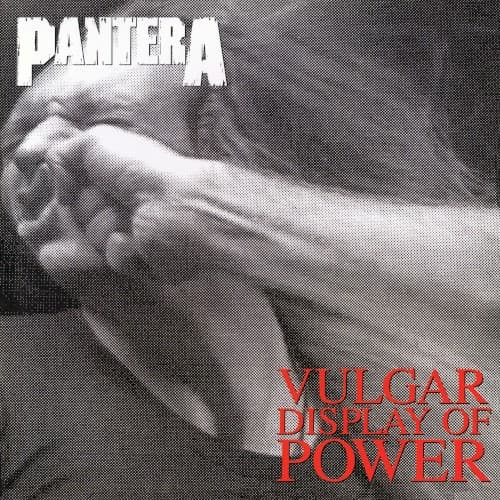
Pantera Vulgar Display of Power — The Album That Made Heaviness a Groove
Metallica had just released their self-titled album in 1991, polishing thrash into something radio could play. Pantera heard that record and decided the opposite move was the one that mattered: make heaviness the point, not a style choice. Vulgar Display of Power, recorded at Pantego Sound Studio with producer Terry Date and released in February 1992, is the result of that decision. It is not the first groove metal album, but it is the one that made groove the center of heavy metal for the next decade, the record that showed a generation of bands how to be heavy without being fast.
The thesis of this album is in the riff to "Walk": a single chord chugged in rhythm, downtuned and played with absolute conviction, more effective than any thrash blizzard. That riff, which Dimebag Darrell played during a soundcheck on the Cowboys from Hell tour, is the blueprint for the entire record. Pantera had already moved away from their glam metal past on Cowboys, but Vulgar Display of Power finishes the transformation. The songs here are built from groove, not speed, and the groove is built from tone and performance, not technicality. It is the sound of a band that knows exactly what it does well and refuses to do anything else.
The stakes were higher than the band probably realized at the time. Thrash was either going commercial or going underground, and the gap between those paths was where Pantera planted their flag. Vulgar Display of Power is the album that defined what heavy meant in the nineties: not velocity, not complexity, but crushing weight delivered with rhythm. It sold two million copies in the United States and is still Pantera's biggest commercial success. More importantly, it is the record that every metalcore, nu-metal and modern groove band has had to reckon with, whether they admit it or not.
The Sound of Groove as Force
Terry Date's production is the other half of why this album works. He had produced Cowboys from Hell, but Vulgar Display of Power is where he perfected the Pantera sound: guitars tuned down, mixed loud and dry, with enough low-end chunk to make every palm-mute land like a kick drum. The tone on "A New Level" and "Fucking Hostile" is not scooped or polished; it is direct, almost harsh, with the midrange left intact so the riff cuts instead of rumbles. Date's work here became the template for heavy guitar production for the next fifteen years, and it still sounds heavier than most records that try to replicate it.
Dimebag Darrell's riffs are deceptively simple on paper. "Walk" is built from one chord. "Mouth for War" is a verse riff, a pre-chorus riff and a chorus hook, all played in the same key with minimal variation. "Fucking Hostile" is two minutes and forty-eight seconds of the same grinding chug with a solo break.
What makes them work is the way they lock into Vinnie Paul's drums, which hit like a machine but swing just enough to keep the groove human. The rhythm section here is not trying to be technical; it is trying to be inevitable, and it succeeds. When the verse riff in "Rise" kicks in, there is no question where the song is going. The question is whether you are ready for it.
Phil Anselmo's vocals are a deliberate break from what he did on Cowboys from Hell. He drops the high shriek almost entirely and replaces it with a roar that sits in the same tonal range as the guitars, reinforcing the riff instead of contrasting it. On "A New Level" and "Mouth for War" he sounds like he is trying to match the guitar tone with his voice, and the result is a vocal performance that feels less like singing and more like another instrument in the mix. The clean singing on "This Love" and "Hollow" shows he can still carry a melody, but even there the delivery is aggressive, pushing against the softer arrangement.
The album does have a weakness, and it is in the songwriting variety. By the time "Regular People (Conceit)" arrives near the end, the formula is showing wear. The riffs are strong, but the song does not develop, and the same can be said for "Live in a Hole." These are not bad tracks, but they are the moments where the album's commitment to one sound becomes a limitation. Eleven songs of this approach is one or two too many, and the back half sags as a result.
How the Album Earns Its Length
The sequencing on Vulgar Display of Power is deliberate: the first six tracks are the argument, and the back five are the supporting evidence. The opening stretch sets the tone immediately and does not let up, building through the first three cuts with pure momentum. The fourth track is the shortest on the album and the most concentrated dose of what the band does, two minutes of pure aggression with no fat.
The middle section breaks the pattern with clean verses and a slower tempo, and it works because the contrast is earned. The first half closes with another gear shift, proving the band can write more than one kind of heavy song. This stretch is nearly flawless in how it builds and varies the groove.
The back half starts strong, but by the time the eighth and ninth tracks arrive, the album has less to say. These cuts are solid on their own, but in sequence they feel like the band circling the same idea without adding to it. The penultimate track picks the energy back up, and the closer ends the album with the nearest thing to a ballad Pantera would write at this point in their career, a deliberate cooldown that works as an ending.
The pacing issue is not severe enough to sink the album, but it is noticeable. If the record had been trimmed to nine or ten tracks, it would be airtight. As it stands, it is a great album with a few moments of drag.
The Record That Defined a Decade
Vulgar Display of Power is Pantera's best album and one of the most important heavy metal records of the nineties. It is not the most experimental or the most varied, but it is the most focused and the most influential. Every groove metal band that came after it either learned from this record or tried to distance themselves from it, and the same is true for metalcore and nu-metal. The production here set the standard for how heavy guitars should sound, and the riff-writing set the standard for how to build a song from groove instead of speed. It is a blueprint album, the kind that defines what a genre can be.
This album is for listeners who want heaviness delivered with conviction and rhythm. It is not for listeners who need variety or technicality or progression. If you want one Pantera album, this is the one. If you already know Pantera and want to hear where they came from, Cowboys from Hell is the logical step backward, and if you want to hear where they went next, Far Beyond Driven is heavier but less focused.
Start with "Walk," "Mouth for War" and "This Love." Those three tracks show the range of what the album does: the groove anthem, the thrash-adjacent banger and the slower, more melodic side of the band. If those three work for you, the rest of the album will as well, with the caveat that the back half repeats some of the same ideas. If you are coming to Pantera for the first time, this is the record that explains why they matter. It is the sound of a band that took heaviness seriously and made it mean something beyond volume.
Track by track
Track Listing
Mouth for War
StandoutThe album opens with a drum roll and a riff that announces the mission: this will be heavy, and it will groove. The verse riff is a chug with just enough syncopation to keep it from turning into a march, and Anselmo's vocal mirrors the rhythm of the guitar. The pre-chorus shifts to a higher register, and the chorus is a shout-along hook that has held up for three decades. The solo is short, melodic and serves the song instead of showing off. This is Pantera at their most accessible, a track that works as both an introduction and a statement of purpose.
A New Level
StandoutThe opening riff is one of the heaviest moments on the album, a downtuned chug that lands with the weight Date's production was designed to capture. The verse is built from the same riff with a vocal melody that sits on top of it, and the chorus is a call-and-response between Anselmo and the guitar. The bridge shifts to a slower, almost doom-metal tempo before the song kicks back into the main riff. The structure is simple, but the execution is near-perfect. This is the track that showed how much force a groove riff could carry.
Walk
StandoutThe riff is one chord, played in rhythm, with Vinnie Paul's drums locking into the same downbeat. It should not work as well as it does, but the tone and the conviction sell it. The verse is minimal, just Anselmo growling over the same riff, and the chorus is the title repeated with a slight melodic lift. The solo is bluesy and short, and the song ends on the same riff it started with. This is the most famous track on the album and the one that became Pantera's signature song. It is also the purest expression of what the album does: make heaviness a matter of groove, not complexity. The lyrics were written in response to friends who thought the band had become arrogant after Cowboys from Hell, and the attitude comes through in every line.
Fucking Hostile
StandoutTwo minutes and forty-eight seconds of grinding, relentless chug with almost no variation. The riff is a single idea repeated, the drums are locked into the same pattern, and Anselmo screams the title over and over. The solo is the only break, and it is more of a noise burst than a melody. This is the most aggressive track on the album and the least interested in being a song. It works because it knows exactly what it is and does not try to be anything else.
This Love
StandoutThe album's first real shift in dynamics: clean guitar verses, a melodic vocal line, and a slower tempo. The pre-chorus builds tension, and the chorus explodes into distortion with one of Dimebag's most memorable riffs. The bridge is a clean guitar solo that leads into a heavier second half, and the song ends with Anselmo screaming over the main riff. This is Pantera proving they can write an actual song structure with dynamics and progression, not just a riff repeated for five minutes. The clean-to-heavy shift became a template for countless bands in the two decades that followed.
Rise
StandoutA slower, mid-tempo groove with a riff that swings instead of chugs. The verse is built from a two-chord pattern, and the chorus is a shout-along hook with a melodic lift. The solo is one of Dimebag's longer performances on the album, and it shows his blues influence more clearly than most of the other tracks. This is one of the more dynamic songs in the first half, proof that Pantera could vary the groove without losing the weight.
No Good (Attack the Radical)
SolidThe back half opens with another grinding riff and a vocal performance that sits somewhere between a roar and a growl. The verse and chorus are built from the same chord progression with slight rhythmic variation, and the bridge shifts to a half-time feel before kicking back into the main riff. This is a solid track, but it does not add much to what the first half already established. The energy is there, but the ideas are starting to repeat.
Live in a Hole
SolidA slower, heavier track with a doom-metal influence in the main riff. The verse is a chug with a vocal melody that sits low in the mix, and the chorus is a slight lift in tempo with a shout-along hook. The solo is bluesy and stretched out, and the song ends on the same riff it started with. This is one of the weaker moments on the album, not because it is bad, but because it does not develop. It is a riff and a structure, nothing more.
Regular People (Conceit)
WeakAnother mid-tempo groove with a riff that swings, but by this point in the album the formula is wearing thin. The verse and chorus are both built from the same idea, and the song does not go anywhere beyond the initial riff. This is filler, the kind of track that would have been cut if the band had been more ruthless in editing. It is not offensively bad, but it does not justify its five-and-a-half-minute runtime.
By Demons Be Driven
StandoutA return to the heavier, faster approach of the first half. The main riff is a thrash-influenced chug, and the verse and chorus are both built from variations of the same idea. The solo is short and aggressive, and the song ends with a breakdown that slows the tempo to a crawl before kicking back into the main riff. This is one of the stronger tracks in the back half, proof that the band still had energy left after the sag of the previous two songs.
Hollow
StandoutThe album closes with its longest track and its closest approach to a ballad. The verse is built from clean guitars and a melodic vocal line, and the chorus shifts to distortion with a riff that is more melodic than most of what came before it. The solo is one of Dimebag's best performances on the album, a mix of blues phrasing and controlled aggression that builds to a climax before the song fades out on the clean guitar pattern. This is the cooldown the album needs, a deliberate step back from the aggression that allows the record to end on a moment of reflection instead of exhaustion.