Style & Context
Influences
Alex Grey visionary art, electron microscopy, Fibonacci sequences, DMT breakthrough imagery
Location
Released during metal's fascination with psychedelic therapy and consciousness expansion, positioning Tool as elder statesmen guiding the journey inward.
Visual Language
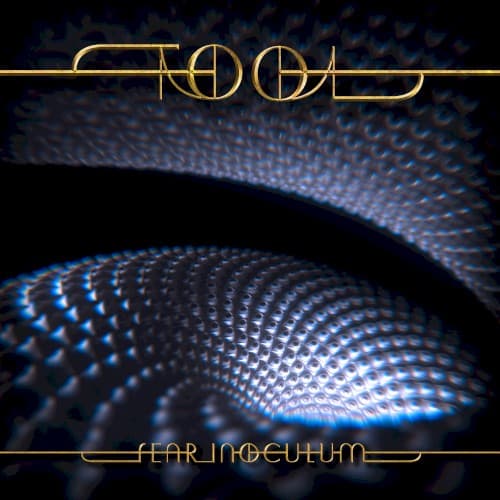
The photorealistic computer rendering abandons Tool's earlier dark occultism for a sterile scientific aesthetic that paradoxically explores spiritual transformation.
Symbols
Fractal cellular structure
The repeating geometric patterns represent biological self-replication and the recursive nature of fear itself spreading through consciousness.
Spiral formation
The golden ratio spiral suggests natural evolution and Tool's mathematical approach to rhythm and composition across their catalog.
Membrane-like surface
The undulating boundary between light and void mirrors the album's exploration of psychological barriers and their dissolution.
Where Sound Meets Image
The radiating cellular patterns perfectly visualize the album's polyrhythmic structures, where each instrument follows its own mathematical pattern while contributing to the larger organism. The cover's cold precision mirrors Danny Carey's mechanical drum programming layered beneath human performance, while the organic subject matter reflects Justin Chancellor's warm bass tones anchoring the clinical guitar work. The spiraling geometry matches the album's themes of ego death and psychological transformation explored across ten-minute compositions.
Fear Inoculum's cover redefined prog-metal packaging for the streaming era, proving that bands could still create compelling physical artifacts. The sterile digital aesthetic influenced a wave of metal artwork abandoning traditional darkness for scientific minimalism. The limited edition version included an LCD screen displaying the fractal animation, setting new standards for deluxe packaging that younger bands have struggled to match without Tool's resources.