Style & Context
Influences
Alex Grey visionary art, medical textbook illustration, Tibetan mandalas, Ernst Haeckel
Location
This artwork emerged when metal began embracing intellectual complexity and rejecting nu-metal's commercial simplification.
Visual Language
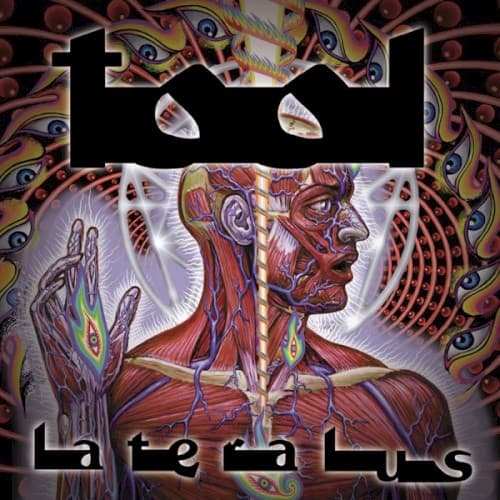
The rendering fuses clinical precision with hallucinogenic color gradients that defined progressive metal's turn-of-millennium aesthetic.
Symbols
Exposed musculature
The flayed figure represents stripping away illusion to reveal the mechanical truth beneath consciousness.
Radiating mandala
Circular patterns symbolize the Fibonacci sequence and sacred geometry central to the album's mathematical construction.
Upraised hand gesture
The reaching palm mirrors both anatomical study and spiritual seeking toward higher understanding.
Where Sound Meets Image
The dissected human form mirrors the album's lyrical exploration of human evolution and consciousness expansion, particularly on the title track's Fibonacci-sequenced structure. The radiating geometric patterns visualize the polyrhythmic spirals and mathematical precision driving songs like Schism and The Patient. The combination of organic flesh and perfect geometry reflects how the music balances Danny Carey's precisely calculated drum patterns against Maynard James Keenan's primal vocal expression.
The Lateralus cover established the visual template for intelligent progressive metal in the streaming era, proving elaborate psychedelic art could coexist with heavy music's mainstream acceptance. Its fusion of anatomical precision and spiritual symbolism influenced countless prog-metal bands to commission visionary artists rather than photographers, shifting the genre's visual language toward the metaphysical.