Style & Context
Influences
Dadaist portraiture, Soviet propaganda posters, clinical psychology imagery, surrealist body horror
Location
The clinical precision reflects the Bush-era obsession with security theater and the normalization of invasive government monitoring.
Visual Language
The clean vector lines imposed on photographic flesh create deliberate cognitive dissonance between organic and mechanical realities.
Symbols
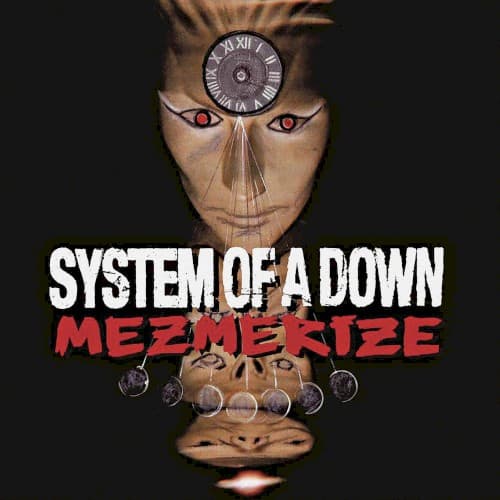
Roman numeral clock face
The clock embedded in the forehead represents time as a prison and society's obsession with control through measurement.
Mirrored facial symmetry
The perfectly split reflection suggests duality, duplicity, and the fractured psyche under authoritarian pressure.
Red glowing eyes
The crimson irises signal rage, surveillance, and the dehumanization that occurs when people become monitored subjects.
Where Sound Meets Image
The fractured symmetry directly reflects the band's signature style of abrupt tempo changes and schizophrenic song structures. Tracks like 'B.Y.O.B.' and 'Soldier Side' dissect war propaganda with the same clinical precision these geometric overlays apply to human features. The clock imagery connects to the album's recurring themes about time running out for political awakening, while the mirrored face represents the duality in songs that swing between dark humor and genuine horror at governmental manipulation.
This cover influenced a wave of nu metal and alternative metal artwork that embraced surreal portraiture over traditional aggression imagery. The clinical approach to visualizing psychological themes became a template for bands addressing political topics without resorting to obvious protest imagery. Its symmetrical geometry and restrained color palette proved that metal covers could unsettle through precision rather than chaos, spawning imitators throughout the late 2000s metalcore and progressive metal scenes.