Style & Context
Influences
H.R. Giger biomechanical detail, Roger Dean fantasy landscapes, classic Egyptian revivalism
Location
This cover emerged when Iron Maiden sold out world tours and Egyptian mysticism pervaded 1980s popular culture entertainment.
Visual Language
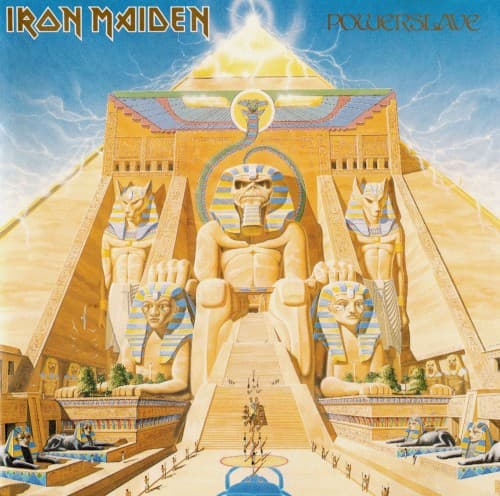
Derek Riggs employs meticulous airbrush gradients to create photorealistic stone surfaces while maintaining comic book dynamism and theatrical excess.
Symbols
Central Eddie Pharaoh
The skeletal mascot transformed into eternal ruler represents Iron Maiden's dominion over heavy metal in 1984.
Winged sun disc above pyramid
The Egyptian symbol of divine protection hovers over the temple, linking metal rebellion with ancient mystical power.
Flanking pharaoh sentinels
Six colossal statues create a symmetrical power hierarchy, mirroring the band's disciplined musical precision and ambition.
Where Sound Meets Image
The pyramid temple's architectural grandeur mirrors the album's epic song structures, particularly the eight-minute title track's journey through ancient curses and mortality. Eddie's transformation into skeletal pharaoh reflects 'Powerslave's lyrical exploration of rulers facing death despite earthly power. The radiant celestial light beams connect to '2 Minutes to Midnight's apocalyptic themes, while the elaborate temple details match the intricate guitar harmonies of Dave Murray and Adrian Smith. The cover's fusion of ancient mysticism and modern power perfectly captures how Iron Maiden blended historical storytelling with aggressive contemporary metal.
Powerslave established the template for metal's maximalist cover art approach, proving that elaborate fantasy illustration could compete with photography in the MTV era. The cover influenced countless power metal and progressive metal bands to commission detailed narrative artwork rather than simple band photos. Derek Riggs' architectural precision raised expectations for metal cover complexity, while the Egyptian aesthetic became permanently embedded in heavy metal's visual vocabulary. The image remains instantly recognizable forty years later, adorning t-shirts and posters as shorthand for 1980s metal's theatrical peak.