The scorecard
8.6/10 · Essential
- Songwriting25%
- 9.0
- Sound25%
- 8.5
- Performance15%
- 9.0
- Cohesion15%
- 8.0
- Originality10%
- 7.5
- Replay value10%
- 9.0
"Rime of the Ancient Mariner" proves Harris can build a 13-minute narrative with multiple movements that develop instead of repeat, while "2 Minutes to Midnight" and "Aces High" establish templates still used today.
Martin Birch's mix at Electric Lady gives each instrument its own lane—the guitar harmonies breathe, the bass drives without muddying, and McBrain's kit has room dimensions that later digital remasters lost.
Dickinson's range on "Powerslave" and the dual leads on "Flash of the Blade" show the lineup clicking, though McBrain's patterns occasionally default to efficient rather than inventive.
The front half runs lean and the back half earns its length, but "Losfer Words" breaks momentum exactly where the album needs to accelerate, and "Back in the Village" feels like a detour.
The gallop rhythm Harris perfected on Beast appears in nearly every track here, and the dual-guitar attack refines a sound the band already owned rather than opening new ground.
Four decades later the twin leads still reveal new details and "Rime" rewards every minute, though "The Duellists" and "Back in the Village" lose urgency on repeat.
Iron Maiden Powerslave — The Gallop Perfected, Then Stretched Past Breaking
Powerslave is the album where Iron Maiden's formula calcifies into doctrine. The gallop bass, the dual-guitar harmonies, the literary conceits, the air-raid vocal—every element that made The Number of the Beast an instant classic in 1982 returns here refined to a gloss, then pushed to extremes that reveal both the ceiling and the cracks. Where Beast was discovery, Powerslave is mastery and the first signs of diminishing returns.
The front half delivers four of the tightest songs the band ever wrote, each one a clinic in how to build a metal anthem without wasting a bar. The back half stretches that same toolkit across 26 minutes and three tracks, culminating in a 13-minute narrative poem that should collapse under its own length but instead became the signature statement of the lineup. The tension between those two impulses—economy and ambition, repetition and development—defines the record and explains why it split critical opinion even as it cemented the band's commercial dominance.
Recorded at Compass Point Studios in Nassau and mixed at Electric Lady in New York by producer Martin Birch, Powerslave arrived in September 1984 as the fifth album from a band that had headlined arenas across the US the previous year. The question every act hits at that altitude: what comes after you have already proven the point? The answer here is to double down on everything that worked and see how far the frame will bend before it snaps. On half the album, it holds. On the other half, the seams show.
When the Gallop Became the Default Setting
The sound Birch captured at Compass Point and refined at Electric Lady is the high-water mark for this lineup: every instrument audible in its own lane, the guitar harmonies breathing instead of blurring, the bass driving without muddying the low end, McBrain's kit recorded with room dimensions that later digital remasters flattened into cardboard. The mix gives Dickinson space to operate at full range—his upper register on the title track still has air around it, and his mid-range bark on "2 Minutes to Midnight" punches through without distortion. The dual guitars, handled by Dave Murray and Adrian Smith, lock into harmonies that sound effortless but required the six weeks of rehearsal at Le Chalet Hotel in Jersey to nail.
Those leads define the album's peaks: the climactic runs in "Rime of the Ancient Mariner," the chase sequence in "Flash of the Blade," the opening salvo of "Aces High." When the two guitars diverge and reconverge, the effect is architectural, like watching arches meet at a keystone.
But the rhythm section is where the formula starts to show its limits. Steve Harris wrote five of the eight tracks and his gallop bass appears in nearly every one, a triplet chug that became the band's signature and here starts to feel like the only gear. McBrain, brought in for Piece of Mind the year before, plays with precision and power but rarely breaks from patterns established in the first two minutes of a song. His fills are efficient; his cymbal work is textbook; his double-bass runs on "Aces High" are fast and clean and entirely predictable.
Compare his performance here to what Clive Burr brought to Beast—looser, more willing to risk a stumble for the sake of a moment—and you hear the trade-off Maiden made for reliability.
The songs themselves follow a template: intro riff, verse, pre-chorus, chorus, solo section with harmonized leads, return to verse, out. "2 Minutes to Midnight" and "Aces High" execute that structure with such confidence that the repetition feels like purpose. "The Duellists" and "Back in the Village" execute the same structure with less conviction and the formula starts to look like a constraint. Harris wrote both tracks—the former inspired by the 1977 film of the same name, the latter a sequel to "The Prisoner" from 1982—and both meander past six and five minutes respectively without developing their ideas.
The riffs are solid, the performances tight, but the songs feel stretched to album length rather than written to it. Dickinson's fencing-inspired "Flash of the Blade" and Smith's co-write on "2 Minutes to Midnight" show what happens when other voices enter the writing process: the structures vary, the tempos shift, the gallop takes a break. That variety is the difference between the front half and the back.
Two Halves, Two Different Records
The album plays like two EPs forced onto one LP. The first stretch runs 25 minutes and contains four instant classics and one instrumental that stops momentum exactly where the album needs to accelerate. The opening track launches with a Battle of Britain dogfight and never lets up; the follow-up delivers the tightest verse-chorus construction the band had written since "Run to the Hills." Then the instrumental arrives as a palate cleanser that clears too much.
It is the band's first instrumental since Dickinson and McBrain joined, and it sounds like a leftover riff stretched to four minutes because no one could find lyrics that fit. The decision to leave it instrumental was correct—forcing words onto this would have made it worse—but the decision to include it at all breaks the flow. The next two tracks rebuild the momentum, the former with a fencing-match energy that matches its subject, the latter with a slower burn that works better in theory than in execution.
The back half runs 26 minutes and stretches the same toolkit across longer forms. The first entry revisits "The Prisoner" without adding much; the second is a seven-minute display for Dickinson's range and the guitar harmonies, with a lyric about a pharaoh facing mortality that Dickinson later described as an allegory for rock stardom. It is the most obviously "epic" track the band had written to that point, and it earns the label through performance rather than structure.
Then the closing run delivers 13 minutes of Samuel Taylor Coleridge adaptation, multiple movements, tempo shifts, and the longest sustained narrative the band ever attempted. Harris wrote it under time pressure and it shows—not in the construction, which is meticulous, but in the willingness to let sections develop past the point where a shorter song would cut. The track divides fans: either it is the definitive Maiden statement or it is an editing failure that should have been two songs. Both readings are defensible. What is not debatable is that it holds attention, and that after forty years it still reveals details in the arrangement that the first ten listens miss.
The Ceiling and the Cracks, Both Visible
Powerslave is the best version of a formula that was already two albums deep when this band arrived at it, and it is the album where that formula begins to constrain more than it enables. It sits above Piece of Mind in the catalog—the production is sharper, the performances tighter, the peaks higher—but it does not reach The Number of the Beast because Beast had the element of surprise and this does not. Everything here is executed with near-perfection, and that execution is both the achievement and the limitation.
The fans who rank Powerslave as the definitive Maiden album are hearing the mastery; the fans who rank it below Beast are hearing the repetition. Both are right. This is an album for listeners who want to hear a band operating at the peak of its powers within a defined sound, and who will forgive the moments where the power is applied to ideas that do not quite justify the effort. It is not for listeners who need constant reinvention or who lose patience with gallop bass by the fourth time it appears.
Start with "Aces High," "2 Minutes to Midnight," and the title track. If those three grab you, commit to "Rime of the Ancient Mariner" in one sitting. If the back half of the album feels like a slog, this is not your entry point—go to Beast or Seventh Son of a Seventh Sea instead. If you finish "Rime" wanting more of that ambition, the live album Live After Death captures this material at its peak.
Powerslave ranks second in the catalog behind Beast and ahead of everything that came before. It is the sound of a band that figured out how to do one thing better than anyone else, then did it until the limits showed.
Track by track
Track Listing
Aces High
StandoutThe Battle of Britain as a three-minute adrenaline shot, with Churchill's "We shall fight on the beaches" speech as the intro in live performances and the official video. The song opens with a climbing guitar riff that mimics a Spitfire takeoff, then locks into a gallop that never relents. Dickinson sings from the cockpit, his delivery clipped and urgent, and the dual-guitar leads in the solo section are the textbook example of how Murray and Smith make two guitars sound like six. The production gives McBrain's double-bass runs enough clarity that you can count the hits, and Harris's bass drives the verses without overwhelming the riff. No wasted bars, no excess, just four and a half minutes of the band doing exactly what it does best. This is the template every power-metal band copied for the next two decades, and it has never been executed better than here.
2 Minutes to Midnight
StandoutWritten by Dickinson and Smith in about twenty minutes, inspired by the Doomsday Clock and Reagan's "Evil Empire" speech, and it sounds like it: the riff is immediate, the chorus is a chant, and the whole thing runs on urgency. The verse riff chugs in a way that feels distinct from the gallop—looser, more groove than sprint—and the pre-chorus builds tension that the chorus releases without fully resolving. The lyrics catalogue Cold War paranoia in broad strokes, and Dickinson delivers them with enough bite that the generalities land. The solo section is short and sharp, the harmonies locked tight, and the song ends before it has a chance to sag. This and "Aces High" are the one-two punch that defines the album's front half, and the reason both were released as singles.
Losfer Words (Big ’Orra)
WeakAn instrumental that the band originally intended to write lyrics for, then abandoned when no theme fit. The title is a pun on "lost for words," and the decision to leave it wordless was correct—this riff does not support a narrative. But the decision to include it at all is questionable. It is four minutes of competent playing with no progression, no development, and no reason to exist beyond filling space. The harmonies are fine, McBrain's fills are fine, the whole thing is fine, and fine is not enough. It arrives exactly where the album needs to accelerate, and instead it clears the palate so thoroughly that "Flash of the Blade" has to rebuild from a standstill.
Flash of the Blade
StandoutDickinson wrote this about fencing, and the song moves like a duel: quick footwork, sudden lunges, constant motion. The verse riff is more nimble than the gallop, the chorus has a melodic hook that sticks, and the solo section features some of the fastest playing on the album without sounding like a technical exercise. The production keeps the guitars separated enough that you can hear both rhythm and lead clearly, and Dickinson's vocal sits higher in the mix than usual, giving the track a brighter tone than the rest of the record. It is not one of the signature tracks, but it is one of the most replayable, and it benefits from the variety in tempo and structure.
The Duellists
SolidHarris wrote this inspired by the 1977 film of the same name, and it suffers from the same problem as "Back in the Village": a solid riff stretched past the point where it develops. The intro is promising, the verse builds tension, but the song settles into a mid-tempo chug that repeats for six minutes without evolving. The solo section tries to inject energy, but the return to the verse afterward feels like a retreat rather than a payoff. McBrain plays it straight, Harris locks into the gallop, and the whole thing sounds competent but uninspired. It is not bad enough to skip, but it is not strong enough to demand attention, and on an album with eight tracks that kind of dead weight shows.
Back in the Village
SolidA sequel to "The Prisoner" from 1982, based on the British TV series of the same name, and it does not add much to the original. The riff quotes the show's theme, Dickinson delivers the verses with the paranoia the lyric requires, but the song meanders for five minutes without building to anything. The chorus is forgettable, the solo section is competent, and the whole track feels like a B-side that made the album because the band needed one more song for side two. Smith and Dickinson co-wrote it, but neither brought the focus they showed on "2 Minutes to Midnight." Functional filler.
Powerslave
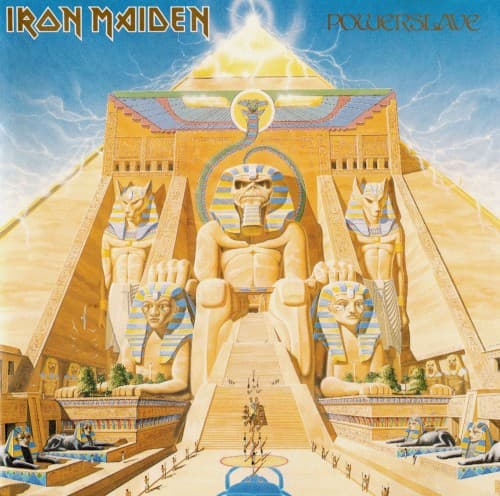
StandoutThe title track and the thematic anchor for the album's Egyptian imagery and the World Slavery Tour stage set. Dickinson wrote the lyric from the perspective of a pharaoh confronting mortality, which he later described as a partial allegory for his life as a rock star, and the arrangement matches the ambition. The intro builds slowly, the verse locks into a mid-tempo groove, and the chorus opens up into one of Dickinson's best vocal melodies on the record. The solo section is the longest on the album outside of "Rime," and it justifies the time: the dual leads climb and diverge, then reconverge in a harmony that lands like a resolution. The production gives the guitars room to breathe, and Birch's mix captures the dynamics—the quiet intro, the building verse, the explosive chorus—without compression. At seven minutes it is the longest track on the album until "Rime," and it earns every second. This is the sound of a band that knows exactly what it is doing and executes without second-guessing.
Rime of the Ancient Mariner
StandoutThirteen minutes and 45 seconds of Samuel Taylor Coleridge adaptation, the longest track Maiden had recorded to that point and the most ambitious narrative they ever attempted. Harris wrote it under time pressure, drawing heavily from Coleridge's 1815-16 gloss to the poem, and the structure shows the influence: multiple movements, tempo shifts, quiet interludes, explosive crescendos. The track opens with a clean guitar figure and Dickinson narrating the story in a hushed voice, then builds through a verse-chorus section, a gallop-driven narrative middle, a quiet breakdown where Harris's bass carries the melody, and a final climax that returns to the opening theme. The lyrics quote two passages from the poem directly, including "Water, water everywhere, nor any drop to drink," and the rest paraphrase Coleridge in a way that tracks the narrative without slavishly following every stanza. The performances are meticulous: Murray and Smith trade leads that develop across sections instead of repeating, McBrain shifts patterns to match the mood changes, and Dickinson modulates his delivery from whisper to scream depending on where the story is. The production captures all of it without losing detail, and the mix keeps the bass audible even when the guitars are at full volume. The question is whether the length is justified, and the answer depends on whether you hear development or repetition. The quiet breakdown in the middle either provides necessary breathing room or stops momentum; the return to the opening theme either completes a circle or overstays a welcome. Both readings are defensible. What is not debatable is that this is the definitive statement of the Dickinson-era lineup, the track that proves Maiden could build a long-form narrative without losing the thread, and the song that fans cite most often when asked what makes this band different from every other metal act of the era. It holds attention for 13 minutes, and after forty years it still reveals new details. That alone justifies the ambition.