The scorecard
8.0/10 · Great
- Songwriting25%
- 8.5
- Sound25%
- 7.5
- Performance15%
- 8.5
- Cohesion15%
- 7.0
- Originality10%
- 8.0
- Replay value10%
- 9.0
Nine tracks of direct, memorable riffs that strip heavy metal to its chassis and rebuild it without the blues sprawl, though the mid-album sag reveals the limits of pure brevity.
Tom Allom's mix turns three instruments into stadium-sized power, with guitar tones so thick and drums so big that analog tricks like cutlery clangs and milk bottles hold up against the real instruments.
Rob Halford commits fully to every hook and scream, K.K. Downing and Glenn Tipton trade leads with precision, and Dave Holland's debut performance anchors the band with clean, powerful drumming.
The first half is relentless and the bookends hit hard, but the middle stretch from 'United' to 'The Rage' loses momentum with shorter ideas that never quite justify their placement.
Against Priest's own catalog and the NWOBHM wave arriving the same week, this album chose simplicity and anthem-writing over complexity, setting the template for arena metal a full year before anyone else figured it out.
The singles have survived forty-plus years of radio rotation without wearing thin, and the deep cuts still sound like blueprints for every band that learned to write a metal song in three minutes.
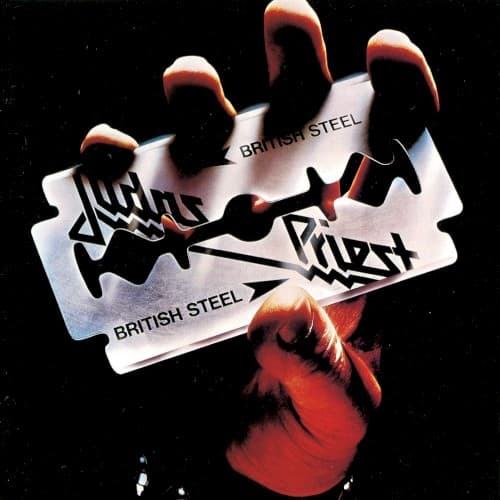
Judas Priest British Steel — Heavy Metal Learns the Three-Minute Thesis
British Steel makes one argument across nine tracks: heavy metal does not need seven minutes or mythological lyrics to leave a mark. Judas Priest had spent the 1970s refining their sound through longer, darker albums, but in April 1980 they released a record that cut every song to its skeleton and dared the riffs to carry the weight alone. The gamble worked because the riffs are bulletproof. Opening track "Rapid Fire" announces the new approach immediately with a one-minute sprint of palm-muted galloping that never stops to explain itself, and closing track "Steeler" ends the album the same way, leaving no room for the blues jams or atmospheric detours that had padded earlier Priest records. Between those two poles the album builds anthems out of hooks so simple they feel inevitable: the two-chord stomp of "Breaking the Law," the robotic march of "Metal Gods," the arena-chant chorus of "Living After Midnight." These are not the band's most ambitious songs, but they are among their most durable, and durability was the point.
The album arrived within days of Iron Maiden's debut and Saxon's Wheels of Steel, three records that together defined the New Wave of British Heavy Metal as a commercial force rather than an underground rumor. But where Iron Maiden leaned on galloping bass runs and Saxon on biker anthems, Priest chose streamlining and volume, recording at Ringo Starr's Tittenhurst Park estate with producer Tom Allom and a pile of analog tricks that included smashing milk bottles for percussion and shaking cutlery trays to simulate marching metal feet. The result sounds bigger than five people in a room, and that scale matters: British Steel is the sound of a band that stopped trying to prove how complex they could be and started writing songs that could fill arenas. The middle stretch sags under its own brevity and a few tracks feel more like sketches than statements, but the peaks are high enough that the album holds its place as the moment Priest figured out how to be Priest.
The Sound of Metal Stripped to Voltage and Chrome
Tom Allom's production isolates each element and amplifies it until the space between notes feels as heavy as the notes themselves. The guitar tone that K.K. Downing and Glenn Tipton locked in here became the reference point for the next decade: thick without mud, sharp without ice, loud enough that every palm-muted chug registers as a physical event. Listen to the rhythm guitars and they sound like engines, each downstroke a piston firing in perfect time. Dave Holland's drums, recorded in his first album with the band, hit with a clarity and power that anchors the whole record. The mix leaves no question about where the power comes from: guitars in the center, bass underneath, drums locked to the kick, vocals on top with just enough delay to fill a stadium.
The songwriting commits to the same reductionist approach. Most of these tracks run three to four minutes and work with one or two riffs instead of the four or five that Priest had used on earlier albums. The band clearly took notes from the AC/DC tour they supported in 1979, learning that repetition is not a weakness if the riff is strong enough to bear the weight. Rob Halford's vocals reinforce the directness: fewer screams than on previous albums, more mid-range melody, phrasing that prioritizes the hook over the pyrotechnics.
When he does let loose, as on the opening scream or the climax of the closer, it lands harder because he has not been doing it for thirty minutes straight.
The weaknesses are structural. Two tracks sit in the middle of the album with good riffs but no real development, ideas that feel like they were written to meet a tracklist length rather than because the band had something urgent to say. One slower track tries to build tension with a moodier verse, but the chorus never pays off the setup and the song drags without the momentum that carries the faster tracks. These are not bad songs, but they are not essential ones either, and on an album that stakes its claim on brevity and impact, filler is harder to forgive. The decision to sequence them together in the back half creates a sag that the album has to recover from, and while the closer does recover it, the momentum never fully returns to the level of the opening run.
An Album That Peaks Early and Ends Strong, With a Soft Middle
The sequencing on British Steel is front-loaded by design, stacking the four strongest tracks in the first five slots and then coasting on goodwill until the closer kicks in. The first stretch is as good as any four-track run Priest ever recorded: relentless, varied enough to avoid monotony, and sequenced so that each song answers the previous one. The tempo shifts down just enough to let the listener breathe before picking up the pace again, and the centerpiece works because it is the simplest and catchiest idea on the album, placed exactly where a radio single should go. That sequence alone would justify the album's reputation.
The back half never matches that intensity. Two strong singles sit next to weaker material and the contrast exposes how much the album depends on its peaks. The middle section occupies space without justifying it, and while neither track is weak enough to skip, neither one makes a case for why it needed to be here instead of another take at the opening's level of urgency. The album feels like it is winding down rather than building to something, and that makes the closer feel like a rescue mission. It works because it returns to the aggression and tightness of the opening, but the fact that the album needs rescuing at all is a problem. At thirty-six minutes British Steel is not long, but the middle stretch still feels like it could have been tighter.
The Album That Chose Anthems Over Epics and Changed the Decade
British Steel ranks as Judas Priest's most influential album because it made a choice that most of their peers were not ready to make in 1980: it prioritized hooks and brevity over ambition and length, and it did so without sounding like a compromise. This is not the band's most complex or adventurous record, but it is the one that distilled heavy metal into a formula that could survive radio, arenas, and decades of imitators. The singles have never left rotation, and the deep cuts still sound like required listening for anyone who wants to understand how metal moved from the club circuit to the mainstream. The middle stretch keeps it from being a flawless record, but the peaks are high enough that the sags barely matter.
This album is for listeners who want to hear where 1980s metal started, and for anyone who thinks Priest is all screams and leather without the songs to back it up. It is not for listeners who want Priest at their most progressive or darkest; for that, go backward to Sad Wings of Destiny or forward to Screaming for Vengeance. Start with "Breaking the Law" and "Rapid Fire" because those are the two songs that every metal band spent the next decade trying to rewrite, then move to "Metal Gods" to hear what Priest could do with atmosphere when they kept it focused. If this album hits, follow it with Screaming for Vengeance to hear the same approach with sharper songwriting, or AC/DC's Back in Black to hear the other band that figured out in 1980 how to make simplicity sound massive. British Steel is not perfect, but it is the record that taught heavy metal how to write a hit without apologizing for being heavy.
Track by track
Track Listing
Breaking the Law
StandoutThe two-chord riff that opens this track is one of the most recognizable moments in metal history, and it earns that status by doing one thing perfectly: it locks into a groove so simple and so heavy that it sounds like it has always existed. Halford's vocal melody in the verse is pure pop structure, rising and falling in predictable intervals, which makes the chorus hit harder when it arrives with a shout-along hook that demands participation. The solo is eight bars of melodic phrasing, no shred, just a clear statement that answers the verse and sets up the final chorus. The milk-bottle smashing that the band recorded for percussion is audible in the intro, a small analog detail that adds texture without overwhelming the song. At two and a half minutes this is the shortest track on the album, and it is also the most essential, the one song that could represent the entire British Steel thesis in a single take. Every second is functional, nothing is wasted, and the song ends exactly when it should. This is Priest at their most efficient and their most lethal.
Rapid Fire
StandoutA one-minute sprint of palm-muted galloping that never lets up, built on a single riff that cycles through the entire song with only minor variations. Holland's drumming is relentless, double-bass patterns that drive the tempo forward without a single fill to break the momentum, and the guitar tone is so thick that the rhythm section sounds like a single instrument. Halford's vocal in the verse is clipped and percussive, matching the rhythm guitar note for note, and when he screams in the chorus it feels like a release of pressure that has been building since the first downbeat. The solo section is the only moment where the song breathes, and even then Tipton and Downing keep the energy high with a trade-off that stays melodic and aggressive at the same time. This is the template for speed metal, recorded a full year before Motörhead's Ace of Spades, and it holds up because the riff is strong enough to carry four minutes without development.
Metal Gods
StandoutThe march of the robots, complete with cutlery trays shaken in front of microphones to simulate metal feet hitting pavement. Halford has said the lyrics came from science fiction and a vague anti-authoritarian sentiment, but the song works because the music sounds exactly like the title: mechanical, cold, heavy, and unstoppable. The main riff is a mid-tempo chug that leaves space for the effects and atmosphere, and the verse vocal is delivered in a near-monotone that reinforces the robotic theme. The chorus is where Halford cuts loose, screaming the title with enough power to break the mechanical mood and assert that humans are still in control of the machine. The solo is brief and melodic, more about mood than flash, and the outro section brings back the marching-feet effect one more time before the song ends abruptly. This is Priest experimenting with atmosphere within the constraints of a four-minute single, and it works because they commit to the concept without overexplaining it.
Grinder
StandoutA thrash riff before thrash was codified, with a verse that locks into a tight palm-muted groove and a chorus that opens up into a more traditional metal gallop. The lyrics describe machinery and industrial violence in broad strokes, nothing specific, just enough imagery to match the aggression of the music. Halford's phrasing in the verse is clipped and rhythmic, almost rapped, and the contrast with the soaring chorus vocal makes the dynamic shift feel bigger than it is. The solo is one of the album's longest, and both Tipton and Downing take turns, trading melodic phrases that build in intensity before dropping back into the final chorus. The song is tight and focused, with no wasted space, and it works as a bridge between the more anthemic singles and the deeper aggression that Priest would explore on later albums.
United
SolidA solid mid-tempo rocker with a good main riff and a serviceable chorus, but it never quite develops into anything more than the sum of its parts. The verse riff is strong, a descending pattern that gives the song forward motion, but the chorus is too similar in tempo and melody to create a real dynamic shift. Halford's vocal is committed and the solo section is well-executed, but the song feels like it was written to fill space rather than because the band had a specific idea they needed to express. It works as a single because it has a hook and a clear structure, but on the album it sits in the middle of the tracklist and contributes to the momentum loss that defines the back half.
Living After Midnight
SolidThe loosest, most rock-and-roll track on the album, with a swing in the rhythm section that comes directly from the AC/DC playbook. The single-note riff that opens the song is simple to the point of being reductive, but it sticks because Halford's vocal melody is strong enough to carry the weight. The lyrics are about nightlife and hedonism in the most general terms, and the song does not try to be anything more than a party anthem. The solo is brief and melodic, staying in the pocket rather than reaching for flash, and the outro brings back the main riff one more time before fading out. This is Priest at their most accessible, and it works as a gateway track for listeners who find the heavier material too intense, but it is not one of the album's essential moments.
You Don't Have to Be Old to Be Wise
WeakThe longest track on the album at just over five minutes, but the length is not earned. The main riff is serviceable and the verse has a decent groove, but the song never develops a strong enough hook to justify its placement or its runtime. The chorus is forgettable, a generic melody that does not stick, and the solo section feels like it is filling time rather than building to anything. Halford's vocal is strong throughout, but he is working with weak material and there is only so much he can do to elevate it. This is the weakest track on British Steel, a filler song that would not be missed if it had been left off the album.
The Rage
WeakA slower, moodier track that tries to build tension with a verse riff that descends in half-steps, but the payoff never arrives. The chorus is louder and faster than the verse, but it does not resolve the tension or provide a strong enough hook to justify the buildup. The lyrics are vague and the vocal melody is unremarkable, and the solo section is competent but does not add anything memorable. This is another track that feels like it was written to meet a tracklist requirement rather than because the band had something they needed to say. It is not bad enough to skip, but it is not good enough to remember.
Steeler
StandoutThe album closer returns to the aggression and tightness of the opening tracks, with a riff that gallops at full speed and a vocal that matches the intensity. Halford pushes into his upper register here, screaming through the chorus with the kind of power that defines his best performances, and the rhythm section locks in with precision and momentum. The solo section is fast and flashy, both guitarists trading leads that build in intensity before dropping back into the final verse. The song ends abruptly, no fade, just a hard stop that leaves the listener wanting more. This is the second-best track on the album after "Breaking the Law," and it works as a closer because it reminds the listener of what the album does best: short, fast, heavy, and completely committed.