The scorecard
8.4/10 · Great
- Songwriting25%
- 9.0
- Sound25%
- 8.5
- Performance15%
- 8.0
- Cohesion15%
- 7.5
- Originality10%
- 8.5
- Replay value10%
- 8.5
Riffs mutate inside songs instead of looping, transitions are violent but engineered, and the thirteen-minute closer earns its length with discrete movements.
Matt Bayles captures the guitar tone as both sludge and clarity, drums hit hard without burying the riff work, and the mix keeps four limbs audible even at maximum density.
Brann Dailor's drumming is both percussive storytelling and machine precision, dual vocals sound genuinely unhinged rather than performed, though some shouts blur into monotone.
The album sustains momentum across fifty minutes with only one instrumental segue, but the middle tracks occasionally flatten into similar tempos without enough dynamic relief.
In 2004 this was progressive metal played with sludge's heaviness and hardcore's aggression, a blueprint that hundreds of bands would copy for the next two decades.
The riffs reveal new details on repeat listens and the album has aged into a clear benchmark: if you know modern progressive metal you know this record.
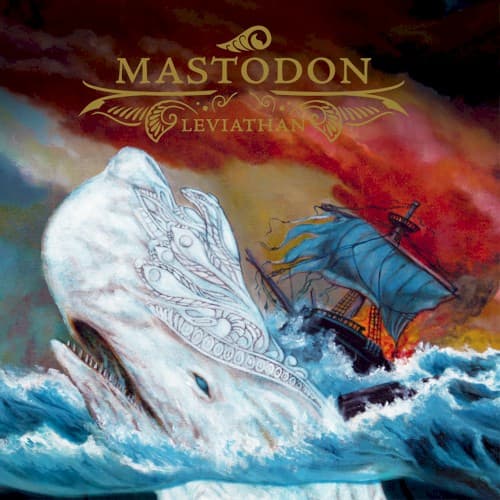
Mastodon Leviathan — When Sludge Learned Fugue State Architecture
Leviathan is progressive metal that refuses to sound like a seminar. Where most bands in 2004 treated technicality as a display separate from heaviness, Mastodon made them the same thing: the riffs are intricate because the songs demand it, and the songs are heavy because the riffs never settle. This is a concept album about Herman Melville's novel, but the literary frame matters less than what it permitted the band to attempt. The Moby-Dick structure gave them license to write ten songs that spiral and collide instead of repeating, to stretch one track past thirteen minutes, and to sequence the album like a hunt that escalates rather than a collection of singles. The result landed Mastodon on year-end lists in three major metal magazines and later topped MetalSucks' poll of the best metal album of the twenty-first century, not because it invented a sound but because it executed one so completely that it became the standard.
The thesis is in the mechanics. Blood and Thunder opens with a riff that sounds like it is being torn in half, and for the next three minutes the song never stops moving: the verses lurch, the choruses double the tempo, and the bridge is a different riff entirely before Neil Fallon's guest vocal drags it back to the hook. That construction, a song built from competing parts that somehow cohere, is the template for the album. I Am Ahab and Seabeast work the same way, piling riff on riff without losing the thread, and even the shorter tracks like Iron Tusk and Naked Burn contain at least three discrete ideas. The band came out of sludge metal, but Leviathan jettisons the genre's devotion to repetition and crawl. This is sludge rewritten as progressive metal's frantic architecture, and in 2004 no one else was playing it this way.
Riffs That Refuse to Loop and Drums That Write the Plot
The songwriting works by constant mutation. Where traditional progressive metal uses clean-to-heavy dynamics and verse-chorus templates, Mastodon writes riffs that change shape inside a single section. Blood and Thunder's main riff is a chugging figure that bends at the third bar, and the song never lets it settle before shifting to a new tempo or a new vocal pattern. I Am Ahab condenses the same approach into two and a half minutes, treating the bridge as a tempo shift rather than a breather, and Seabeast strings together four distinct riffs in four minutes without any of them feeling like filler. The album's best trick is making these transitions sound inevitable rather than stitched together: Hearts Alive, the thirteen-minute closer, moves through at least six movements, from clean guitar arpeggios to blast beats to a melodic coda, and each section grows out of the one before it instead of arriving by cut.
Matt Bayles' production is the other half of the equation. He recorded the guitars heavy enough to satisfy sludge fans but clear enough that the riff work stays audible, a balance that was rare in 2004 when most heavy bands chose one or the other. The drum sound is huge and dry, with Brann Dailor's fills and double-bass runs sitting high in the mix without crowding the guitars. That clarity matters because Dailor's playing is not just accompaniment: he writes countermelodies with the kit, especially on tracks like Megalodon and Aqua Dementia, where the drum patterns shift independently of the riffs. The bass from Troy Sanders is less prominent in the mix, often doubling the guitars rather than carving a separate line, which is the album's one significant production compromise. Alan Douches' mastering is loud but not crushed, and the album retains enough dynamic range that the quiet sections in Hearts Alive and Joseph Merrick feel like actual shifts rather than volume drops.
The vocals are the weakest element, not because of the performances but because the range is narrow. Sanders and Brent Hinds split duties, both shouting in variations on the same mid-range bark, and by the album's back half the tone starts to blur. Neil Fallon's guest spot on Blood and Thunder and Scott Kelly's appearance on Aqua Dementia add texture, but most tracks rely on the same vocal attack without enough melody to offset it. The lyrics paraphrase Moby-Dick without quoting it directly, focusing on the whale as destroyer and the obsession as madness, but the shouted delivery makes them secondary to the riffs. This is not a fatal flaw because the songs do not depend on the vocals to carry them, but it is the one area where the album could have pushed further without losing its identity.
Fifty Minutes That Peak Twice and Sag Once
The sequencing is deliberate. The album opens with its three most immediate tracks, which establishes the sound and the velocity before the pace varies. A brief instrumental functions as the first breather, and the next two continue the aggression with slightly longer development time. The sag comes in the middle: two solid tracks occupy similar tempos and vocal approaches, and by the eighth song the formula starts to show. The album would be tighter at forty-five minutes, either by cutting one of those two or by varying the vocal delivery enough to differentiate them.
The thirteen-minute centerpiece redeems the length. It justifies every minute by treating its runtime as space for development rather than indulgence. The song opens with clean guitars, builds to a mid-tempo riff section, explodes into blast beats, collapses into a melodic interlude, and ends with a triumphant lead guitar coda that feels earned because the song took the time to get there. The closing instrumental with organs from Matt Bayles works as a cooldown, giving the album an ending rather than just stopping. The flow is front-loaded and then recovers: the opening stretch and the final two tracks are the strongest sequence, and the middle section is where attention drifts.
The Album That Made Progressive Sludge a Playbook
Leviathan is the album that proved progressive metal could be played with sludge's weight and punk's momentum, and in 2004 that combination was new enough to feel like a genre shift. It belongs in the top tier of 2000s metal, not because it is flawless but because it executed an idea so convincingly that it became the template. The guitar work, the drum performance, and the production are all operating at a level that most bands in the genre never reach, and the songwriting is ambitious without becoming a flex. The vocal monotony and the slight sag in the middle are real weaknesses, and the album would be stronger if one of the mid-album tracks had been cut or reworked, but those are minor complaints against a record that swings this hard for fifty minutes.
This is for listeners who want heaviness with intricacy, who care about riff construction as much as tone, and who have the patience for a long closer that earns its length. It is not for fans of traditional progressive metal's clean singing and keyboard layers, and it is not for sludge purists who want repetition and crawl. Start with Blood and Thunder to hear the thesis in three minutes, then play Hearts Alive to hear what happens when the band stretches the idea to its limit. If those two tracks work, the album works. For next steps, hear High on Fire's Blessed Black Wings for a simpler take on the same aggression, or Baroness' Red Album for a more melodic evolution of the sound. Leviathan is the record that showed a generation of metal bands how to write songs that are both heavy and complicated without sacrificing either quality, and twenty years later it still sounds like the standard.
Track by track
Track Listing
Blood and Thunder
StandoutThe album's most famous track and its clearest thesis statement, opening with a riff that sounds like it is being pulled apart and then reassembled at a different tempo. The verses lurch in 4/4 with Brent Hinds' shout barely staying ahead of the drums, the choruses double the speed, and the bridge introduces a new riff entirely before Neil Fallon's guest vocal pulls everything back to the main hook. The song never loops: every return to a section includes a variation, whether in the drum fill or the vocal rhythm, and the three-minute runtime feels compressed rather than complete. Brann Dailor's drumming is the structural anchor, with fills that function as transitions instead of decoration, and the production keeps every element audible even when the song is at maximum density. This is the track that made Mastodon a name outside of sludge circles, and it earned the attention by refusing to be either a tech demo or a simple banger.
I Am Ahab
StandoutThe album's shortest full song and one of its most direct, built on a mid-tempo chug that mutates at every repetition. The verses are half-time against the main riff, the bridge shifts to a faster gallop, and the outro is a descending figure that sounds like the song collapsing in on itself. Troy Sanders' bass is more audible here than on most tracks, doubling the guitar in the verses but playing a separate line in the bridge. The vocal delivery is pure shout with no melody, which works for the two-and-a-half-minute runtime but would wear thin if the track were longer. The song feels like a condensed version of the album's longer tracks, proof that the riff-mutation approach works even when there is no time to stretch.
Seabeast
StandoutFour minutes of riff序列 that never settles, moving from a sludgy opening figure to a thrash-tempo verse to a breakdown that sounds like the song grinding to a halt before it lurches forward again. The structure is verse-bridge-verse-bridge-outro with no chorus, which makes the song feel like continuous forward motion rather than a loop. Bill Kelliher and Brent Hinds' guitar interplay is most audible here, with the rhythm and lead parts weaving around each other in the verses and then locking together in unison for the breakdowns. The vocal melody, such as it is, follows the riff contours instead of working against them, which reinforces the heaviness but also limits the dynamic range. The music video for this track was completed in 2006, two years after release, and it remains one of the album's most visually represented songs, though the track itself is stronger than its later promotional push might suggest.
Ísland
SolidA three-and-a-half-minute instrumental that functions as the album's first breather, built on a clean guitar arpeggio that gradually layers in distortion and drums. The track is more atmospheric than the songs around it, with less emphasis on riff complexity and more on dynamics, and it serves as a palate cleanser after the opening sprint. The clean tone is bright and slightly chorused, a contrast to the grinding guitar sound that dominates the rest of the album, and the drums enter halfway through to build momentum rather than establish it. This is the kind of segue that progressive metal albums often use as filler, but Ísland earns its place by giving the listener space to reset before Iron Tusk begins.
Iron Tusk
StandoutA three-minute track that feels like it could have been twice as long, cycling through enough distinct riffs for a five-minute song but compressing them into constant motion. The main riff is a chugging palm-mute figure that bends upward at the end of each phrase, and the verses are built on a half-time groove that gives Brann Dailor space to fill around the beat. The bridge is a brief clean guitar interlude that lasts about ten seconds before the song crashes back into the main riff, a fake-out that barely qualifies as a dynamic shift but functions as one because the song moves so quickly. The vocals are split between Sanders and Hinds, both shouting the same melody in unison, and the lack of variation is noticeable but not fatal. This was released as a promotional single and featured in the Tony Hawk's American Wasteland soundtrack, and it works as a standalone track because it delivers the album's core sound in a compact form.
Megalodon
SolidThe longest track before Hearts Alive at just over four minutes, built on a riff that cycles between palm-muted chugs and open-string drones. The verses are mid-tempo with Sanders' vocal leading, the bridge shifts to a faster thrash section, and the outro is a breakdown that lets the riff decay into feedback before cutting. Brann Dailor's drumming is the highlight, playing a countermelody to the main riff in the verses and then shifting to a blast beat in the bridge without losing the groove. The song title references the prehistoric shark, tying into the Moby-Dick concept, but the lyrics are general enough that the theme does not dictate the structure. This track was released as downloadable content for Rock Band, and its riff-heavy construction makes it a good fit for the rhythm game format, though it is one of the album's less essential songs when sequenced in full.
Naked Burn
WeakA solid but unremarkable track that occupies the same tempo and vocal approach as the songs around it, making it one of the album's few moments that feel like filler. The main riff is a descending figure that repeats with minor variations, and the verses are built on a half-time groove that sounds like a slower version of Megalodon's structure. The bridge introduces a new riff but it arrives too late to differentiate the song, and the outro is a fade on the main riff rather than a conclusion. The vocals are shouted in unison by Sanders and Hinds with no melody, and by this point in the album the lack of vocal variety is starting to drag. The song is not weak by the standards of the genre, but it is weak by the standards of this album, and the sequencing would be stronger if this track had been cut or reworked.
Aqua Dementia
SolidA four-minute track featuring guest vocals from Scott Kelly of Neurosis and cello from Phil Peterson, both of which add texture without fundamentally changing the song's structure. Kelly's vocal is a deeper growl than Sanders or Hinds can manage, and it provides a brief contrast in the verses, but the majority of the track is still mid-tempo chugging with shouted vocals. The cello appears in the intro and the bridge, playing long tones that sit under the guitars rather than leading, and the effect is more atmospheric than melodic. The song is stronger than Naked Burn because of the guest contributions and the slightly more varied riff work, but it still occupies a similar space in the album's pacing, and the back-to-back placement of these two tracks is where the sequencing sags. The production captures the cello well, keeping it audible without letting it dominate, and Matt Bayles' choice to feature it in the mix rather than bury it is the right one.
Hearts Alive
StandoutThe album's centerpiece and its longest track at nearly fourteen minutes, justifying the runtime by treating it as space for development rather than repetition. The song opens with a clean guitar arpeggio and brushed drums, building slowly for the first two minutes before the distortion enters and the main riff begins. The first movement is a mid-tempo chug with Sanders' vocal leading, the second movement shifts to a faster thrash section with Hinds on vocals, and the third movement is a breakdown that lets the riff decay before rebuilding into a blast beat section. The fourth movement is a melodic interlude with clean guitars and no vocals, functioning as a breather before the final movement, which is a triumphant lead guitar coda that resolves the song's tension and feels earned because the track took the time to get there. Brann Dailor's drumming is the structural spine, shifting between grooves and blast beats and fills without losing the thread, and the transitions between movements are seamless rather than stitched together. This is the track that proves Mastodon can write long-form compositions that work as songs rather than exercises, and it is the album's peak.
Joseph Merrick
SolidA three-and-a-half-minute instrumental closer featuring organs from Matt Bayles, named after the historical figure known as the Elephant Man. The track is quieter and slower than the rest of the album, built on a clean guitar melody and organ drones that give the album an ending rather than just stopping after Hearts Alive. The drums are sparse, mostly cymbal work and tom hits, and the bass plays a melodic line that mirrors the guitar. The song is more of a cooldown than a statement, and it functions as a palette cleanser after the intensity of the previous nine tracks. The organ tone is warm and slightly distorted, sitting in the middle of the mix rather than leading, and the production choice to feature it as a texture rather than a lead instrument is the right one. This is not a strong track on its own, but it serves its purpose in the sequencing.