The scorecard
8.5/10 · Essential
- Songwriting25%
- 8.5
- Sound25%
- 9.0
- Performance15%
- 7.5
- Cohesion15%
- 8.0
- Originality10%
- 9.5
- Replay value10%
- 8.5
The three-motif structure across 62 minutes and the single-riff variations on 'Jesu død' stretch minimal ideas to their absolute limits without breaking them.
The stereo-amp guitar tone and helicopter headset vocals are deliberately degraded but preserve every compositional detail the album needs.
The vocals are half-buried howls and the drumming is metronomic, serving atmosphere over technique, though the guitar phrasing holds focus across all durations.
The E minor key lock on the first three tracks and the Decrepitude pairing establish clear movements, though the 25-minute ambient piece divides the second half.
Recording black metal through a stereo amp in 1993 and building half the runtime on single-melody repetition had no precedent in the genre.
The riffs are simple enough to recall instantly but arranged to reveal new details in the layers on each listen, and the lengths now feel essential rather than excessive.
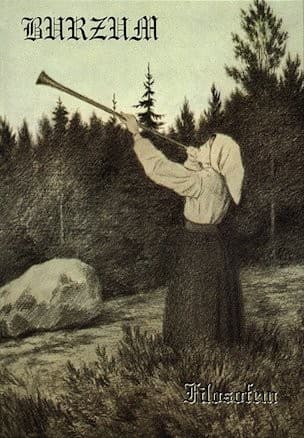
Burzum Filosofem — Black Metal Learns to Sit Still
Filosofem is the album where Norwegian black metal stopped sprinting and started staring. Recorded in March 1993 but held until January 1996, it strips the second wave down to three guitar motifs, a broken fuzz tone, and the patience to let a single riff cycle for eight minutes without variation. Varg Vikernes called it an anti-trend record, and the method proves the claim: while his peers were sharpening their tremolo attacks and tightening their blastbeats, he plugged his guitar into his brother's stereo amplifier, sang into a helicopter headset, and built six tracks that move like fog rather than fire. The result is black metal as trance music, where repetition is the structure and degraded sound is the atmosphere.
The thesis is in the opening track. 'Burzum' rides a two-chord riff and a synthesizer melody for seven minutes, neither of them developing, both of them hypnotic. That synthesizer line does more work than most black metal albums manage with a dozen riffs: it sits on top of the distortion like a frozen horizon, turning a simple E minor progression into something vast and patient.
Vikernes had written the song in 1992 as the first Burzum composition, tried it once for Hvis lyset tar oss, hated the sound, and re-recorded it six months later under worse conditions. The 1996 release would place it at number nine on Decibel's Top 100 Black Metal Albums list two decades later, and a music video for the German-titled version 'Dunkelheit' would air on MTV and VH1, an absurdity that speaks to how far ahead of the genre's commercial curve this album was. The gap between recording and release matters: Filosofem was finished before Vikernes murdered Euronymous in August 1993 and was sentenced to prison in May 1994, making it both the last document of his brief creative run and a record that arrived into a scene that had already moved past it. It sounds like it was made for no audience at all.
Fuzz, Repetition, and the Limits of Less
The production is the composition. Vikernes recorded Filosofem at Grieg Hall in Bergen with producer Pytten, the same space used for the previous three Burzum albums, but this time he engineered the sound to fail. The guitar tone comes from a borrowed stereo amplifier and old fuzz pedals, yielding a distortion that is dense and blurred rather than sharp. The vocals were tracked through the worst microphone the engineer could find, which turned out to be a surplus helicopter headset, burying the voice in static and distance.
The drums are programmed or played with metronomic simplicity, serving as timekeepers rather than dynamic elements. The result is black metal as murk: every instrument occupies the same grey middle distance, and clarity is sacrificed to create a wall of sound that forces the listener to lean in rather than be assaulted. It is lo-fi by design, not by budget, and it works because the compositions are built to survive degradation. A sharp riff would be wasted here; a simple one becomes architecture.
The songwriting operates on motif rather than progression. 'Jesu død' is eight and a half minutes of a single riff, shifting only in texture and vocal phrasing, testing how long a two-bar idea can hold attention before it becomes mantra. 'Beholding the Daughters of the Firmament' adds a second motif midway through but returns to the first, anchoring the track to its opening gesture. The first three songs are all in E minor, locking the album into a single tonal center and making the shifts between tracks feel like movements within a suite rather than separate compositions. The Decrepitude pair splits a single idea across two tracks: the first keeps the guitars in front and adds buried vocals, while the second is instrumental and foregrounds the keyboard melody and sound effects that were background textures in the first version. It is minimalism by accumulation, where repetition is not laziness but method, and the album's 62-minute runtime is justified by how much weight each motif can carry.
The weakness is in the gaps. 'Rundtgåing av den transcendentale egenhetens støtte' is 25 minutes of a single bass ostinato that switches to a harmony ostinato halfway through, and while the piece has its own logic as ambient music, it stops the album's momentum entirely. Placed between the two Decrepitude tracks, it divides the second half into two separate listening experiences rather than one arc. The vocals across the album are mixed so far back that entire passages lose their foreground element, which serves the atmosphere but makes some tracks feel underwritten. And the simplicity of the drumming, while effective as pulse, occasionally flattens dynamics that a human drummer might have inflected. These are not failures of execution but choices that limit the album's range: Filosofem is patient to the point of stasis, and that patience will either lock you in or leave you waiting for something that never arrives.
The Album as One Long Descent
Filosofem sequences its material as a slow withdrawal from black metal into ambient void. The first three tracks are the metal core: distorted guitars, vocals, and drums, though each one is slower and more repetitive than most second-wave records would allow. The progression from the synthesizer-led opener to the single-riff hypnosis of the second track to the two-motif structure of the third establishes the album's method, and by the time the first Decrepitude track arrives seven minutes of additional motif development feels almost generous. Then the middle stretch stops the metal entirely and commits to 25 minutes of keyboard-driven repetition, a centerpiece that functions as an intermission or an endurance test depending on your tolerance for stasis. The fact that the piece was later used in the Gummo soundtrack suggests it works as ambient music on its own terms, but placed in the middle of the album it creates a gap that the closing section has to bridge on the other side.
The length is both the point and the problem. At 62 minutes, Filosofem is asking for full immersion, and the longest track is designed to function as a trance state rather than a song. The pacing works if you accept that the album is not building toward a climax but deepening a single mood. If you are listening for riffs and development, the second half will feel like it has run out of ideas. The flow between the paired Decrepitude sections is clever: hearing the same material twice with different emphasis reveals how much texture Vikernes layered into the background, but it also means the album ends on a restatement rather than a resolution. Filosofem does not end; it just stops.
The Record That Defined Atmospheric Black Metal Before the Term Existed
Filosofem is Burzum's most influential album and the one that has aged best, not because it captured the Norwegian scene but because it ignored it. While Darkthrone were tightening their riffs and Emperor were adding symphonics, Vikernes was recording black metal through broken equipment and letting single ideas stretch past the point where most bands would have moved on. The result is the template for every atmospheric and depressive black metal record that followed: the lo-fi aesthetic as deliberate choice, the repetition as compositional structure, the ambient passages as equal partners to the metal, and the willingness to let a 25-minute drone piece sit in the middle of the tracklist without apology. It is not the most violent Burzum album or the most dynamic, but it is the one that proved black metal could work as trance music, and it did so with three motifs and a broken amplifier.
This is for listeners who want black metal to slow down and stretch out, who hear atmosphere as a goal rather than a side effect, and who can let a riff repeat for eight minutes without needing a chorus or a breakdown. Skip it if you need sharp production, dynamic drumming, or songwriting that develops rather than circles. The best entry point is the opening track, which shows the method in its most compact form, followed by 'Jesu død' to test your patience for single-riff structures.
If those two tracks work, the rest of the album will follow. If they do not, the 25-minute ambient piece will be a wall. The albums to hear next are Hvis lyset tar oss for a slightly sharper version of the same approach, and Darkthrone's Transilvanian Hunger for a different take on lo-fi minimalism. Filosofem is the record where black metal learned to sit still and discovered that stillness could be heavier than speed.
Track by track
Track Listing
Burzum
StandoutThe opening track is the album's clearest statement and its most accessible entry point. The synthesizer melody that runs across the entire seven minutes is the hook, sitting above the two-chord guitar progression and the buried vocals like a frozen sky. The riff itself is simple, a descending E minor figure that repeats without variation, but the way the synth line interacts with it creates the illusion of development: the melody does not change, but your attention moves across its layers. The vocals are mixed so far back they function as texture rather than narrative, and the drumming is a metronomic pulse that never deviates. This was the first song Vikernes wrote as Burzum, originally intended for Hvis lyset tar oss but re-recorded here under worse conditions, and the degraded sound is what makes it work. A sharper production would have exposed how little is happening; the murk makes the repetition hypnotic. The German-titled version 'Dunkelheit' received a music video that aired on MTV, a surreal moment of mainstream exposure for a record this patient and this lo-fi.
Jesu død
StandoutThis is minimalism as endurance test: eight and a half minutes of a single two-bar riff, cycling without variation, building atmosphere through sheer persistence. The riff is a slow tremolo figure in E minor, and the only changes across the runtime are in vocal phrasing and slight shifts in texture as the fuzz distortion thickens and thins. There is no chorus, no bridge, no second riff to provide contrast. The track asks whether a single idea can hold attention for this duration if the tone and the repetition are hypnotic enough, and the answer is yes, but only if you meet it halfway. The vocals are half-buried howls, more rhythm than lyric, and the drumming is a slow 4/4 that never accelerates or adds fills. It is black metal as mantra, and it either locks you into a trance or leaves you waiting for something that never arrives. The length is the point: this is not a riff that needed development, but a riff that needed time to sink in.
Beholding the Daughters of the Firmament
StandoutThe longest of the three metal-focused tracks, this one introduces a second motif midway through but keeps returning to the opening riff, using contrast to reinforce rather than escape the central idea. The main riff is another slow E minor tremolo line, slightly more melodic than the one on 'Jesu død', and the second motif is a descending figure that appears around the four-minute mark, provides a brief shift in texture, and then disappears back into the first riff. The vocals are more present here than on the previous track, though still buried, and the synth layers are more active, adding a sense of movement to what is still a fundamentally static composition. The title suggests a cosmic or mythological scale, and the music matches that ambition by stretching a simple idea across nearly eight minutes without breaking it. The weakness is that the second riff is not developed enough to justify its appearance: it functions more as a texture shift than a compositional event, and the track would have worked just as well without it.
Decrepitude I
SolidThe first of the paired tracks, this one keeps the distorted guitars in the foreground and adds buried vocals, functioning as the more metal-adjacent version of the idea. The riff is minimal, a slow progression that repeats with slight variations in phrasing, and the background contains keyboard melodies and sound effects that are easy to miss on a first listen. The vocals are mixed so far back they are almost subliminal, more atmosphere than performance, and the drumming is metronomic. The interest is in how much texture Vikernes layered into the background: there are synth lines, ambient noise, and subtle harmonic shifts that only become audible once you know to listen for them. Heard on its own, this track is solid but unremarkable; heard as the first half of a paired structure, it gains function as setup for the instrumental version that follows later.
Rundtgåing av den transcendentale egenhetens støtte
SolidTwenty-five minutes of a single bass ostinato that switches to a harmony ostinato halfway through, this is Burzum's longest ambient piece and the most divisive track on the album. The first half is built on a repeating low-end pulse with keyboard melodies layered on top, creating a slow, hypnotic drone that functions as trance music or background atmosphere depending on how you approach it. Around the midpoint, the bass ostinato drops out and a harmony ostinato takes over, shifting the texture but not the method: this is still one idea repeating for the duration, asking the listener to sink into the repetition rather than wait for development. The piece was later featured in the Gummo soundtrack, which suggests it works as ambient music in its own right, but placed in the center of Filosofem it stops the album's momentum entirely and divides the runtime into two separate experiences. If you are listening for black metal, this is an obstacle. If you are listening for atmosphere, it is the deepest point on the record. The length is either justified by the trance state it creates or unjustifiable because the idea does not develop. There is no middle ground.
Decrepitude II
SolidThe instrumental counterpart to the first Decrepitude track, this version removes the vocals and foregrounds the keyboard melody and sound effects that were buried in the background of the first version. Hearing the same material twice with different emphasis reveals how much layering Vikernes built into the original: the synth lines are more intricate than they seemed, and the ambient noise creates a sense of space that the guitars obscured. The riff is the same slow progression, and the drumming is the same metronomic pulse, but the absence of vocals shifts the focus entirely. It is a clever structural choice, and it works as a way to end the album by revisiting earlier material rather than introducing new ideas. The weakness is that it also means the album ends on a restatement rather than a resolution, and after 25 minutes of ambient drift, a return to the Decrepitude motif feels less like closure and more like the album simply running out of track slots.