The scorecard
8.4/10 · Great
- Songwriting25%
- 8.5
- Sound25%
- 9.0
- Performance15%
- 9.0
- Cohesion15%
- 7.0
- Originality10%
- 8.0
- Replay value10%
- 8.5
Fibonacci-structured title track and suites like Disposition/Reflection/Triad demonstrate compositional architecture that serves musical ideas rather than just displaying cleverness.
David Bottrill's mix at Cello Studios gives each instrument clarity in dense polyrhythmic passages while maintaining crushing weight on Ticks & Leeches.
Danny Carey's drumming on the title track and Ticks & Leeches ranks among the most technically demanding performances in metal without sacrificing groove.
The 79-minute runtime earns most of its length through the three-song Disposition suite, but ambient interludes like Mantra and Eon Blue Apocalypse pad the sequencing.
The move from alternative metal to full progressive architecture in 2001 predated the prog revival by several years and brought mathematical rigor to heavy music.
Two decades on, the album rewards close study more than casual listening, with details like the 987 time signature pattern emerging only after repeated exposure.
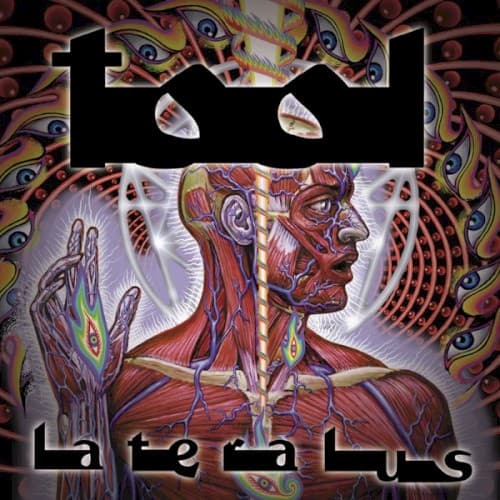
Tool Lateralus — Math Metal Learns to Breathe
Lateralus proves that technical ambition in metal does not require sacrificing dynamics for complexity. Where most progressive metal in 2001 meant either dream theater-style virtuoso runs or atmospheric post-rock drift, Tool built an album around structural ideas—Fibonacci sequences, three-song suites, polyrhythmic cycles—that function as songwriting tools rather than as displays. The thesis is audible in the title track: a 9:22 composition that uses the mathematical sequence to determine syllable counts and time signatures, yet never announces itself as a puzzle. The song works as a hypnotic spiral before you notice the architecture, and the architecture deepens rather than explains the effect.
The stakes were commercial as much as artistic. After a four-year legal dispute with Volcano Entertainment stalled new material, Tool returned with a 79-minute album that sold 555,200 copies in its first week and debuted at number one on the Billboard 200. That success suggested an audience for patient, layered metal at the peak of nu-metal's radio dominance. The album earned a Grammy for Schism in 2002 and triple platinum certification by 2021, proving the commercial viability of music that refuses to resolve quickly. Lateralus marked Tool's full transition from the alternative metal of Undertow into progressive territory, recorded at Cello Studios and The Hook with producer David Bottrill, who had helmed the previous album. The result is not flawless—the runtime includes filler, and some ideas overstay their clarity—but it remains the clearest argument for progressive metal as a compositional discipline rather than a genre of solos.
Polyrhythm as Structure, Not Decoration
The songwriting treats odd time signatures and layered rhythms as foundational rather than ornamental. The Grudge opens the album with a seven-minute build that cycles through shifting meters without announcing the changes; the riff and vocal phrasing make the transitions feel inevitable rather than imposed. Danny Carey's drumming anchors the complexity: his work on Ticks & Leeches, ranked third on NutSie.com's Top 100 Rock Drum Performances, demonstrates how technical precision can intensify aggression rather than diffuse it. The song is the album's most direct assault, with Carey's double bass work and Adam Jones's guitar tone recalling the sludge of earlier Tool records, but the rhythmic interplay between Justin Chancellor's bass and Carey's kit turns brute force into architecture.
The production, handled by Bottrill and the band at Cello Studios and several North Hollywood facilities, gives each instrument space in the mix without sacrificing heaviness. The guitar tone on Schism is dry and percussive, allowing Jones's riff to function as both rhythm and melody, while Chancellor's bass sits forward enough to articulate the contrapuntal lines that make the song's 6:43 runtime feel economical. Bottrill's mix on Reflection, an 11-minute centerpiece, keeps the low end clear even as Carey layers piano string samples and delays across the stereo field. The mastering by Bob Ludwig used HDCD technology, and the clarity holds up two decades later, particularly in how the quietest passages—Parabol, Disposition—retain detail rather than disappearing into ambient wash.
Maynard James Keenan's vocal approach shifts across the album, from the controlled rage of The Patient to the floating melodies of Parabola, but his phrasing often works against the expected downbeats, creating tension with the rhythm section rather than doubling it. On the title track, his syllable counts follow the Fibonacci sequence (1,1,2,3,5,8), aligning with the song's 9/8, 8/8, 7/8 time signature pattern to create a spiral effect in both lyric and meter. The concept could collapse into gimmick, but the vocal melody is strong enough to work without knowing the math. Producer David Bottrill revealed in interviews that the lyrics to Schism were rewritten after Adam Jones felt the original version too explicitly addressed tensions within the band; the final version keeps the emotional core but broadens the application, and the change makes the song more durable.
The weakness is consistency. For every suite like Disposition/Reflection/Triad—three linked tracks totaling over 22 minutes that justify their length through patient development—there are brief interludes like Mantra and Eon Blue Apocalypse that function more as padding than as necessary breaths. Mantra is Keenan squeezing his cat, slowed down; Eon Blue Apocalypse is a minute-long guitar figure. Both serve as palate cleansers, but they also contribute to a 79-minute runtime that the manufacturer barely guaranteed the band could fit on a CD. Danny Carey stated the band had to cut segues during mastering, and the album would benefit from tighter editing. The vinyl edition resequences Disposition to balance the sides, breaking the segue into Reflection, which suggests even the band recognized the tracklist as negotiable rather than sacred.
The Album as Expanding Spiral
The sequencing mirrors the Fibonacci concept: escalation, breath, escalation. The opening stretch establishes the album's patient aggression and extends it through multiple movements. The middle section tightens the approach into the album's most compressed statement, and the pairing of two connected pieces functions as a single ten-minute emotional peak. The ambient build earns the release of the main riff, where the compositional discipline serves catharsis rather than just complexity.
The back half sags before it peaks. One necessary reminder of unsubtle crushing sits awkwardly, breaking momentum rather than building it. The real arc resumes with the three-song suite that closes the album. Two meditative pieces run 4:46 and 11:07 of slow builds and textural layering, but they earn the six-minute instrumental that brings back the heaviness. The sequence works because it refuses to resolve quickly; the patience required to sit through the penultimate stretch makes the final heavy piece hit harder. The closing track samples a 1997 call to Art Bell's Coast to Coast AM radio show and ends the album on dissonance rather than resolution, functioning more as a conceptual coda than as music, which makes the 79-minute runtime feel indulgent rather than earned.
The Case for Patience in Heavy Music
Lateralus ranks as Tool's fullest embrace of progressive metal, the album where mathematical structure and crushing weight found equilibrium. It is not their most immediate record—Undertow has more direct songs, and the follow-up 10,000 Days would tighten some of the sprawl—but it is their most ambitious, and the ambition mostly justifies itself. The Fibonacci conceit could have been a gimmick; instead it provided a compositional framework that made the songs cohere across a length that would sink most metal albums. The record's commercial success, debuting at number one and selling over 555,200 copies in its first week, proved that progressive metal could reach beyond the niche that had contained it since the late 1980s.
This album is for listeners who want metal to reward study rather than provide immediate release, and who can tolerate a 79-minute runtime that includes genuine filler. Skip it if you need songs under five minutes or if you find polyrhythm exhausting rather than hypnotic. The best entry points are the six-minute compressed approach and the ten-minute pairing that demonstrates how the band's patience serves emotional payoff. The title track is essential for understanding the compositional ambition, and the closing three-song suite is worth hearing for how it recasts heaviness as the resolution of tension rather than as constant assault.
For further listening, the earlier album from this producer, along with the band's subsequent work, shows the trajectory: Lateralus is where they committed fully to structure as the song itself. Twenty years later, it remains the strongest argument that progressive metal can be both technically rigorous and physically overwhelming, that math and heaviness are not opposed but complementary. The album does not go beyond its influences so much as it synthesizes them into something that still sounds like an outlier in 2001 and has aged into a standard that most progressive metal since has failed to meet.
Track by track
Track Listing
The Grudge
StandoutThe album's opening argument: eight and a half minutes that establish patient aggression as the governing principle. The song cycles through multiple riff variations and tempo shifts without announcing the changes, as Danny Carey's drumming guides the transitions through feel rather than through obvious cues. Maynard James Keenan's vocal builds from a low mutter to a sustained scream that stretches past a minute in the final section, demonstrating control and endurance rather than just volume. The track works because the length serves development; each section earns its place by adding new rhythmic or melodic information rather than repeating for emphasis. The mix keeps the low end clear even as layers accumulate, and the song's arc from controlled to chaotic mirrors the lyrical theme of releasing resentment. A strong opener that sets expectations the album mostly meets.
Eon Blue Apocalypse
SolidA one-minute instrumental interlude featuring a clean guitar figure and ambient wash. It functions as a breath between The Grudge and The Patient, but adds little beyond pacing.
The Patient
StandoutSeven minutes of controlled menace, with a main riff that shifts between 5/8 and 7/8 without disrupting the groove. Keenan's vocal phrasing works against the expected downbeats, creating tension with the rhythm section that makes the song feel unstable even as it locks into a hypnotic cycle. The production highlights the space between instruments: Justin Chancellor's bass articulates melodic counterpoints rather than just doubling the guitar, and Carey's hi-hat work provides texture in the quieter sections. The song builds to a release that never quite arrives, which serves the lyrical theme of patience but also makes the track feel slightly unresolved. The structure is strong enough to carry the length, though the final two minutes could be trimmed without loss.
Mantra
SolidThe sound of Maynard James Keenan gently squeezing one of his cats, slowed down and processed. At just over a minute, it serves as a palate cleanser, but contributes to the sense that the album's 79-minute runtime includes padding.
Schism
StandoutThe album's most economical statement, and its most successful: six minutes and 43 seconds that earned a Grammy for Best Metal Performance in 2002 and proved progressive structure could function in single format. The main riff is a polyrhythmic conversation between Chancellor's bass and Jones's guitar, each instrument playing against the other's downbeat to create a push-pull tension that mirrors the lyrical theme of fractured communication. Keenan's vocal melody is the song's strongest on the album, and it works independently of the complex rhythm section, which makes the song accessible even as it refuses to resolve in 4/4. Producer David Bottrill revealed that the lyrics were rewritten late in the process after Adam Jones felt the original version too explicitly addressed band tensions; the final version keeps the emotional core but broadens the application, and the change strengthens the song by making it less specific. The production is dry and percussive, with each instrument occupying its own space in the mix, and the mastering by Bob Ludwig keeps the clarity even at high volume. The track remains the best entry point to the album for listeners new to Tool's progressive era.
Parabol
StandoutThree minutes of ambient build, with clean guitar arpeggios and Keenan's floating vocal melody establishing a meditative space. The track functions as the first half of a ten-minute composition, and it earns its place by creating tension that Parabola will release. Carey sampled himself breathing through a tube to simulate Buddhist monk chanting, and the texture adds weight to what could have been a simple interlude. The song works only in sequence with Parabola; separated, it feels incomplete.
Parabola
StandoutThe release that Parabol promised: six minutes of the album's most direct heaviness, with a main riff that hits harder because of the patience required to reach it. The song's structure is relatively straightforward compared to the rest of the album—verse, chorus, bridge—but the riff itself is complex enough to justify the repetition, and Keenan's vocal melody in the chorus provides the emotional peak that much of the album withholds. The ten-and-a-half minute music video for this track, mentioned in Rolling Stone's coverage, posed a challenge to music programming in 2001, but the song's accessibility made it one of the album's most successful tracks. The pairing of Parabol and Parabola demonstrates how Tool's patience serves catharsis rather than just delaying it, and the combination ranks among the album's strongest moments.
Ticks & Leeches
SolidThe album's most direct assault, and its least progressive: eight minutes of sludge-heavy aggression with minimal rhythmic complexity. Danny Carey's drumming, ranked third on NutSie.com's Top 100 Rock Drum Performances, is the track's justification—his double bass work and tom patterns turn brute force into precision without sacrificing intensity. The song recalls the alternative metal of earlier Tool records more than the progressive architecture of the rest of Lateralus, and it sits awkwardly after Parabola, breaking momentum rather than building it. The track is necessary as proof that Tool can still crush without subtlety, but it also reveals the limitation of their heavier mode: when the complexity drops, the songs become less distinctive. The vocals are the weakest on the album, more shouted than phrased, and the riff is effective but not memorable. A solid track that would work better elsewhere in the sequence.
Lateralus
StandoutThe album's conceptual centerpiece and its strongest defense of progressive metal as compositional discipline. The song uses the Fibonacci sequence to structure syllable counts and time signatures—9/8, 8/8, 7/8 correspond to the sequence's 9,8,7 pattern, and Keenan's phrasing follows 1,1,2,3,5,8 in syllables per line. The concept could collapse into gimmick, but the vocal melody is strong enough to work without knowing the math, and the structure serves the lyrical theme of spiraling outward toward knowledge and expansion. The riff cycles through variations rather than repetitions, and Carey's drumming makes the odd meters feel like natural phrasing rather than imposed difficulty. The song's 9:22 runtime is justified by patient development: new rhythmic and melodic information appears throughout, and the final section builds to a release that feels earned. The production keeps the polyrhythmic layers clear, with each instrument occupying distinct space in the mix. The track is essential for understanding the album's ambition, and it remains the clearest example of how mathematical structure can deepen rather than distract from musical effect. A landmark track in progressive metal.
Disposition
SolidThe beginning of the three-song suite that closes the album: four minutes and 46 seconds of slow build and textural layering. Clean guitar, bass drones and ambient washes establish a meditative space, with Keenan's vocal melody barely emerging from the mix. The track is nearly static—it develops through accumulation of texture rather than through harmonic or rhythmic change—and it requires patience that not every listener will grant. The song works as the first movement of a 22-minute composition, but isolated it feels incomplete. The vinyl edition moves this track earlier in the sequence to balance the sides, breaking the segue into Reflection, which suggests even the band recognized the suite as negotiable. Necessary for what follows, but not strong enough to stand alone.
Reflection
SolidEleven minutes of the album's most extreme patience: a single idea developed through layering, repetition and gradual intensification. Danny Carey banged piano strings for samples and used delays to create shifting textures across the stereo field, and the production by David Bottrill keeps the low end clear even as the track accumulates density. The song is meditative to the point of stasis for the first half, with minimal harmonic movement and a tempo that barely qualifies as a pulse. The second half introduces a main riff and allows the drums to move from ambient texture into groove, but the development is so gradual that the song tests even sympathetic listeners. The track earns its length only if you accept its refusal to resolve quickly; the patience required to sit through the slow build makes the final section hit harder, but the calculus does not work for everyone. The song is essential to the suite's arc—it creates the tension that Triad will release—but it is also the album's most divisive moment, the point where compositional ambition and listener endurance collide.
Triad
StandoutThe instrumental resolution of the Disposition/Reflection/Triad suite: six and a half minutes that bring back heaviness after 16 minutes of meditation. The main riff is built on a descending figure that Carey's drums drive into a groove, and the track builds intensity through repetition and layering rather than through structural complexity. Live performances of the suite have featured guests like members of Meshuggah, King Crimson and Mike Patton, and the track's openness to collaboration suggests it functions more as a groove than as a composition. The song works because it refuses to develop too quickly; the patience built through Disposition and Reflection makes the release feel earned rather than rushed. The track is the suite's payoff, and it justifies the preceding 16 minutes for listeners who grant the premise. Without the suite's context, it is a solid instrumental that does not rank among the album's most essential moments, but within the sequence it is the necessary conclusion.
Faaip de Oiad
WeakA 2:41 noise piece sampling a 1997 call to Art Bell's Coast to Coast AM radio show, with the caller claiming to be a former Area 51 employee warning of extraterrestrial danger. The title is Enochian for The Voice of God. The track is processed and distorted to the point of near-incomprehensibility, and it ends the album on dissonance rather than resolution. It functions as a conceptual coda—a final statement that refuses closure—but it also makes the 79-minute runtime feel indulgent. The track is more interesting as an idea than as something to listen to repeatedly, and it weakens the album's ending by following the earned resolution of Triad with unearned chaos. Skippable.