Style & Context
Influences
19th-century Nordic landscape photography, medieval woodcuts, folk art documentation
Location
This pastoral retreat reflected the scene's post-imprisonment phase, with key figures incarcerated or seeking distance from violence.
Visual Language
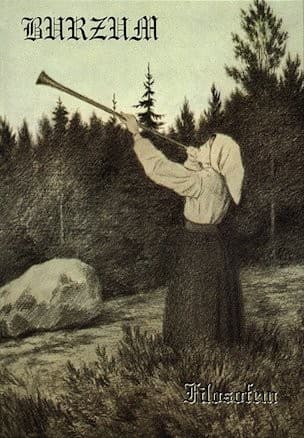
The grainy, underexposed quality matches Filosofem's notoriously raw production, making visual aesthetics mirror sonic minimalism.
Symbols
Horn blower facing forest
The figure summons ancestral spirits while turning away from civilization, embodying black metal's misanthropic paganism.
Corpsepaint in daylight
Wearing black metal makeup in natural light strips it of theatrical menace, transforming it into ritual warpaint.
Boulder and evergreens
The primordial landscape represents permanence against human transience, anchoring the scene in geological time.
Where Sound Meets Image
The cover's sparse, repetitive visual elements mirror Filosofem's hypnotic minimalism across tracks like 'Dunkelheit' and 'Jesus' Tod.' Just as Vikernes stripped black metal to skeletal guitar lines and ambient drones, the photograph reduces metal imagery to lone figure, forest, and horn. The sepia grain matches the album's deliberately degraded production, recorded on cheap equipment to achieve primitive purity. The horn evokes 'Gebrechlichkeit II's' medieval ambient passages, suggesting folk traditions beneath black metal's modern aggression.
Filosofem established the template for atmospheric black metal artwork: lo-fi nature photography replacing elaborate paintings or shock imagery. Countless Cascadian and depressive black metal bands adopted this aesthetic of solitary figures in forests, making the style nearly synonymous with the subgenre. The cover's refusal of legibility—obscured face, amateur composition—influenced bands like Wolves in the Throne Room and Paysage d'Hiver who similarly embrace visual austerity. Even as black metal diversified, this image remains shorthand for the genre's misanthropic, nature-worshipping strain.