The scorecard
9.5/10 · All-time
- Songwriting25%
- 9.5
- Sound25%
- 10.0
- Performance15%
- 9.5
- Cohesion15%
- 9.0
- Originality10%
- 9.0
- Replay value10%
- 10.0
Ten songs, ten riffs per song minimum, zero repetition, every track ending exactly when it needs to the architecture of Angel of Death and Raining Blood alone justifies the score
Rubin stripped out the reverb and made 220 bpm legible: every kick drum hit and tremolo pick lands exactly where Lombardo puts it, no blurring
Lombardo's performance throughout is the fastest recorded drumming that stays metronomically tight; Araya's scream on Angel of Death was first-take for a reason
Twenty-nine minutes sequenced as one accelerating argument from Angel of Death to Raining Blood, no fat, though the middle six tracks blur into a similar tempo
First thrash album to strip tempo changes down to pure speed without losing structure, and the first metal production to omit reverb entirely
Thirty-eight years later it remains the benchmark for extreme metal velocity, still used to test whether new bands can actually play
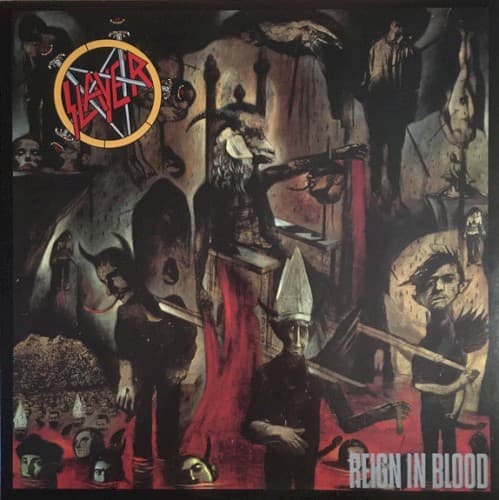
Slayer Reign in Blood — Twenty-Nine Minutes That Collapsed Thrash Into a Sprint
Reign in Blood solved a problem thrash did not know it had. Metallica and Megadeth in 1986 were writing longer, more ambitious songs, adding progressive structure and clean interludes, treating thrash as a vehicle for composition. Slayer went the opposite direction: they took the riff-stacking approach of Bay Area thrash and asked what would happen if every riff lasted eight bars, every song lasted two and a half minutes, and the entire album ended before the listener could catch their breath. The result is twenty-nine minutes of music played at an average of 220 beats per minute with almost no repetition, no reverb, and no concessions to radio or traditional album pacing. It is not the first thrash album, but it is the one that made thrash and hardcore punk finally meet in the middle.
Rick Rubin, a hip-hop producer with no metal experience, recorded Reign in Blood at Hit City West with engineer Andy Wallace. His lack of baggage in the genre led him to strip out the studio conventions that had blurred earlier thrash records. He removed the reverb that Slayer had used on Hell Awaits, tightened the low end so the bass drum pulse stayed clear at high speed, and mixed the guitars dry and forward. The band were initially apprehensive about leaving Metal Blade Records for Def Jam, a label known for Run-DMC and LL Cool J, but drummer Dave Lombardo initiated contact and the partnership redefined what extreme metal could sound like in a studio. The album entered the Billboard 200 at number 127 and peaked at 94, Slayer's first chart appearance, and was certified gold in 1992. Columbia Records refused to distribute it because of the opening track Angel of Death, which describes Josef Mengele's experiments at Auschwitz; Geffen eventually released it without putting their logo on the cover.
The Sound — Reverb Removal and the Two-Minute Riff Pile
Rubin's production philosophy for Reign in Blood came from a practical observation: fast music with big reverb turns into mush. He recorded the guitars and drums dry, used minimal effects, and mixed everything for clarity at speed rather than for heaviness or atmosphere. Kerry King later said the band had been playing in what he called Reverb Land, comparing their earlier sound to Venom and Mercyful Fate, and that hearing the dry mix was a revelation. The result is a recording where every note of Lombardo's double bass work is audible, where the tremolo picking on the riffs has definition instead of blending into a wash, and where the breakdowns hit with actual punctuation instead of bleeding into the next section. Rubin described his goal as creating space for the riffs to land next to each other without becoming a blur of bass. The stripped-back approach gives the album a punchy, almost live sound, closer to hardcore punk production than to the cavernous metal mixes of the era.
The songwriting is built on transitions rather than traditional verse-chorus structure. Hanneman and King wrote riffs in piles, taught them to Lombardo quickly, and recorded the ten best songs they had at that moment. The band has said they were getting bored with the repetition in Metallica and Megadeth at the time, and decided that if they were already tired of a riff after two or three plays, they would move on. The result is songs that average under three minutes, most of them structured as a series of discrete riff sections with minimal reprises.
Angel of Death opens with Araya's scream (first take, at Hanneman's suggestion) and then cycles through at least ten distinct riffs over four minutes and fifty-one seconds, never repeating a verse. Altar of Sacrifice and Postmortem follow the same format: a shocking opening riff, a middle section at full tempo, and a memorable closing riff, with the velocity in between serving as connective tissue rather than development. The guitars are tuned down but not to the extremes that would define later death metal; the tone is sharp and cutting, with King and Hanneman's solos built on dive bombs and tremolo bar abuse rather than on melody.
The weakness is in the middle of the album, where the format starts to feel algorithmic. Piece by Piece, Necrophobic, Jesus Saves, Criminally Insane, Reborn, and Epidemic all follow the same blueprint: fast intro riff, faster middle section, breakdown, fast outro riff. At two minutes each they do not overstay their welcome individually, but sequenced together they blur into a nearly interchangeable block of velocity. The tempos are so similar and the structures so uniform that the midsection of the record offers few landmarks for the listener to grab onto. The album's length was not intentional; the band only realized they had a twenty-nine minute runtime when they were mixing with Andy Wallace, and Rubin's response was that ten songs with verses, choruses, and leads constituted an album regardless of length. That logic works when the songs are distinct, but six of the ten tracks here are primarily exercises in speed rather than in songwriting.
The Arc — Bookends With a Velocity Plateau Between
Reign in Blood is front-loaded and back-loaded, with a long plateau of nearly identical tempos in the middle. The opening track is the most significant Slayer recorded to that point: Araya's scream leading into the opening riff, Lombardo's fills throughout, the structure that keeps adding sections without ever circling back, and the lyrical controversy that delayed the album's release. The album then drops into a sequence of six sub-three-minute tracks that, while individually solid, do not vary enough in tempo or structure to create real dynamic contrast. The first stretch after the opener could be rearranged without changing the listener's experience; these tracks are all fast, all built on riff transitions, and all over before they establish a strong identity.
The sequencing finally pays off in the last two tracks. The penultimate track slows to a mid-tempo chug for the first time on the record, with a main riff that actually repeats and breathes, and then transitions directly into the closer, the album's only other track over four minutes. The closer opens with a rain sound effect and a slow, ominous build before the main riff kicks in, and it ends with a return to the rain and the slow riff, giving the album the only proper conclusion on the tracklist. The final two songs justify the runtime and the single-side-of-a-cassette format; the album works as a twenty-nine minute sprint because it knows where it is going. The question is whether the middle six tracks earn their place or whether the album would be stronger at eighteen minutes: the opener, the penultimate track, the closer, and nothing else?
The Judgment — The Thrash Blueprint That No One Can Repeat
Reign in Blood is the most important thrash album of 1986 and the template for extreme metal velocity that still has not been matched for clarity at speed. It sits alongside Master of Puppets, Peace Sells, and Among the Living as one of the four releases that defined the genre's peak year, but where those albums aimed for ambition and length, Reign in Blood aimed for pure adrenaline and nailed it. The production alone makes it essential: Rubin's dry, punchy mix became the standard for fast metal, and Andy Wallace's engineering made Lombardo's performance the benchmark for extreme drumming. It is the best entry point for listeners who think thrash is too slow or too self-indulgent, and it is the album that forced death metal and grindcore to exist because nothing else in 1986 could match its extremity.
The album's reputation as the greatest thrash record ever made is overstated. The six tracks in the middle are well-executed but interchangeable, and the format is more influential than the songs themselves once you move past Angel of Death and Raining Blood. It is less consistent front-to-back than Master of Puppets and less ambitious in its songwriting than Peace Sells. What it does better than anything else from the era is commit fully to speed without losing structure, and strip out every studio trick that would soften the impact.
Listeners should start with Angel of Death, Altar of Sacrifice, and Raining Blood; if those three tracks land, the rest of the album will work as a sustained assault. For a second Slayer album, South of Heaven offers a more varied and deliberate approach, though it abandons the velocity that makes Reign in Blood distinct. The record is for fans who want thrash at its most uncompromising, and for drummers who need to know what Dave Lombardo was capable of in 1986. It holds up because the production has never been bettered for this kind of speed, and because twenty-nine minutes is exactly the right length for an argument this violent.
Track by track
Track Listing
Angel of Death
StandoutThe opening scream, recorded in one or two takes at Hanneman's suggestion, remains the most famous vocal moment in thrash. The song then cycles through at least ten discrete riff sections over four minutes and fifty-one seconds, none of them repeated verbatim, with Lombardo's fills and tempo shifts holding the structure together. The lyrics describe Josef Mengele's experiments at Auschwitz in clinical detail, which led to Columbia Records refusing to distribute the album and to accusations of Nazi sympathizing that have followed the band since. Hanneman has said the lyrics do not glorify Mengele and that calling him a bad man should be obvious, but the song's perspective is descriptive rather than condemnatory, and the controversy was predictable. Musically it is the most ambitious track on the album, the only one that treats riff transitions as development rather than as a blur of velocity, and the one song here that justifies its length. The main riff is among the most recognizable in thrash, and the song has been a permanent part of Slayer's live set since release.
Piece by Piece
SolidTwo minutes and two seconds of the album's standard format: fast intro riff, faster middle section, brief breakdown, fast outro. The main riff is solid but the song does not establish a strong identity before it ends. It is the first sign that the album's commitment to brevity will flatten some of the material into a velocity plateau.
Necrophobic
SolidOne minute and forty seconds, the shortest full track on the album. The opening riff has a slight groove before the song shifts into the standard high-speed riff cycling. It functions as a transition piece between Piece by Piece and Altar of Sacrifice, and would not be missed if the album jumped directly from track two to track four.
Altar of Sacrifice
StandoutThe best of the mid-album velocity tracks, with a main riff that has enough melodic shape to be memorable and a breakdown section that actually shifts the tempo instead of just pausing for a bar. The song still follows the format of shocking open, velocity middle, memorable end, but it executes that format well enough to stand out from Piece by Piece and Necrophobic. The structure is tighter than the two songs before it, and Lombardo's performance has more variation in the fills. Oderus Urungus of Gwar cited this as his favorite Slayer song, and it is easy to hear why: it is the most efficient demonstration of the album's approach, with all the speed and none of the interchangeability that plagues the next three tracks.
Jesus Saves
SolidTwo minutes and fifty-four seconds, the longest of the midsection tracks, but it does not use the extra length to develop ideas. The main riff is serviceable and the tempo is consistent with the rest of the album, but the song does not add anything that Altar of Sacrifice did not already demonstrate.
Criminally Insane
SolidAnother two-minute riff pile with a solid opening but no strong hook to carry it. The breakdown in the middle is brief and does not change the song's momentum. Filler in the context of the album's velocity, though the riff work is competent.
Reborn
SolidTwo minutes and eleven seconds, the third consecutive track at nearly the same tempo with nearly the same structure. The opening riff has a slight swing to it but the song disappears into the midsection blur. It is well-played but redundant.
Epidemic
SolidThe last of the velocity plateau tracks before the album shifts into its closing sequence. Two minutes and twenty-three seconds, fast and tight, but it does not distinguish itself from Criminally Insane or Reborn. The solo section is brief and built on dive bombs rather than melody.
Postmortem
StandoutThe album finally downshifts. The main riff is mid-tempo and actually repeats, giving the song a clear identity for the first time since Altar of Sacrifice. The slower pace makes the riff land harder, and the structure allows space for the song to breathe before it accelerates into the transition to Raining Blood. Lombardo's drumming here is more varied than anywhere in the midsection, with fills that punctuate the riff rather than just keeping time at 220 bpm. The song is three minutes and twenty-seven seconds, and it uses the length to build tension rather than to stack riffs. It is the second-best track on the album after Angel of Death, and the moment where the sequencing justifies the velocity plateau that preceded it.
Raining Blood
StandoutThe only track besides Angel of Death that earns its length over four minutes. The rain sound effect and the slow build at the opening are the only atmospheric moments on the album, and the payoff when the main riff kicks in is immediate. The song alternates between the main riff and faster riff sections, with a solo from Hanneman and King that uses the full range of the tremolo bar. The final minute returns to the rain and the slow opening riff, giving the album a proper conclusion instead of just ending on another fast riff. It has been a permanent part of Slayer's live set since release, and the band performed it covered in fake blood during the Still Reigning tour in 2004. The track is the clearest example of Rubin's production working at full effectiveness: every note of the main riff is audible, the bass drum pulse stays clear through the fastest sections, and the breakdown has actual weight because the mix is dry enough to let the guitars land without blurring. It is the second-most important song on the album after Angel of Death, and the reason the twenty-nine minute runtime works as a complete statement.