The scorecard
7.6/10 · Great
- Songwriting25%
- 7.0
- Sound25%
- 8.5
- Performance15%
- 8.0
- Cohesion15%
- 6.5
- Originality10%
- 8.0
- Replay value10%
- 7.5
"Roots Bloody Roots" and "Ratamahatta" are built to last, but "Spit" and "Straighthate" repeat the same riff ideas for five minutes without development.
Ross Robinson's murky, downtuned guitar tone and the dense layering of Brazilian percussion create a wall of sound that serves the aggression, though the mix buries some of the instrumental detail.
Max Cavalera's bark has real conviction and Igor Cavalera's drumming is at its most inventive, but the groove-locked riffs demand less technically from the players than the thrash years did.
The Xavante chant threading "Itsári" and "Born Stubborn" provides a thematic anchor, but the album sags badly in the middle stretch from "Spit" through "Dusted" and the thirteen-minute "Canyon Jam" feels tacked on.
Blending samba reggae percussion and indigenous field recordings with downtuned metal was genuinely new in 1996, though the Korn-derived riff style was already established by others.
"Roots Bloody Roots," "Attitude," and "Ratamahatta" remain essential, but the weaker mid-album tracks and the formlessness of some jams make full-album listens feel like work.
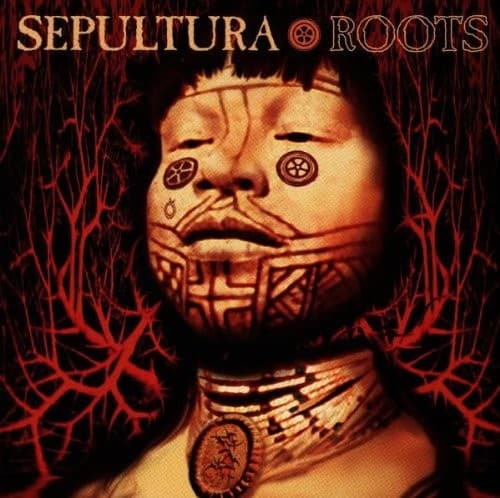
Sepultura Roots — When Thrash Went Tribal and Never Came Back
Roots is the album where Sepultura stopped being a thrash band and became something else entirely. The change is audible in the first thirty seconds of "Roots Bloody Roots": downtuned guitars locked into a single-note chug, tribal percussion layered over a half-time groove, Max Cavalera barking the title like a slogan. This is not Beneath the Remains. This is not even Chaos A.D. This is Sepultura deciding that Korn's self-titled debut pointed toward the future and that Brazilian indigenous music could be grafted onto nu metal's framework to create a new hybrid. The gamble worked commercially—Roots sold two million copies and remains the band's highest-charting album—but it also marked the end of an era. Max Cavalera left Sepultura in late 1996, and the sound of Roots became the template for his next band, Soulfly, rather than the foundation for Sepultura's future.
The thesis of Roots is that metal could expand by looking inward, to Brazil's marginalized indigenous cultures, rather than outward to the Bay Area or Tampa. Sepultura traveled to Mato Grosso to record with the Xavante tribe, incorporated percussionist Carlinhos Brown to arrange ensemble sections, and filled the album with field recordings, chants, and Brazilian instrumentation that no metal band had used before. The Xavante healing chant on "Itsári" reappears on "Born Stubborn," threading the album with a loose thematic unity. The music is consciously anti-commercial: murky, groove-heavy, and willing to let jams sprawl past the seven-minute mark. But Roots is also the album that helped birth nu metal as a commercial force, and its influence on that genre—downtuned riffs, hip-hop guests, Ross Robinson's production—has aged less well than its Brazilian experiments. The question is whether the album's genuinely original ideas are strong enough to carry the weaker material that surrounds them.
Downtuned Riffs Meet Samba Drums
Roots is a groove metal album first and a thrash album never. The riffs are built on single-note chugs and palm-muted patterns that lock into Igor Cavalera's drumming, which abandons the double-bass runs of the thrash years for half-time grooves and samba-derived rhythms. The guitars, tuned down and processed through modified pedals, create a thick, oppressive tone that buries the melodic detail under layers of distortion. Ross Robinson's production, honed on Korn's first two albums, gives the record a claustrophobic density: every instrument fights for space in a mix that favors weight over clarity.
The result is an album that sounds massive but also muddy, with solos and lead lines often lost in the murk. The Brazilian elements are the album's most distinctive feature. Carlinhos Brown arranged the ensemble percussion sections that appear throughout the record, blending samba reggae rhythms with metal's aggression in ways that feel both inventive and occasionally awkward. "Ratamahatta," sung mostly in Portuguese, uses polyrhythms and call-and-response vocals to celebrate life in Brazil's favelas, and the percussion drives the song as much as the guitars do.
"Itsári" is a Xavante chant recorded in Mato Grosso, a field recording that stands on its own as a brief interlude and then reappears woven into "Born Stubborn." The Xavante collaboration was not cosmetic: the band spent time with the tribe, learned about their dream-based approach to composition, and incorporated their music with clear intent. The problem is that the integration is not always seamless. Some songs, like "Ratamahatta," feel like genuine hybrids.
Others, like "Lookaway," pile on guests—Jonathan Davis, Mike Patton, DJ Lethal, David Silveria—without a clear musical reason, resulting in a track that sounds like a nu metal summit meeting rather than a coherent song. The weakness of Roots is in the songwriting. Too many tracks are built on a single riff idea that gets repeated for four or five minutes without development. Locked grooves dominate without variation.
The thrash years demanded technical precision and structural complexity; Roots deliberately strips that away in favor of raw, monolithic simplicity. The trade-off works on "Roots Bloody Roots" and "Attitude," where the simplicity has force and purpose, but it fails on the filler tracks, where the lack of development becomes monotonous. The thirteen-minute "Canyon Jam," a mostly instrumental sprawl of percussion and ambient noise, was omitted from the first vinyl pressing due to its length, and that decision was correct.
Front-Loaded Power, Mid-Album Sag
Roots is an album that peaks early and struggles to maintain momentum. The opening stretch establishes the album's sound and delivers its strongest moments with compressed, aggressive riffing and vocal hooks that have outlasted the record itself. After that, the album sags. The middle stretch occupies space with riffs that feel interchangeable and structures that repeat without developing.
The back half recovers slightly with better integration of indigenous elements and focused political content. The closing run on some editions includes two covers that feel like afterthoughts rather than album tracks. The pacing problem is real: seventeen tracks is too many for material of this density, and the album would have been stronger at twelve or thirteen tracks with the filler removed. The sequencing does not earn the length.
The Album That Ended Sepultura's Thrash Era
Roots is historically important and frustratingly uneven. It is the album that proved metal could incorporate indigenous music and world rhythms without sounding like a world music tourism project, and it is also the album that helped launch nu metal as a commercial force. The best moments are essential and have aged better than most of the nu metal that followed. The worst moments are filler that should have been cut.
The Brazilian experiments are the album's legacy: bands like Alien Weaponry, Melechesh, and Chthonic have built entire careers on the idea that metal can draw from indigenous and regional cultures, and Roots opened that door. The nu metal influence is more mixed. The downtuned riffs and groove-locked rhythms became a cliché within five years, and the guest-heavy approach sounds dated in ways that the Xavante chant does not.
This is Max Cavalera's last album with Sepultura, and it is not hard to hear why he left to pursue this sound further with Soulfly. Roots is the sound of a thrash band deciding it no longer wants to play thrash, and the members who stayed with Sepultura spent the next two decades trying to reconcile that decision. For listeners new to the band, this is not the place to start—Beneath the Remains and Arise are better representations of what made Sepultura essential. But for those who already know the thrash albums, Roots is worth hearing for its ambition and its best tracks.
After Roots, hear Chaos A.D. to understand the shift toward slower tempos that made this album possible, then compare Roots to Soulfly's self-titled debut to hear where Max Cavalera took the sound next.
Track by track
Track Listing
Roots Bloody Roots
StandoutThe album's signature track and its most enduring moment. The riff is a single-note chug that locks into Igor's half-time groove, and the vocal hook—"Roots bloody roots"—is delivered with enough conviction to carry the repetition. The song's simplicity is its strength: this is not a thrash riff or a death metal riff, but a groove metal anthem designed for maximum impact. The midsection breaks down into ensemble percussion before building back to the main riff. The song proved metal could work with fewer notes and slower tempos if the execution was committed enough. It remains the best argument for everything Roots attempts.
Attitude
StandoutBuilt on a descending riff that shifts between palm-muted chugs and open notes, with a midsection that drops into a slower groove before accelerating back to the main idea. The lyrics, co-written by Dana Wells, deliver the aggression the title promises. The song earned its place as a single and holds up better than most of the album's mid-tempo tracks because the riff develops across the song's four minutes rather than repeating a single idea. The breakdown two-thirds through gives Igor space to show his samba-derived drumming, and the final minute builds to a satisfying payoff.
Cut‐Throat
StandoutA faster, more direct track that comes closest to the thrash sound of earlier albums. The riff is a palm-muted gallop that shifts between single-note chugs and chromatic runs, and Max's vocal is one of the album's angriest. The song is about Epic Records, with the final words spelling out the label's name as an acrostic insult. At two minutes and forty-four seconds, it benefits from its brevity and does not overstay its welcome. A solid album track that reminds the listener what Sepultura used to sound like.
Ratamahatta
StandoutThe album's most successful fusion of Brazilian percussion and metal. The song is sung mostly in Portuguese and celebrates life in Brazil's favelas, referencing figures like Coffin Joe and the outlaw Lampião. The riff is a polyrhythmic chug that works with the samba reggae percussion rather than fighting it, and the midsection drops the guitars entirely to let Carlinhos Brown's ensemble take over. The integration feels intentional rather than cosmetic, and the song's structure earns its four-and-a-half-minute length by developing the ideas instead of repeating them. David Silveria's drumming contributions blend into the mix without calling attention to themselves. One of the album's essential tracks.
Breed Apart
SolidA mid-tempo groove that locks into one riff and stays there for four minutes. The song has force but no development, and it begins the album's mid-section sag. The riff is a downtuned chug that could have come from any nu metal band, and the vocal melody does not add enough to justify the repetition. Not actively bad, but not memorable either.
Straighthate
WeakOver five minutes of a single palm-muted riff idea repeated with minimal variation. The song exemplifies the album's weakest tendency: taking a groove-metal riff that works for two minutes and stretching it to five without adding new sections or development. The breakdown two minutes in provides brief relief, but the song returns to the same pattern and stays there. The album would have been stronger without it.
Spit
WeakTwo minutes and forty-five seconds of the same riff. Filler. The brevity keeps it from becoming unbearable, but it adds nothing to the album's argument.
Lookaway
WeakA summit meeting of nu metal guests—Jonathan Davis, Mike Patton, DJ Lethal, David Silveria—that sounds like a guest list rather than a song. Each vocalist takes a section, and the result is disjointed and unfocused. Patton's contribution is the most interesting, adding his usual weirdness to the midsection, but the song has no center. The riff is serviceable, and the percussion sections are well-executed, but the track feels like a promotional stunt rather than a coherent piece of music. It has aged poorly.
Dusted
WeakAnother mid-tempo groove built on repetition. The riff has a slight melodic hook in the verse, but the song does not develop the idea, and the four-minute runtime feels longer than it is. Skippable.
Born Stubborn
StandoutThe Xavante chant from "Itsári" reappears here, woven into a metal framework rather than standing alone as a field recording. The integration is more successful than "Lookaway"'s guest pile-up: the chant functions as a recurring motif that interrupts the main riff, creating a call-and-response structure between the indigenous recording and the metal band. The riff itself is one of the album's better downtuned grooves, with enough variation to justify the four-minute length. The song makes the case for the album's thematic ambition better than most of the tracks that surround it.
Jasco
SolidA two-minute instrumental built on a clean-tone riff and ambient noise. A brief palate cleanser that does its job without overstaying its welcome.
Itsári
StandoutA Xavante healing ceremony chant recorded in Mato Grosso, presented as a field recording with minimal overdubs. The title means "Roots" in the Xavante language. The chant is hypnotic and works as an interlude, providing a moment of genuine otherness in an album that otherwise stays within metal's boundaries. The recording captures the Xavante's dream-based approach to composition, and the band's decision to include it unaltered shows respect for the source material. The chant's reappearance on "Born Stubborn" creates a thematic thread that gives the album some cohesion.
Ambush
StandoutA tribute to murdered rainforest activist Chico Mendes. The riff is a descending chug that works better than most of the album's mid-tempo grooves, with a midsection that shifts into a faster section before returning to the main idea. The song has purpose and conviction, and it earns its place in the album's back half. One of the stronger late-album tracks.
Endangered Species
SolidAddresses environmental destruction with a slower, sludgier riff than most of the album. The song's five-minute length is too long for the single riff idea it presents, and the pacing drags. The lyrical theme is clear, but the execution is repetitive. A weaker moment in the album's second half.
Dictatorshit
StandoutNinety seconds of fast, aggressive thrash addressing the 1964 Brazilian coup. The brevity is the point: the song makes its statement and ends before it can become repetitive. A solid closer to the main album, though it feels slight compared to the longer tracks.
Procreation (of the Wicked)
SolidA Celtic Frost cover that appears on some editions. Sepultura plays it faithful to the original, with a sludgy, doom-inflected riff and Max's bark replacing Tom G. Warrior's growl. The cover adds nothing new to the original and feels like a bonus track rather than an album track. For Celtic Frost fans only.
Symptom of the Universe
SolidA Black Sabbath cover that closes some editions. Sepultura speeds up the riff and adds their downtuned tone, but the arrangement is otherwise faithful. The cover is competent but unnecessary, and it highlights how much stronger Sabbath's songwriting was than most of the material on Roots. An acknowledgment of influence rather than a reinterpretation.