The scorecard
7.5/10 · Great
- Songwriting25%
- 7.5
- Sound25%
- 8.0
- Performance15%
- 8.0
- Cohesion15%
- 6.5
- Originality10%
- 7.0
- Replay value10%
- 7.5
"Du hast" and "Engel" are built around single ideas that sustain through repetition, while "Spiel mit mir" and "Tier" develop actual narrative tension, but half the album recycles the same verse-chorus formula without variation.
Jacob Hellner and the band lock guitar tone, industrial programming and drum sound into a clean, forceful mix that works equally well in arenas and on car stereos, with Ronald Prent's mix keeping every element distinct even at maximum volume.
Till Lindemann's baritone commands attention on every track and the band plays with mechanical precision, but the vocals rarely shift from declamatory mode and the rhythm section serves the groove more than it explores it.
The album front-loads its strongest songs and then coasts through mid-tempo industrial marches that blur together, with "Küss mich (Fellfrosch)" ending the German tracklist on a whimper and two English remakes exposing the limits of the formula.
Rammstein imports Ministry's sequenced guitar attack and KMFDM's stomp into German and sets it to anthems instead of noise, but the second album repeats the first's template with cleaner production and less surprise.
"Du hast" and "Engel" have proven durable enough to anchor setlists decades later, and the album's best moments still hit hard, but the filler tracks that seemed atmospheric in 1997 now feel like waiting for the next single.
Rammstein Sehnsucht — Industrial Metal Learns German and Conquers America
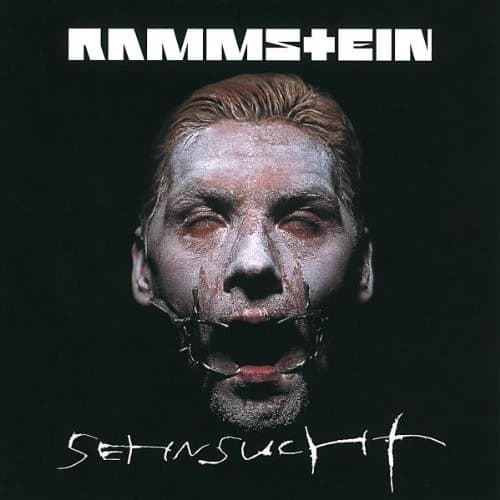
Sehnsucht is the album that proved Rammstein could export their formula beyond Germany without compromising the language or the sound. The band took the template from their 1995 debut Herzeleid—sequenced guitar riffs, martial drums, Till Lindemann's baritone chanting over the top—and rebuilt it with clearer production, sharper hooks and just enough melody to survive radio edits. "Du hast" became the unlikely crossover: a song in German, built on a three-note guitar loop and a vocal that barely qualifies as singing, that went platinum in the United States and made Rammstein the first German metal band to headline arenas outside Europe since the Scorpions. The album reached number one in Germany and Austria, went platinum in the US without an English-language version, and made Neue Deutsche Härte a genre instead of a gimmick.
That success, however, came at a cost. Where Herzeleid sounded like a band discovering a sound, Sehnsucht sounds like a band applying a sound to a set of songs, some of which can bear the weight and some of which cannot. The opening run from the title track through "Bück dich" is as strong as any six-song sequence in late-nineties metal: industrial riffs that lock into grooves instead of just grinding, vocals that command attention even when the listener does not speak the language, and production from Jacob Hellner that makes every element hit hard without burying the dynamics. The back half, however, leans on atmosphere and repetition where the front half used structure and tension, and the album's sixty-minute runtime—stretched further by two English remakes that add nothing—exposes the limits of a formula that works best in bursts.
The Sound — Sequenced Guitars, Martial Drums, and the Baritone That Holds It Together
Sehnsucht works because the production makes the industrial elements sound massive and the band plays them with the discipline of a military exercise. Jacob Hellner, who produced both this album and Herzeleid, uses the same toolkit—sequenced guitars, programmed drums layered with live percussion, synth textures from Christian Lorenz that fill space without competing for attention—but the mix is cleaner and more forceful. Ronald Prent's mix keeps the guitars sharp and the low end controlled, so the songs hit hard without collapsing into distortion.
The guitar tone, handled by Richard Kruspe and Paul Landers, is the album's foundation: a sequenced, palm-muted chug that borrows from Ministry and KMFDM but strips out the noise in favor of clarity and groove. On the strongest tracks the riffs are simple enough to be anthems but tight enough to drive the songs forward without additional elements. On the heavier material the guitars layer into walls of sound that still leave room for Lindemann's voice and Christoph Schneider's drumming.
The rhythm section, Oliver Riedel on bass and Schneider on drums, locks into grooves that prioritize feel over complexity. The drums are a mix of live playing and programming, with Schneider's actual performance reinforcing the sequenced patterns rather than replacing them. The result is a sound that works in stadiums because it is built for volume and repetition, not for detail or surprise.
Lindemann's baritone is the element that makes this more than an industrial metal exercise. He does not sing in a traditional sense; he declaims, chants and occasionally bellows, but he does it with enough conviction and rhythm that the vocals become hooks even when the melodies are minimal. On the album's only track with an actual sung chorus (courtesy of guest vocalist Bobo), the contrast between Lindemann's verses and the soaring refrain proves that the band understands melody but chooses not to use it most of the time.
The songwriting, however, reveals its limits as the album progresses. The best tracks build tension through repetition and release it with vocal or instrumental payoffs. The weaker tracks repeat the same verse-chorus structure without developing the ideas or varying the dynamics, and the result is songs that sound atmospheric on first listen and like filler on the fifth. One attempted slow-burn build spends four minutes setting up a climax that never arrives.
The album ends with two English-language remakes that prove how much the band's power depends on the German language: the English versions use the same riffs and the same production, but Lindemann's pronunciation is awkward and the syllable stress breaks the rhythms that make the originals work. They are catalog padding disguised as international outreach.
The Album Arc — Six Strong Songs and Seven That Mark Time
Sehnsucht is a tale of two albums: a first stretch that justifies the band's reputation and a back half that coasts on the momentum. The opening material sets the tone immediately, with riffs that build from whispers to marches and vocals that command like drill sergeants addressing formations. The first six tracks are structured as anthems: big choruses, clear hooks, and dynamics that shift between quiet verses and loud refrains, each one built around a single riff and a single vocal idea that the band executes with enough conviction to make the simplicity feel intentional.
After that opening sequence, however, the album begins to sag. The middle section has strong melodic ideas and narrative structures that build tension, but the material is surrounded by mid-tempo marches that recycle the same formula without the same hooks. The later material aims for atmosphere and dynamic range, but the tracks do not develop their ideas enough to justify the runtime.
The closing portion of the German material offers competent industrial metal that does nothing to distinguish itself from the stronger work that came before. The pacing is front-loaded by design, with the singles clustered in the first half and the album tracks filling the second, but the result is a listen that peaks early and then waits for the end. The two English remakes that close the international editions make the problem worse: they add ten minutes to an album that already struggles to sustain its energy, and they offer nothing that the German versions do not do better.
Where It Stands — The Album That Made Rammstein a Global Act, for Better and Worse
Sehnsucht is the album that made Rammstein a phenomenon, and it is also the album where the formula that made them distinctive began to show its limits. The first six tracks contain some of the strongest industrial metal of the nineties, and the production from Jacob Hellner makes all of it sound huge. The back half, however, is where the band's reliance on repetition and atmosphere instead of development becomes a liability, and the album's length—especially on editions that include the English remakes—drags what should be a tight forty-five minutes into an hour-long slog.
For listeners who want to understand why Rammstein became the biggest German metal band since the Scorpions, start with the opening stretch, then decide whether the rest is worth the time. For fans of Ministry, KMFDM or Oomph! who want to hear what the industrial sound became when it crossed into arena rock, Sehnsucht is essential context, but it is not the strongest execution of the idea. For completists and for listeners who came to Rammstein through the hits, the album is worth owning for the first half alone.
The second half is not bad, but it is not necessary, and the English versions are best ignored entirely. Sehnsucht has aged well where it is strong and poorly where it is not, and the verdict depends on whether you value the peaks or penalize the valleys. If you want more after this, the live album Live aus Berlin captures the songs in their proper setting, and the band's later albums Mutter and Reise, Reise refine the formula with better pacing and less filler.
Track by track
Track Listing
Sehnsucht
StandoutThe title track opens with a quiet, ominous riff that builds gradually into a full industrial march, with Lindemann's baritone entering like a drill sergeant addressing a formation. The song establishes the album's template: sequenced guitars, martial drums, and vocals that declaim rather than sing. The dynamics shift between the quiet verses and the louder choruses, and the song builds tension effectively even though the melody is minimal. The riff is simple but the execution is disciplined, and the track works as an introduction because it announces the sound without giving away the best hooks. The lyrics focus on longing and desire, delivered with enough conviction to make the theme land even when the listener does not speak German. It is a strong opener that sets the tone without overshadowing what follows.
Engel
StandoutThe album's first true anthem, "Engel" is built around a contrast between Lindemann's chanted verses and a soaring sung chorus delivered by guest vocalist Bobo. The song proves that Rammstein understands melody and chooses not to use it most of the time, and the chorus is the most overtly melodic moment on the album. The riff is insistent but not aggressive, and the production uses space and dynamics to make the shift from verse to chorus feel like a release. The song became a single and a setlist staple for good reason: it has a clear structure, a memorable hook, and enough variation to sustain repeated listens. The bridge features a keyboard line from Christian Lorenz that adds texture without cluttering the mix, and the final chorus lands with the same impact as the first. It is one of the two or three essential tracks on the album, and it remains one of the band's strongest songs.
Tier
Standout"Tier" is a mid-tempo industrial march built on a single descending riff and a vocal that alternates between a whisper and a shout. The song creates tension through dynamics rather than development, with the quiet verses making the loud choruses feel heavier by contrast. The production keeps the guitars sharp and the drums forceful, and the rhythm section locks into a groove that drives the song forward without variation. Lindemann's delivery is commanding, and the lyrics—focused on animalistic desire—are direct enough to work even in translation. The song does not reinvent the formula, but it executes it with enough conviction to stand alongside the stronger tracks on the first half of the album. It is one of the better deep cuts, and it works well in the context of the album's opening sequence.
Bestrafe mich
StandoutA relentless industrial assault, "Bestrafe mich" is one of the album's heaviest and most aggressive tracks. The riff is a palm-muted chug layered into a wall of sound, and the rhythm section plays with mechanical precision. Lindemann's vocal is a chant that barely shifts in pitch, but the conviction and rhythm make it a hook. The song builds no tension and offers no release; it simply pounds forward for three and a half minutes, and the lack of dynamics is the point. The production makes the guitars sound massive without losing clarity, and the track works because it commits fully to its one idea. It is not subtle, but it is effective, and it belongs in the album's strong opening run. The lyrics focus on punishment and submission, delivered with the same intensity as the music.
Du hast
StandoutThe song that made Rammstein a global act, "Du hast" is built on a three-note guitar riff, a marching drum pattern, and a vocal that is more chant than melody. The structure is verse-chorus-verse with no bridge or solo, and the entire song is constructed around the wordplay in the title: "Du hast" (you have) versus "Du hasst" (you hate). The production is clean and forceful, with every element hitting hard and nothing cluttering the mix. Lindemann's delivery is commanding, and the rhythm section locks into a groove that does not vary for the entire song. The track works because it is simple, disciplined and committed to its one idea, and because the production makes that simplicity sound huge. It became the band's signature song, went platinum in the United States, and remains one of the defining industrial metal tracks of the nineties. It is also the moment where the album's reliance on repetition and formula becomes both a strength and a limitation.
Bück dich
SolidThe last track in the album's strong opening sequence, "Bück dich" is a mid-tempo industrial stomp with a riff that cycles without development and a vocal that alternates between quiet menace and shouted commands. The song is built for live performance, with a structure that leaves space for theatrics and a rhythm that is simple enough to sustain a crowd's attention. The production keeps the guitars heavy and the drums punchy, and the track works in context because it varies the tempo and dynamics after the relentless drive of "Du hast." The lyrics are provocative and confrontational, and Lindemann delivers them with the same conviction as the stronger tracks. It is a solid closer for the first half of the album, but it also marks the point where the formula begins to wear thin.
Spiel mit mir
Standout"Spiel mit mir" is one of the album's most melodic and narratively focused tracks, with a structure that builds tension through dynamics and a vocal that tells a story rather than repeating a slogan. The song shifts between quiet verses and a louder, more aggressive chorus, and the production uses space and layering to make the contrasts feel earned. The riff is more developed than most of the album's guitar work, and the rhythm section supports the shifts in dynamics rather than just locking into a groove. Lindemann's vocal is one of his most expressive performances on the album, and the lyrics—focused on childhood trauma—give the song a thematic weight that most of the other tracks lack. The song is longer than it needs to be, and the final minute feels like repetition rather than climax, but it is one of the stronger tracks on the second half and a reminder that the band can write songs that develop ideas instead of just repeating them.
Klavier
SolidA slow-burn build that spends four minutes setting up a climax that never arrives. The song opens with a quiet piano line and a whispered vocal, and it gradually adds guitars, drums and synths until it reaches a mid-tempo march. The problem is that the song never shifts out of that gear: it builds to a plateau and then stays there, and the result is a track that sounds like it is waiting for a payoff that the band chose not to deliver. The production is clean and the performance is disciplined, but the songwriting does not justify the runtime. It is atmospheric filler that works better as a live interlude than as a standalone track.
Alter Mann
WeakAnother mid-tempo march that recycles the album's formula without adding new ideas. The riff is competent, the rhythm section is tight, and Lindemann's vocal is commanding, but the song does nothing to distinguish itself from the stronger tracks that came before it. The structure is verse-chorus-verse with no variation, and the dynamics are flat throughout. It is professional industrial metal that sounds like Rammstein going through the motions, and it suffers from its placement in the back half of an album that has already used its best material. Filler.
Eifersucht
SolidA short, punchy industrial march that delivers its idea and exits without overstaying its welcome. The riff is insistent, the drums are forceful, and Lindemann's vocal is direct, but the song is too similar to the stronger tracks on the first half to feel necessary. It works in context because it is brief, but it does not add anything that "Tier" or "Bestrafe mich" did not already deliver. Competent but redundant.
Küss mich (Fellfrosch)
WeakThe weakest track on the German portion of the album, "Küss mich (Fellfrosch)" is a plodding mid-tempo march with a riff that goes nowhere and a vocal that repeats the same lines without variation. The song lacks the dynamics and conviction that make the stronger tracks work, and the production cannot salvage songwriting that is simply not there. It ends the main album on a whimper, and it is the clearest example of Rammstein stretching their formula past the breaking point. Skip it.
Engel (English version)
WeakA note-for-note remake of "Engel" with English lyrics that expose how much the band's power depends on the German language. Lindemann's pronunciation is awkward, the syllable stress breaks the rhythms that make the original work, and the sung chorus loses its impact when the words are in a language that Lindemann does not command as naturally. The production and the riff are identical to the German version, but the vocal performance is weaker, and the result is a track that adds nothing and diminishes the original. Catalog padding for international markets.
Du hast (English version)
WeakThe same problem as the English "Engel," only worse. "Du hast" works in German because of the wordplay in the title and because Lindemann's delivery fits the rhythm of the language. In English, the wordplay is gone, the syllables do not fit the riff as naturally, and the entire song feels like a translation that nobody asked for. It is the same riff, the same production, and a worse vocal performance. Skip it and listen to the German version.